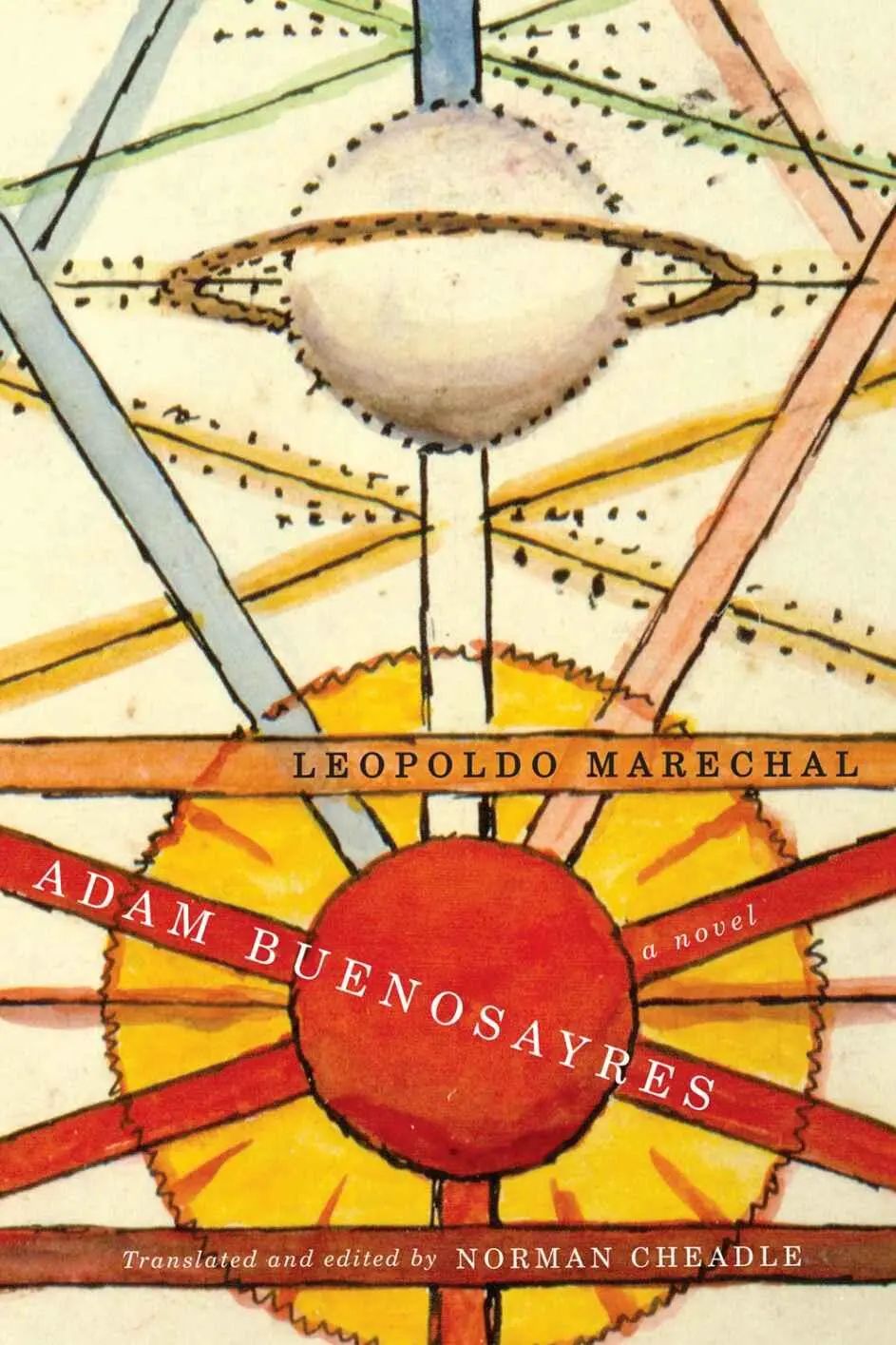
Leopoldo Marechal - Adam Buenosayres
Здесь есть возможность читать онлайн «Leopoldo Marechal - Adam Buenosayres» весь текст электронной книги совершенно бесплатно (целиком полную версию без сокращений). В некоторых случаях можно слушать аудио, скачать через торрент в формате fb2 и присутствует краткое содержание. Год выпуска: 2015, Издательство: McGill-Queen's University Press, Жанр: Классическая проза, на английском языке. Описание произведения, (предисловие) а так же отзывы посетителей доступны на портале библиотеки ЛибКат.
- Название:Adam Buenosayres
- Автор:
- Издательство:McGill-Queen's University Press
- Жанр:
- Год:2015
- ISBN:нет данных
- Рейтинг книги:5 / 5. Голосов: 1
-
Избранное:Добавить в избранное
- Отзывы:
-
Ваша оценка:
Adam Buenosayres: краткое содержание, описание и аннотация
Предлагаем к чтению аннотацию, описание, краткое содержание или предисловие (зависит от того, что написал сам автор книги «Adam Buenosayres»). Если вы не нашли необходимую информацию о книге — напишите в комментариях, мы постараемся отыскать её.
Adam Buenosayres — читать онлайн бесплатно полную книгу (весь текст) целиком
Ниже представлен текст книги, разбитый по страницам. Система сохранения места последней прочитанной страницы, позволяет с удобством читать онлайн бесплатно книгу «Adam Buenosayres», без необходимости каждый раз заново искать на чём Вы остановились. Поставьте закладку, и сможете в любой момент перейти на страницу, на которой закончили чтение.
Интервал:
Закладка:
Fatso Atadell has been watching the farce, his mouth full, eternally ruminating the pleasant fruits of the earth. He is vast in flesh, in clothing, in smiles.
— Fatso! Adam accosts him, pretending to be deeply concerned. Chewing on something again? Is man born only to encase himself in a horrible layer of fat? No, Fatso, no! The spirit has its needs, too. If you stopped chewing for a minute, you’d hear — oh, Fatso! — the voice of your soul asking for its lunch.
Serenely impervious, not ceasing to chew and smile, Fatso Atadell pretends to ignore Adam’s chiding.
— Sir, he announces. Papucio is sad.
Adam turns to look at Papucio, who has the look of an adolescent malevo overcome by melancholy.
— What’s wrong? Adam asks him.
— Nothing, grunts Papucio. My flowerpots are too tight.
— Your what?
— My shoes, sir. They’re gonna bring on my loquats again.
— What loquats?
— My corns. And if we play against the other class today — oh, brother!
Américo Nossardi is standing at the end of the line, apparently wrapped up in his own little world. He’s examining a model airplane, the patient work of his own hands.
— Does it fly? Adam asks him.
The young man raises perplexed eyes.
— No, he says. The motor’s too heavy.
The review is finished, and youthful squirming is making the lines wobble. Adam Buenosayres, detached from himself, is now one more member of the noisy phalanx.
— Heads up! he shouts. Look to the future!
Thirty childish smiles respond to his joke.
— Forward, march!
Beneath a sky of tarnished brass proceed thirty smiles.
The classroom is on the top floor, olive-coloured, with a big corner window overlooking the intersection of two little suburban streets. The rows of desks are all oriented toward the light of the window. On the right stands a wardrobe; on top of it, displayed for the world’s amazement, rests a cardboard planetarium, Nossardi’s ingenious construction. The nine planets, dyed a demonic red, revolve by means of a clockwork device around a happy sun within a space of violent indigo. Facing the pupils’ seats is the teacher’s desk, its only decoration a globe of the world with a cracked and fissured surface (a symbol?). Two chalkboards extend their black expanse across the front and lefthand walls. The former has a right-angled triangle drawn on it. On each of the triangle’s sides, Falcone has just drawn a square in different colours, to wit: a yellow square on the hypotenuse, and on the two adjacent sides a green and a blue one. At the other blackboard, Núñez is concluding the arithmetic demonstration.
— That’s it, sir, he says. A difference of only twenty-six square millimetres.
— Very good, Adam Buenosayres approves from his desk. He turns then to Falcone, who has just completed the graphic demonstration.
— What does that demonstrate? Adam asks.
— It demonstrates, recites Falcone, that in every right-angled triangle the square of the hypotenuse is equal to the sum of the squares of the other two sides.
— Good. You can both return to your seats.
As Falcone and Núñez go back to their desks, Adam addresses the class:
— Has everyone understood?
— Yes, sir.
— So this is the famous Pythagorean theorem? Falcone says, without hiding the disappointment already gnawing at his voracious mind.
— Nothing more, nothing less, Adam responds. Let’s see, now. Who was Pythagoras?
— Sir, answers Dauthier. He was a Greek philosopher and mathematician.
Fratino the orator lets his melodious voice be heard:
— The story goes that Pythagoras discovered his theorem in the bathtub and that he ran out into the street, completely naked, crying “Eureka!”
— Musta bin a nutcase! Papucio grumbles from his corner.
But golden-headed Ramos smiles with pointed irony.
— Wasn’t Archimedes the guy who jumped up out of the bathtub? he asks.
— Archimedes was the one, Adam confirms. The orator Fratino is slandering Pythagoras, who was a very serious gentleman.
— Sir, declaims an unmoved Fratino. I committed a lapsus … how do you say?
— I’d say a lapsus memoriae , laughs Adam.
— That’s it, a lapsus memoriae .
From his corner, Papucio eyes Fratino malevolently.
— If you didn’t yap so much, he says, you wouldn’t make so many dumb mistakes.
— One can have a temporary lapse of memory, can’t one? protests Fratino.
— Go on back to the farm and drink chicken milk!
Papucio’s advice causes a wave of hilarity throughout the class, except for Cueto, off in his own world, and the clown Bustos, who is tatooing an anchor on his wrist; both boys are deep in meditation. The actor Terzián, moreover, is miming a pensive and dignified Pythagoras, the index finger of one hand on his temple, the other stroking his hypothetical philosopher’s beard. All to the delight of Fatso Atadell, who encourages him with his vast, full-moon smile. Meanwhile, the hilarity has calmed down. When silence has been restored, Papucio can still be heard whinging in his corner.
— The flowerpots still bothering you? inquires Adam.
— No, grouses Papucio. I was thinking about that theorem. What’s it good for?
Adam Buenosayres looks at him benevolently.
— Once upon a time, he says, a great mathematician had to sleep in a bed so short that, no matter how he tried, the poor fellow couldn’t stretch out to his full length. Either his feet hung over one end, or his head over the other. Well, he got out of bed quite perturbed, turned on the light, measured the bed, found a pencil, and started writing out all kinds of formulas. Until finally he remembered Pythagoras’s theorem and found the solution.
— How? Falcone, very intrigued, wanted to know.
— He lay down along the line of the hypotenuse — in other words, diagonally.
Amid the unanimous classroom laughter, Papucio scolds one last time:
— Wouldn’t do me no good, he says. I sleep on the floor.
— Seriously, though, Adam continues, man cannot ask that all things be useful in a grossly utilitarian fashion. How have we defined man?
— An intellectual creature, says Ramos.
— That’s right. Man, as an intelligent being, takes pleasure in knowing. And that pleasure in intelligence — isn’t that in itself useful?
— True! exclaims Falcone, astounded perhaps by an insight into himself.
But Adam Buenosayres notices that most of the boys are not following him. And so, changing his tone of voice, he adds:
— That’s why I always tell my pupil Atadell… Heavens!
Suddenly the target of everyone’s gaze, fat Atadell exhibits his mandibles in motion, his eternal, ruminating placidity, his smile lodged somewhere beyond good and evil.
— Up to the front! Adam tells him. Empty those pockets!
Not without effort, fat Atadell gets up from his desk, walks between two rows of curious onlookers, and lumbers up to the teacher’s desk. Once there, splendidly good-natured, he plunges his left hand into a fathomless pocket. From the cave comes a host of objects that form a line on the desk: two small half-eaten chocolate bars, a handful of currants, six obviously sticky dates, nine not-very-clean mints, a shapeless packet of Japanese-style nougat, two pods of carob beans, half a cake wrapped in tissue paper, a string of rock-hard doughnuts, four walnuts, and eight almonds. The felicitous birthing of the pocket’s progeny elicits jubilant exclamations. Expectations are high when Atadell plumbs his other pocket with his magic fingers. But, alas! The other pocket disappoints such legitimate hopes, for its contents amount only to six beat-up marbles, six feet of twine, and the very rusty trigger from a revolver. The fat boy’s two cornucopias now emptied, Adam Buenosayres sends him off with a benevolent gesture, then turns to the class.
Читать дальшеИнтервал:
Закладка:
Похожие книги на «Adam Buenosayres»
Представляем Вашему вниманию похожие книги на «Adam Buenosayres» списком для выбора. Мы отобрали схожую по названию и смыслу литературу в надежде предоставить читателям больше вариантов отыскать новые, интересные, ещё непрочитанные произведения.





Обсуждение, отзывы о книге «Adam Buenosayres» и просто собственные мнения читателей. Оставьте ваши комментарии, напишите, что Вы думаете о произведении, его смысле или главных героях. Укажите что конкретно понравилось, а что нет, и почему Вы так считаете.