Leopoldo Marechal - Adam Buenosayres
Здесь есть возможность читать онлайн «Leopoldo Marechal - Adam Buenosayres» весь текст электронной книги совершенно бесплатно (целиком полную версию без сокращений). В некоторых случаях можно слушать аудио, скачать через торрент в формате fb2 и присутствует краткое содержание. Год выпуска: 2015, Издательство: McGill-Queen's University Press, Жанр: Классическая проза, на английском языке. Описание произведения, (предисловие) а так же отзывы посетителей доступны на портале библиотеки ЛибКат.
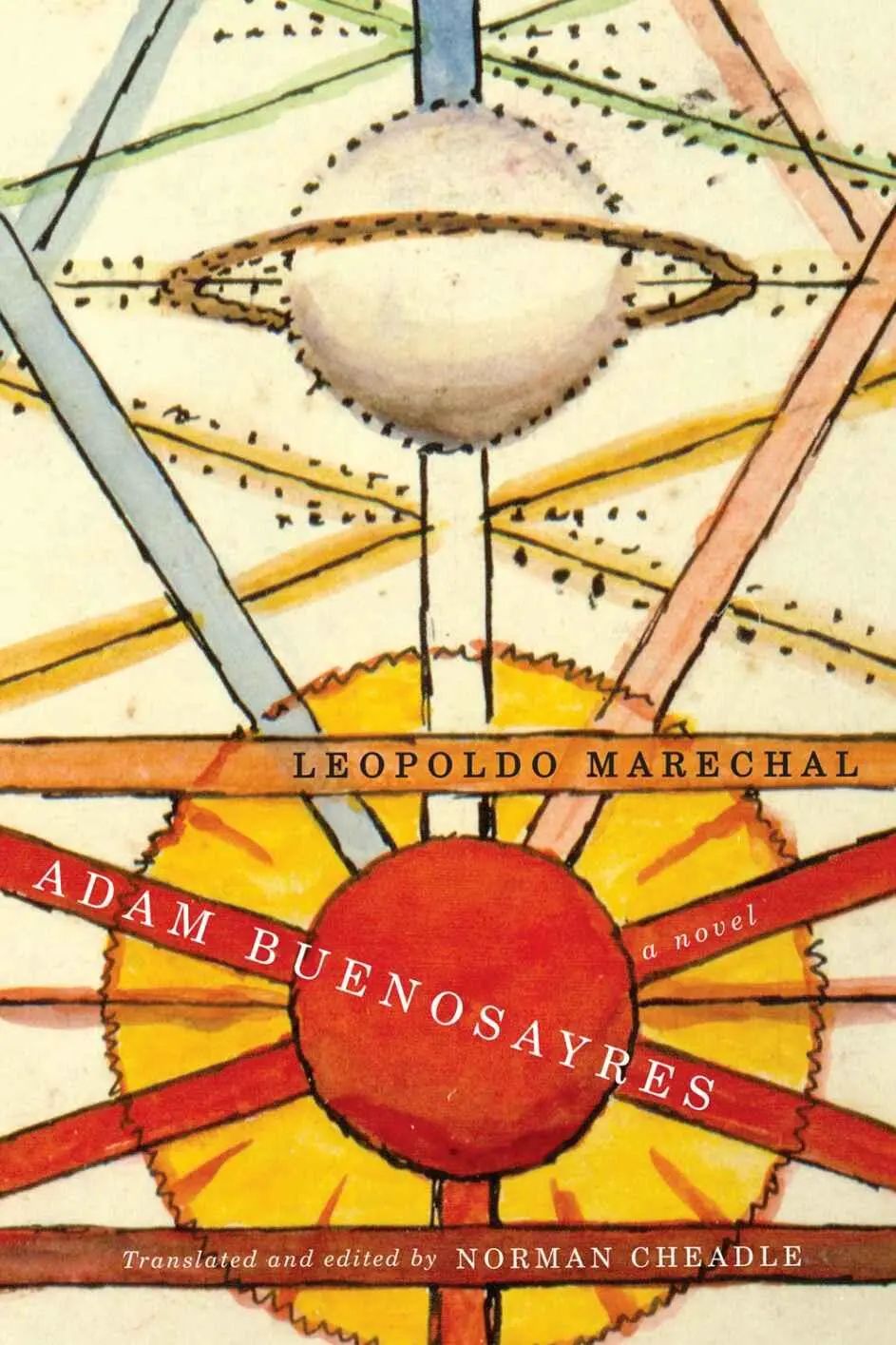
- Название:Adam Buenosayres
- Автор:
- Издательство:McGill-Queen's University Press
- Жанр:
- Год:2015
- ISBN:нет данных
- Рейтинг книги:5 / 5. Голосов: 1
-
Избранное:Добавить в избранное
- Отзывы:
-
Ваша оценка:
Adam Buenosayres: краткое содержание, описание и аннотация
Предлагаем к чтению аннотацию, описание, краткое содержание или предисловие (зависит от того, что написал сам автор книги «Adam Buenosayres»). Если вы не нашли необходимую информацию о книге — напишите в комментариях, мы постараемся отыскать её.
Adam Buenosayres — читать онлайн бесплатно полную книгу (весь текст) целиком
Ниже представлен текст книги, разбитый по страницам. Система сохранения места последней прочитанной страницы, позволяет с удобством читать онлайн бесплатно книгу «Adam Buenosayres», без необходимости каждый раз заново искать на чём Вы остановились. Поставьте закладку, и сможете в любой момент перейти на страницу, на которой закончили чтение.
Интервал:
Закладка:
In the watery afternoon light that rubs out lines, kills colours, and seems to devour even the slightest sound, thirty boys under the spell of ancient words now leave their jail and clamber over a honey-coloured beach, beneath a torrential sun that makes Circe’s palace glitter in the distance. The musical coast is festooned by a double line of foam. Beside the saltwater, the ship of grand adventures still lies upon the sand. The sparkling sea, bellowing like a young bull, licks the keel and the naked heels of the sailors. As Circe speaks, Adam Buenosayres, from his corner, studies the constellation of rapt eyes. Ramos, golden-headed, holds his breath as though afraid that his creative urge might disrupt the harmonious flight of the rhapsody. Forgetting his cardboard wings, Nossardi is now gliding in other skies. And even Bustos has been enraptured, his penknife in one hand and a half-tortured pencil in the other.
But Ulysses holds forth in his mariner’s voice:
ULYSSES-TERZIÁN: “My companions tie me to the mast, then resume their places on the ship’s benches and once again ply the foaming water with their oars. The vessel moves rapidly. Now we are close to shore, no doubt our voices can be heard from there. And now the Sirens notice the ship’s approach and begin to intone their sonorous chant.”
Ulysses stops talking, and immediately Balmaceda, Fratino, and MacLeish burst out in chorus:
THE SIRENS: “Oh, famous Ulysses, glory of the Achaians! Draw near, stop the boat and hear our song! No mariner has ever passed in his black ship without listening to the sweet tones flowing from our mouths. Rather, he who listens to us returns to his land wiser than before. For we know all the travails that Greeks and Trojans alike have suffered in Ilium; nothing happens in the vast universe outside our awareness.”
Ah, the ship! Watch out! The oars rise and dip in the accelerated rhythm of flight. The oarsmen’s torsos glisten in the sun. And thirty boys, aboard the ship of Ulysses, watch the hero as he struggles to free himself, at once prisoner of a mast and of a song. The boat flies over the salty meadows. The threat of the music has been left behind. Now it is time to untie Ulysses! Let wax no longer cover his prudent ears!
But Adam Buenosayres has deserted the ship and leapt to the beach. Amid carrion stinking in the sun and under a cloud of sticky bluebottle flies, he has seen the face of the Sirens and inhaled the breath from their horrible mouths. To hear the music, without falling into the snare of the one who proffers it! How? Most certainly, a ship and a mast are required.
Within the classroom and without, the foggy afternoon light gnaws at everything in a sort of universal dissolution. But thirty children row with Ulysses in the direction of the Blessèd Isles.
And Adam Buenosayres, lost in his corner, evokes an enigmatic figure of Woman in whose right hand a little ship fills its sails.
Chapter 3
— One, two, three, four, five, six, seven, eight, nine, ten, eleven, twelve.
The twelve bell-strokes were twelve little owls:
Someone opened the cage of the steeple, and off they flew. 1
Midnight: solitude, emptiness. Alone, I alone on the skin of the world, spinning as it flees, fleeing as it spins, “an old top without children.” 2Why without children? At that time I was playing around with logic, not noticing that dissimilar objects are always harmoniously related: splendor ordinis . Last night I tried to explain it at Ciro’s place — quite sloshed. That other image, too: “The Earth is an antelope in flight.” Or this one: “World, a stone buzzing in the seven colours.” Cosmic terror, ever since my childhood: a little boy clinging to his motionless horse and sobbing in anguish beneath the southern stars. The cold mechanism of time, cone of shadow, cone of light, night and day, solstice and equinox: the sun tells us fabulous lies, and the earth dons and doffs her splendours like a prostitute; “Hail, drunken bluebottle!” 3And in the end only a stone fleeing as it spins, spinning as it flees in an infinite space… no, indefinite space. Because the notion of infinity applies only to… Enough, my soul, enough!
Adam pauses, under the rain, at the corner of Gurruchaga and Triunvirato. From there, still undecided, he contemplates the ghostly ambience of Gurruchaga Street, a tunnel burrowing into the very flesh of the night, elongated between two rows of shivering paradise trees, their feet bound in metal rings, like two files of galley slaves trudging toward winter. Phosphorescent like the eye of a cat, the clock of San Bernardo peeps out from its tower. Not a single tremor of the final bell-stroke remains in the air, and silence flows now from above, blood of dead bells. Unexpectedly, a treacherous gust rakes the trees and they whimper like children. A fistful of rain hits Adam in the face; he staggers in a deluge of fallen leaves rushing along, rustling like old papers, while the streetlamps suspended overhead dance a mad jig of hanged men. The gust has passed. Silence and stillness are restored beneath the rain’s soft song. Solitude, emptiness, Adam enters Gurruchaga Street.
— Hermetic doors and windows, the keys turned, bolts drawn: thus they defend their escape into sleep. The sleeper’s house, safeguarded like trench or tomb. Yesterday’s combat, right here: not a soul left on the battlefield! Men and women, Trojans and Tyrians, what are they doing now? Their prone bodies sailing away on beds of iron, wood, or brass inside impregnable cubes — all have stolen away! Only I alone. If in the depths of midnight, if at the precise instant when one day gives way to another, if at that very juncture one might slip through a crack, freed from time! Yesterday, an anxious little boy among the party lights and music, who saw how time flowed like acid, gnawing at the festive house and those inside. Or an adolescent who dreamed of banishing Time from his poetry… Lord, I would have liked to be like the men of Maipú, who knew when to laugh and when to cry, when to work or sleep, fight or be reconciled; men well grounded in this world, in its bright and colourful reality! And not go wandering doubtful and mistrustful as though among vain images, reading into the signs of things much more than they literally say, and receiving, in the possession of things, much less than they promised. For I have devoured creation and its terrible multiplicity of forms: ah, colours that call out, impetuous gestures, lines to make one die of love! Only to find my thirst deceived, then to suffer remorse for my injustice to the world’s creatures, for demanding of them a happiness they cannot give. And now this disappointment — also unjust! — that makes me see creatures as letters of a dead language. Not to have looked, ah, not to have looked! Or to have looked always and only with a reader’s eyes like those I had in childhood, back there in the garden of Maipú, when in the beauty of intelligible forms I attained a vision of that which is stable and neither suffers autumn nor undergoes change. And therein lie the injustice and the remorse: to have regarded with a lover’s eyes what I should have seen with the eyes of a reader. (Must jot this down as soon as I get home.) How well they go together, the street and midnight and the drizzle! The Izmir Café is closed, too. No. Somebody’s singing.
With his ears peeled, Adam Buenosayres stops in front of the Izmir. Past the half-drawn metal blinds, in the murky interior, he can see hazy human figures standing still or gesturing sleepily. From within come the strains of an Asian song; accompanied by a lute or zither, a plangent voice is tearing at throaty gutturals and wringing a sob from each and every ah . Adam can smell sweet anisette, as well as strong tobacco smouldering no doubt in four-tubed hookahs.
Читать дальшеИнтервал:
Закладка:
Похожие книги на «Adam Buenosayres»
Представляем Вашему вниманию похожие книги на «Adam Buenosayres» списком для выбора. Мы отобрали схожую по названию и смыслу литературу в надежде предоставить читателям больше вариантов отыскать новые, интересные, ещё непрочитанные произведения.











Обсуждение, отзывы о книге «Adam Buenosayres» и просто собственные мнения читателей. Оставьте ваши комментарии, напишите, что Вы думаете о произведении, его смысле или главных героях. Укажите что конкретно понравилось, а что нет, и почему Вы так считаете.