Leopoldo Marechal - Adam Buenosayres
Здесь есть возможность читать онлайн «Leopoldo Marechal - Adam Buenosayres» весь текст электронной книги совершенно бесплатно (целиком полную версию без сокращений). В некоторых случаях можно слушать аудио, скачать через торрент в формате fb2 и присутствует краткое содержание. Год выпуска: 2015, Издательство: McGill-Queen's University Press, Жанр: Классическая проза, на английском языке. Описание произведения, (предисловие) а так же отзывы посетителей доступны на портале библиотеки ЛибКат.
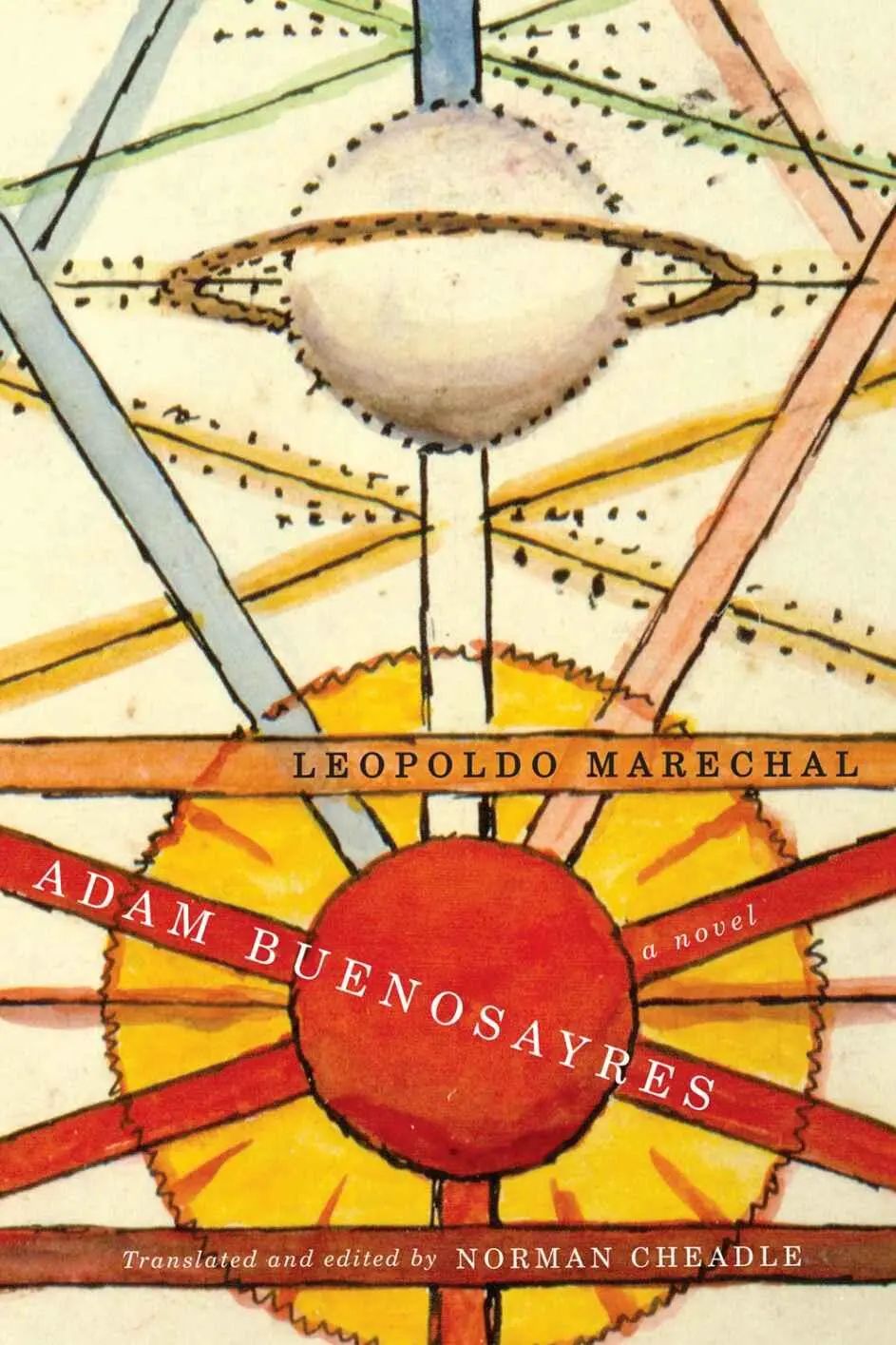
- Название:Adam Buenosayres
- Автор:
- Издательство:McGill-Queen's University Press
- Жанр:
- Год:2015
- ISBN:нет данных
- Рейтинг книги:5 / 5. Голосов: 1
-
Избранное:Добавить в избранное
- Отзывы:
-
Ваша оценка:
Adam Buenosayres: краткое содержание, описание и аннотация
Предлагаем к чтению аннотацию, описание, краткое содержание или предисловие (зависит от того, что написал сам автор книги «Adam Buenosayres»). Если вы не нашли необходимую информацию о книге — напишите в комментариях, мы постараемся отыскать её.
Adam Buenosayres — читать онлайн бесплатно полную книгу (весь текст) целиком
Ниже представлен текст книги, разбитый по страницам. Система сохранения места последней прочитанной страницы, позволяет с удобством читать онлайн бесплатно книгу «Adam Buenosayres», без необходимости каждый раз заново искать на чём Вы остановились. Поставьте закладку, и сможете в любой момент перейти на страницу, на которой закончили чтение.
Интервал:
Закладка:
Adam Buenosayres distractedly feels around in his pocket for his pipe and tobacco pouch. In vain. Forgotten at home.
— Heroic lives without laurels, on the prairie: unsung heroic deaths. Uncle Francisco, Grandfather Sebastián, Aunt Josefa, Casiano the Pampa Indian: all of them have slipped away, out there on the hillside in Maipú. After their battle with the land, they’re laid out and asleep in the fragrant earth; all of them reconciled with the land, in an ultimate embrace. And maybe with heaven too, because they deserved it.
Adam prolongs his midnight walk home. Slow and doubtful, his gait is that of someone not wanting to arrive. The night is intimate, the street abstract, the rain without beginning or end. And Adam would like to forget, let the wind rock him into forgetfulness of himself; or to dissolve like a chunk of salt in the rainwater as it falls and falls, whispering its ancient flood song. But he is all one sleepless eye that turns upon itself a cold, contemplative gaze. He has stopped now beside Old Lady Clotho’s doorway, as deserted as the night. There, in the shadow of Clotho the spinner, the children played the game of Angel and Devil. Adam touches the frigid marble with a sort of caress.
— A game of symbols. What are the Angel and the Devil looking for? A flower. What flower? The predestined rose, happy or sad. Yes, the game of games, perhaps. But if the soul receives the name of rose or carnation, before Angel or Devil come to claim their carnation or rose, where does that leave the soul’s free will? Where is the soul’s responsibility? A game of obscure laws: the theologians in suspense. In any case, the kids play the game happily, as if it were a comedy and not a tragedy. And what if it turned out to be not a drama but an ineffable comedy by the great Author? Then it ought to be played as the children play it, innocently and joyfully, with that wonderful whole-heartedness of children and saints. The drama lies in the loss of one’s innocence and joy. That’s why He said: “Become as little children.” 13Difficult! Ah, Old Lady Clotho has played well, no doubt. I believe she was picked by the Angel! We meet once in a while, at dawn, in front of San Bernardo. I’m going home from a night out, not having slept, grubby with ill-spent wakefulness and ashamed before the new light that smites me like remorse. Clotho is leaving the church after hearing early Mass, her capacious patched-up shawl over her head, ancient rosary between her fingers. We look at each other, I unclean and envious, she clear and true. She smiles at me. I think she smiles at me alone, unless the old woman’s smile is universal like the light. And Clotho redeems me with her gaze and her smile. She knows all and she absolves me, maybe because she has recovered the wisdom of children who play Angel and Devil. How good it would be tonight to rest one’s temples against her hard, grandmotherly knees, and to hear from her lips the great secret!
But Clotho’s doorway is empty, and Adam Buenosayres touches it, in a kind of caress. The limitless night, the murky street, and the infinite rain create around him an abstract ambience, in which he effortlessly divines the soul and himself. Never before has Adam felt so certain of a great divination, but the whole of him is a wakeful eye that turns upon itself, taking in his own unworthiness, and he tells himself it’s too late now to garner the wisdom of Clotho. That’s why, as he continues on his way, he carries within him the notion of his definitive death. He does not know — and it is good he doesn’t know — that he is only wounded and the nature of his wounds is admirable! He thinks he is alone and defeated. And he does not know that invisible armies have just gathered around him and are now fighting for his soul, in a silent clash of angelic swords and demonic tridents! He is unaware of this, and that’s good! But, isn’t that the Flor del Barrio? Yes, Adam recognizes her. Flor del Barrio is huddled in the hollow of a doorway and she waits as always for the Unknown One, gazing toward the end of the street, plastered in makeup and dressed up like a bride doll. A streetlamp, swaying to the rhythm of the wind, alternately bathes her in light and leaves her in the dark. Adam, now in front of the woman, observes her face, slathered in makeup, lifeless; her motionless mascara-stiffened eyelashes; her arms and legs, beneath motley-coloured clothing, more rigid than ever. And he asks her: “Flor del Barrio, who are you waiting for?” Silence! Flor del Barrio doesn’t answer. Then an unknown terror seizes Adam Buenosayres. He feels now there’s something artificial in those eyes, that mouth, those petrified facial muscles. So strong is the impression, Adam cannot resist the impulse to touch her face. But when he does, his fingers are left holding a cardboard mask. And behind it appears the true countenance of the Flor del Barrio: concave eyes, gnawed-away nose, the toothless mouth of Death.
— Imagination! Always busy, as now, on its deceitful loom! It wasn’t enough that I violated creatures, demanding of them what they need not give, could not. No, taking possession of their fantasies, I had to force upon them destinies alien to their essence, some of them poetic, others unmentionable. In how many invented postures have I placed myself, weaver of smoke, since childhood! I confess that, way back when, I imagined my mother’s death, suffering it in daydreams as if it were true. I confess to having beaten world champion Jack Dempsey in Madison Square Garden in New York, a hundred thousand frenetic spectators cheering me on. I confess that, one prodigious night, I broke the bank in Monte Carlo and walked away, rich in gold and melancholy, between a double row of polite gamblers and beautiful international prostitutes. I confess to having suffered the fury of Orlando because of jealous love, and to demolishing Villa Crespo armed only with a mace. I confess to having been a pioneer in Patagonia and founded there the port city of Orionopolis, famous for its navy, which was to expand its reign over the seven seas. I confess to having been dictator of my country, which under my iron rule experienced a new Golden Age through the application of Aristotelian political doctrine. I confess to having practised the purest asceticism in the province of Corrientes, where I cured lepers, performed miracles, and attained beatitude. I confess to having lived poetical-philosophical-heroical-licentious lives in the India of Rama, in the Egypt of King Menes, in Plato’s Greece, in Virgil’s Rome, in the Middle Ages of the monk Abelard, in… Enough!
So do his imagination’s monstrous offspring return now, one after another, filing past his shame-stricken conscience, tracing their ridiculous gestures, theatrical poses, damnable attitudes. Adam Buenosayres wants to be rid of them, but the monsters persist; he has the impression they’re circling him — laughing like demons, palming their howling mouths, winking malignant eyes — as they whirl in a carnivalesque round.
— Enough! Enough! I’ve wasted my only real destiny by assuming a hundred invented shapes. Like a weaver of smoke. Or a motionless god, perhaps, one who never loses his serenity, never breaks his necessary unity, but develops ad intra his possibilities, as though dreaming… Analogy? No! Megalomania. Only a wordsmith!
Angelic swords and demonic tridents clash noiselessly on Gurruchaga Street, fighting over the soul of Adam Buenosayres, wordsmith. For, according to the supreme economy, the soul of one man is worth more than the entire visible universe. But Adam does not know this, and it’s good that he doesn’t yet know. Phew! His nostrils sense the first emanations from La Universal tannery, looming now only a stone’s throw away, with its reeking walls and blind windows. Viscous and shiny under the rain, it looks like a malignant mushroom. Before facing the tannery, Adam stops at the corner, still hesitant. Usually, he holds his breath while making a dash for it across the danger zone. And this time?
Читать дальшеИнтервал:
Закладка:
Похожие книги на «Adam Buenosayres»
Представляем Вашему вниманию похожие книги на «Adam Buenosayres» списком для выбора. Мы отобрали схожую по названию и смыслу литературу в надежде предоставить читателям больше вариантов отыскать новые, интересные, ещё непрочитанные произведения.









Обсуждение, отзывы о книге «Adam Buenosayres» и просто собственные мнения читателей. Оставьте ваши комментарии, напишите, что Вы думаете о произведении, его смысле или главных героях. Укажите что конкретно понравилось, а что нет, и почему Вы так считаете.