Leopoldo Marechal - Adam Buenosayres
Здесь есть возможность читать онлайн «Leopoldo Marechal - Adam Buenosayres» весь текст электронной книги совершенно бесплатно (целиком полную версию без сокращений). В некоторых случаях можно слушать аудио, скачать через торрент в формате fb2 и присутствует краткое содержание. Год выпуска: 2015, Издательство: McGill-Queen's University Press, Жанр: Классическая проза, на английском языке. Описание произведения, (предисловие) а так же отзывы посетителей доступны на портале библиотеки ЛибКат.
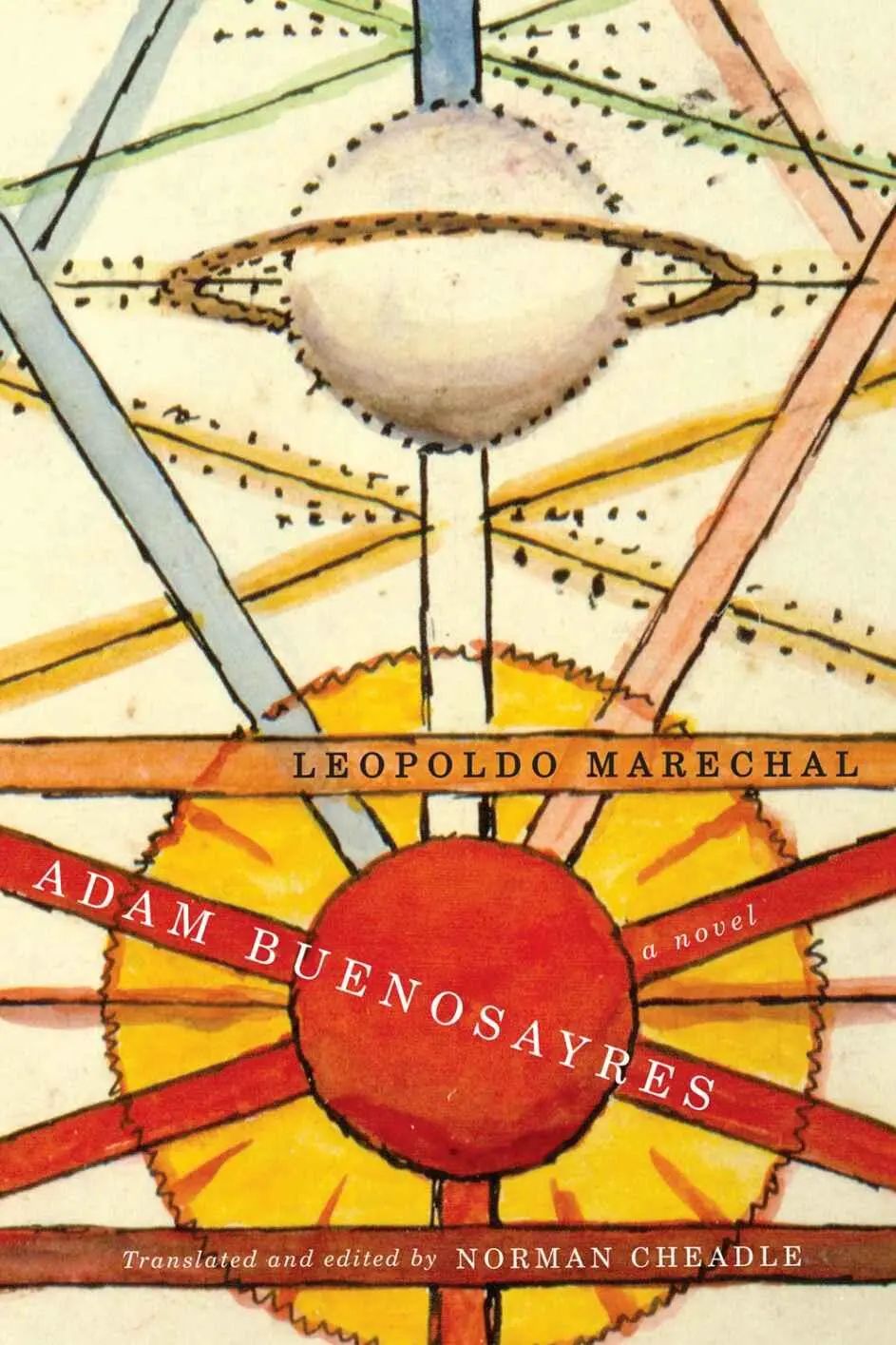
- Название:Adam Buenosayres
- Автор:
- Издательство:McGill-Queen's University Press
- Жанр:
- Год:2015
- ISBN:нет данных
- Рейтинг книги:5 / 5. Голосов: 1
-
Избранное:Добавить в избранное
- Отзывы:
-
Ваша оценка:
Adam Buenosayres: краткое содержание, описание и аннотация
Предлагаем к чтению аннотацию, описание, краткое содержание или предисловие (зависит от того, что написал сам автор книги «Adam Buenosayres»). Если вы не нашли необходимую информацию о книге — напишите в комментариях, мы постараемся отыскать её.
Adam Buenosayres — читать онлайн бесплатно полную книгу (весь текст) целиком
Ниже представлен текст книги, разбитый по страницам. Система сохранения места последней прочитанной страницы, позволяет с удобством читать онлайн бесплатно книгу «Adam Buenosayres», без необходимости каждый раз заново искать на чём Вы остановились. Поставьте закладку, и сможете в любой момент перейти на страницу, на которой закончили чтение.
Интервал:
Закладка:
Quickly, Adam turns to his three friends and parodies:
— Jail, I said. Sacred word!
And he makes his escape through the door, leaving behind three cruel chortles, one mother engrossed in thought, one worried boy, one vexed Principal, one dead swallow.
A glacial wind whips through the column-flanked corridor. Adam Buenosayres deeply inhales its gusts. Then he slips between two columns out to the schoolyard where three hundred wound-up schoolboys yell and push and shove beneath a sky the colour of tarnished brass, between walls sweating moisture and fatigue. As he makes his way through hectic bunches of children, Adam Buenosayres takes the measure of the void in his soul. More than ever he feels a lack of internal pressure that leaves him helplessly exposed to external images. Scenes, shouts, colours, and shapes irrupt into his empty soul, like a mob of brutal strangers invading an uninhabited site.
Just then, a deafening clamour breaks out among the schoolboys. Looking across the schoolyard, he sees a swarm of boys around a centre he can’t yet make out. Their jeers and hoots of laughter seem to condense into one:
— Iron face! Iron face!
He walks toward the source of the uproar. But the chorus of boys is breached violently, as a kid comes charging out with head lowered in a wild bid to escape. Adam Buenosayres catches him on the fly and, glancing at his face, discovers the reason for the tumult: a terrible paralysis has hardened the lines of the child’s countenance, imposing a strange metal-or rock-like rigidity. Mouth and chin seem to be permanently contracted in a cruel rictus. His eyes, staring fixedly, express ferocity, undermined only by the tear trembling on each of his eyelids. He’s wearing a sailor suit; the long pants veil the severity of the orthopedic shoes. While straightening up the boy’s dishevelled clothes, Adam takes a look around. He sees a circle of faces observing him expectantly. Some of them, innocent in their wickedness, are still laughing and whispering, “Iron face!” Stroking the child’s cheeks still trembling under his hands, Adam asks him:
— What’s your name?
— Tristán Silva, answers Iron Face in a kind of grunt.
— Is this your first day at this school?
— Yes.
Adam uses his handkerchief to dry the two tears that can’t quite decide to slide down that frightful face. Then he holds out his open hand to the child.
— Tristán Silva, he says. You and I are going to be friends. How about it?
— Yes, grunts Tristán, who has grasped the offered hand.
To make the others aware of this gesture of friendship, Adam walks around among the onlookers, Tristán’s hand in his. Then he returns him to the group of his enemies, who now embrace and acclaim him. Oh, world! But Señor Henríquez, embalmer of birds, has just given the order to line up for a run. Three hundred schoolboys, anxious to shake off the cold, form up in impatient squads.
— Ready, set, go!
The race begins, the schoolyard rumbles underfoot, shouts of joy explode. Adam, in the centre of the circle, is watching the parade of vertiginous faces, when he feels Tristán Silva’s hand slip back into his.
— Shall we run? he asks.
— Yes! answers Tristan, piercing Adam with hard eyes.
Holding on tight to the child’s hand, Adam joins the circle of runners, amid flushed cheeks and noisy breathing. Clinging to Adam’s hand, Tristan hops in the air like a rag doll; the metal of his orthopedic boots clangs on the hard tiles. Not a single muscle moves in his face, but a long roar comes out of his chest and bursts from his lips. And Adam understands that Iron Face probably has no other way to laugh.
When the bell rings for the second time, the pupils break from standing at attention and in orderly fashion seek their habitual place in line. Adam is standing in front of his pupils, observing as they form up in a wiggly double file that is gradually straightening. Suddenly, he sees the Principal approaching with a triumphant air, his eyes tearful, his mouth quivering in an imminent sob.
— They’ve reacted! he exclaims. The mother and the boy have reacted positively!
— Congratulations, Adam tells him, winking to his left at Quiroga, who chokes back laughter.
But the Principal waves an energetic hand above his brow, as though refusing an invisible crown of laurel leaves.
— Just doing my job, he concedes. All in a day’s work.
Drying his tears with a coloured handkerchief, he turns and flees down the hallway.
Emptiness of soul, solitude, and ice. The two lines are now still, and Adam Buenosayres, tearing himself away from the spectacle of his own desolation, looks at thirty childish faces looking back at him, faithful mirrors of his own face. They mustn’t notice anything! And, as so many times before, a revivifying echo awakes in his heart at the sight of this new world waiting for him. To approach their world, to go back up the stream of their newborn language, grasp that burgeoning new life pliant to the mere weight of his voice or gaze! So he puts his right hand on Ramos’s shoulder and his left on Falcone’s, each of them at the head of a line.
— Did you bring your composition? he asks Ramos, the boy with the golden head.
— Yes, Ramos answers. It was a hard subject.
— Did it turn out all right?
In the boy’s blue eyes there is a glint of restless creativity.
— Hmm! he says. The description of Polyphemus…
— Sir! interrupts Falcone, rubbing his hands together. Today we’re doing Pythagoras’s theorem!
Adam looks at him, and smiles again at how the well the bird’s name suits the boy: his lean profile, bushy brows, and keen gaze are somehow as fierce and avid as intelligence itself.
— That’s right, Adam admits. Were you looking forward to learning it?
— Yes, answers Falcone.
— Why?
— The kids in the other sixth-grade class say they didn’t understand it.
— How tragic! Ramos mocks.
— I always understand, Falcone says confidently, blinking like a bird of prey.
Adam hugs the two heads, golden and hawkish, to his chest. Then, sought by many eyes, he begins his habitual walk between the double file.
First he comes upon Bustos, who stops him with his sharp voice, his perfidious clown smile, and his puddle-coloured eyes that look about ready to pop out of his head.
— Sir, announces Bustos. Another miracle!
— What happened?
— Cueto laughed!
Adam turns to Cueto, the sphinx of the class, and contemplates the child’s immutably serious face.
— No! he exclaims. It can’t be true!
— Cross my heart and hope to die! Bustos assures him.
Amid singing laugher, Adam moves on, pausing in front of Gaston Dauthier, a bundle of nerves.
— Bonjour , Dauthier.
— Bonjour, monsieur , Gaston answers. Are we going to play against the other class today?
— Hmm, Adam prevaricates dubiously.
He turns to the orator Fratino who, like Gaston, is already peering up at the sky.
— What do you think? he asks the boy.
Teseo Fratino raises a professorial hand and suggests in an exquisite voice:
— Should the weather conditions be favourable…
— Will we get rain in the fourth period? Adam insists.
— Sir, I cannot say. I have not consulted the barometer.
Fratino’s vocabulary provokes more laughter. But the orator’s cold eyes nail his mockers, and a sneer of disdain breaks the impeccable line of his mouth. Then Adam abruptly sticks two fingers into the ribs of Terzián, the actor.
— Hands up! he says.
Terzián raises his arms, as if terrified. His mercurial face reflects fear, then fury, then a furtive attempt at resistance. His arm begins to creep down to draw an imaginary revolver. But Adam keeps him covered, and the actor soon gestures his compliance before the inevitable.
Читать дальшеИнтервал:
Закладка:
Похожие книги на «Adam Buenosayres»
Представляем Вашему вниманию похожие книги на «Adam Buenosayres» списком для выбора. Мы отобрали схожую по названию и смыслу литературу в надежде предоставить читателям больше вариантов отыскать новые, интересные, ещё непрочитанные произведения.










Обсуждение, отзывы о книге «Adam Buenosayres» и просто собственные мнения читателей. Оставьте ваши комментарии, напишите, что Вы думаете о произведении, его смысле или главных героях. Укажите что конкретно понравилось, а что нет, и почему Вы так считаете.