Leopoldo Marechal - Adam Buenosayres
Здесь есть возможность читать онлайн «Leopoldo Marechal - Adam Buenosayres» весь текст электронной книги совершенно бесплатно (целиком полную версию без сокращений). В некоторых случаях можно слушать аудио, скачать через торрент в формате fb2 и присутствует краткое содержание. Год выпуска: 2015, Издательство: McGill-Queen's University Press, Жанр: Классическая проза, на английском языке. Описание произведения, (предисловие) а так же отзывы посетителей доступны на портале библиотеки ЛибКат.
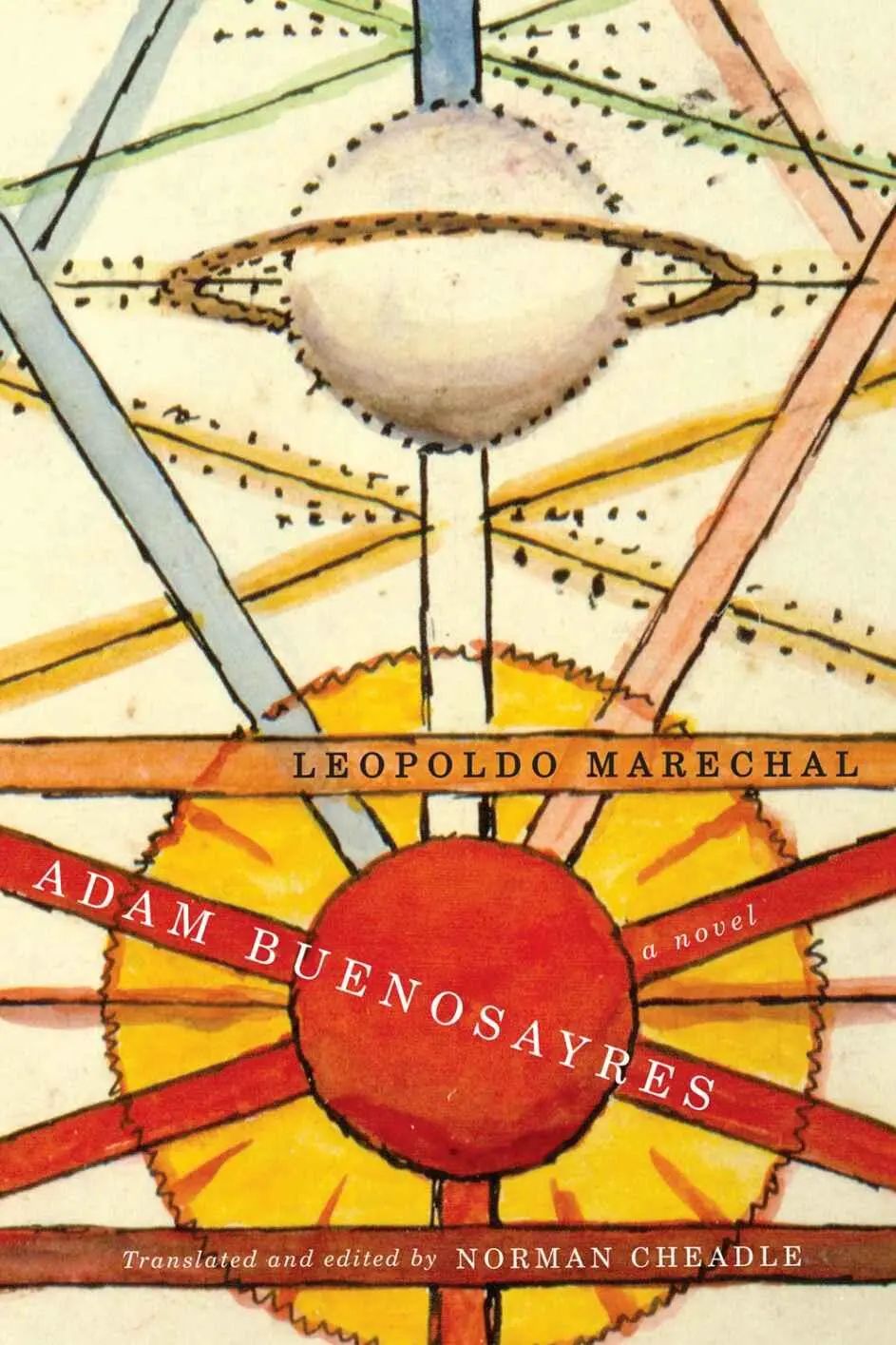
- Название:Adam Buenosayres
- Автор:
- Издательство:McGill-Queen's University Press
- Жанр:
- Год:2015
- ISBN:нет данных
- Рейтинг книги:5 / 5. Голосов: 1
-
Избранное:Добавить в избранное
- Отзывы:
-
Ваша оценка:
Adam Buenosayres: краткое содержание, описание и аннотация
Предлагаем к чтению аннотацию, описание, краткое содержание или предисловие (зависит от того, что написал сам автор книги «Adam Buenosayres»). Если вы не нашли необходимую информацию о книге — напишите в комментариях, мы постараемся отыскать её.
Adam Buenosayres — читать онлайн бесплатно полную книгу (весь текст) целиком
Ниже представлен текст книги, разбитый по страницам. Система сохранения места последней прочитанной страницы, позволяет с удобством читать онлайн бесплатно книгу «Adam Buenosayres», без необходимости каждый раз заново искать на чём Вы остановились. Поставьте закладку, и сможете в любой момент перейти на страницу, на которой закончили чтение.
Интервал:
Закладка:
— There’s another way, he said. Dazzle her with wealth. Suppose I wrap a necklace of the finest pearls around her goddess-like neck. And dangle sparkling diamonds before her eyes, and emeralds, and rubies.
— Faust, mused Adam Buenosayres.
— Yes, Samuel admitted. But he forgot about the furs, the big fool. Haven’t you ever seen how women surrender unconditionally when they’re at the furrier’s shop, looking at ermines, martens, foxes, astrakhans? Jewels and furs: two instruments of domination. I don’t know if you’ve noticed, but most of the world’s great jewellers and furriers are men of my race. And then there’s the automobile! It’s incredible how cars fascinate females so. Put a gorilla at the wheel of a Rolls-Royce, and women will see the Apollo of Belvedere.
By the time he finished this quasi-monologue, the initial harshness in Samuel’s voice had become vitriolic, his tone seeming to translate all his turbid imaginings, ancient resentments, and flaming despair. Adam couldn’t see his face, but he sensed the eloquence of its diabolical grimaces and how it moulded itself according to the infamy of each of the words he uttered. When he came to the end, Samuel squeezed his friend’s arm till it hurt:
— It’s all true, he announced in a fury. But what’s still needed is gold. Gold!
— Let go of my arm! Adam ordered.
— Gold! Gold! shouted Samuel. It picks the lock of the world!
He laughed perversely and continued:
— And why not? My race knows well the secret of gold. We manufacture it, we adore it. And why not?
The scars of the whip were still bleeding on your skin, and the mud of the Nile was still fresh on your feet. The manna sent from heaven melted in your mouth, and in your throat was the freshness of the prodigious fount. And you were already forgetting, hard-hearted man! Already you had made burnt offerings to the golden beast, and kissed its hooves cast in the metal of your women’s earrings and bracelets! (But the Just Man struggled on the mountain; he held back the arm of his Lord that was about to fall upon your shaven head.) 4And later you were among your brothers in the house of Naphtali, and you went weaving your obscene dance around the golden calves wrought by Jeroboam. (But the Just Man looked up to the ever clear sky, and descended at dawn, heading for Jerusalem.) 5And still later you were seen on the plain of Dura, in the province of Babylon, with your aquiline nose in the air and your ear attentive to the sound of the cornet, flute, harp, psaltery, dulcimer, and the entire musical ensemble. And when the signal sounded, you fell on your face, adoring the golden statue that Nebuchadnezzar had built. (But the three men sang in the fiery furnace: Fires of the Lord, praise the Lord! ). 6And later still you were the sordid alchemist, vainly working with mercury, sulphur, and salt. (But Abraham the Jew made authentic gold, and saw in his athanor the fulfilment of the great work: the Green Lion and Lion’s Blood.) 7And nowadays you can be seen working to transmute blood and sweat into gold. And fulfilling the liturgy of gold, and enjoying the beatitudes of gold, and suffering the martyrdom of gold. (But announced is Philadelphia, city of brothers.) 8
— That is the great temptation, concluded Tesler. To accumulate that yellow stuff!
— I don’t see how, Adam rejoined. Unless you sell your soul to the devil. And what devil would buy it from you?
The philosopher laughed disdainfully.
— Black magic, he said. Bah! It used to work when man knew himself to be the proprietor of a soul. But now we live in the time of the body.
— So what would be your plan? asked Adam.
— He who rules over bodies will rule over gold, Tesler responded prophetically.
— You’re wandering off topic.
— No, I’m not. I’m short three courses to fulfil my degree in Medicine. Only three! I take the three courses, and I become Doctor Samuel Tesler, clinician and surgeon.
— What’s the connection?
— It’s another key to gold.
Samuel took on an air of cold calculation.
— To be a doctor now, he said, means being able to rule over bodies in the age of the body.
And he added, with glacial brutality:
— The bourgeois slobs who amass gold will be parted from it by only two powers: those who defend it for them, and those who keep their viscera in good working order. That’s why we live in the era of lawyers and doctors.
He laughed cruelly:
— Let’s imagine a financial idol, inaccessible, all-powerful, revered, feared. Along comes Doctor Samuel Tesler, and the idol falls apart. Doctor Tesler makes the idol strip naked, prods and pinches him, sticks a cannula up his anal orifice or a catheter up his urethra, keeps him nervous about the state of putrefaction of his vital organs, plays on his hopes and fears, regulates how much he eats, sleeps, and fornicates. Thus does Doctor Tesler elegantly take control of the broken idol. Is it worth taking the three exams?
— Hmm! grumbled Adam Buenosayres, not convinced by the ease with which Samuel had just knocked down the idol.
— It’s like this, insisted the philosopher. Medicine, too, is an instrument of domination.
And he added with overweening pride:
— Not for nothing has my race abounded in great doctors.
— An imperialist race, Adam insinuated sarcastically.
— And one that conquers the enemy by attacking his weak spot.
— What weak spot?
— The sensuality of his oppressors.
Adam Buenosayres laughed in real amusement:
— For half an hour now, he said, you’ve been inventing dreams of gold and luxury. And all for Haydée Amundsen’s flesh, be it tough or tender!
— Tender! protested Samuel in ecstasy.
Right away he added in a penitential tone:
— I’m the black sheep. Samuel has deserted his tribe.
— Your tribe is no better, Adam rejoined. Your race is disgustingly sensual. You can’t deny it.
The philosopher’s long sigh sounded in the shadows.
— Yes, he admitted, it’s an oriental race. It still has a penchant for luxury. Don’t forget that it has bought and sold all the splendours of the world — precious metals and stones, fabrics, perfumes, slaves, women.
Here he paused, as if about to reveal something confidential.
— I myself, he said at last, despite my Franciscan life and philosophical initiations, can’t break free from the inclination. Of course, it’s an ancestral influence! Sometimes I find myself staring through a shop window, mesmerized by some luxurious trinket.
He interrupted himself again, then finally resolved to confess all:
— When the Chinaman at the drycleaner’s gave me that fantastic kimono, oh boy! — that night, after putting it on, I felt my epidermis would never again tolerate any material but silk. Then again, when Levy the hat manufacturer got married, there was French champagne at the reception. I’d never tried it before. And would you believe it? Once I’d tasted it, I knew without a doubt that from then on life would be unbearable without that wonderful wine. And women! I don’t know why, but I study them, measure them, mentally touch them, as if I had to buy and sell them at so much a pound!
He lapsed into an afflicted silence, and Adam Buenosayres patted him on the shoulder consolingly, even though he was still wondering whether the confession was a product of sincerity, drunkenness, or farce, a mode in which the philosopher so often moved.
— I believe you, he said. That’s why I laughed when you were talking about the sensuality of others.
— And doesn’t it exist? protested Samuel, who never admitted defeat and was already rising from his ashes.
— It exists, Adam admitted. We’re in the time of the body, as you were saying. A felicitous turn of phrase.
Читать дальшеИнтервал:
Закладка:
Похожие книги на «Adam Buenosayres»
Представляем Вашему вниманию похожие книги на «Adam Buenosayres» списком для выбора. Мы отобрали схожую по названию и смыслу литературу в надежде предоставить читателям больше вариантов отыскать новые, интересные, ещё непрочитанные произведения.





Обсуждение, отзывы о книге «Adam Buenosayres» и просто собственные мнения читателей. Оставьте ваши комментарии, напишите, что Вы думаете о произведении, его смысле или главных героях. Укажите что конкретно понравилось, а что нет, и почему Вы так считаете.