Leopoldo Marechal - Adam Buenosayres
Здесь есть возможность читать онлайн «Leopoldo Marechal - Adam Buenosayres» весь текст электронной книги совершенно бесплатно (целиком полную версию без сокращений). В некоторых случаях можно слушать аудио, скачать через торрент в формате fb2 и присутствует краткое содержание. Год выпуска: 2015, Издательство: McGill-Queen's University Press, Жанр: Классическая проза, на английском языке. Описание произведения, (предисловие) а так же отзывы посетителей доступны на портале библиотеки ЛибКат.
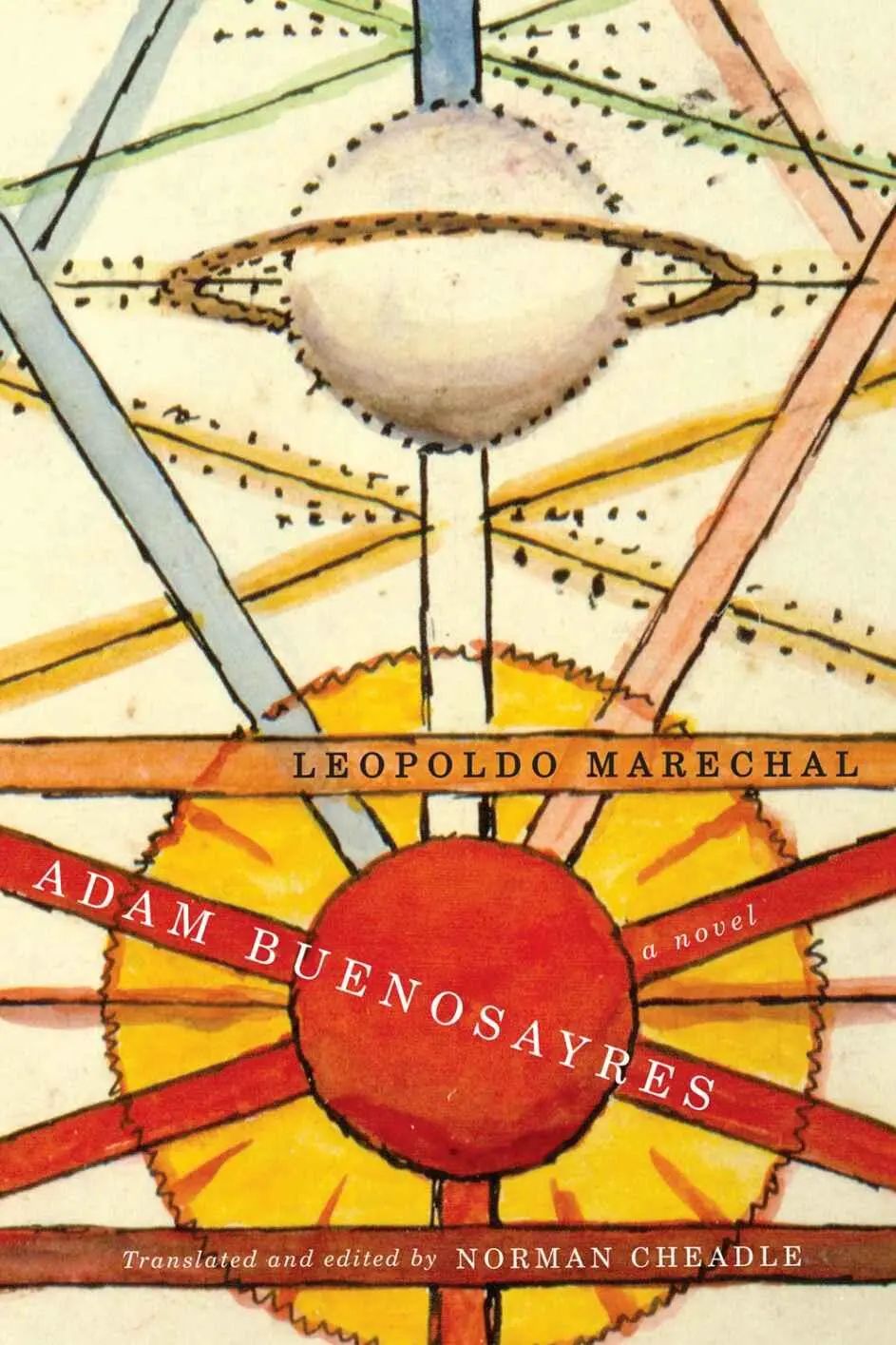
- Название:Adam Buenosayres
- Автор:
- Издательство:McGill-Queen's University Press
- Жанр:
- Год:2015
- ISBN:нет данных
- Рейтинг книги:5 / 5. Голосов: 1
-
Избранное:Добавить в избранное
- Отзывы:
-
Ваша оценка:
Adam Buenosayres: краткое содержание, описание и аннотация
Предлагаем к чтению аннотацию, описание, краткое содержание или предисловие (зависит от того, что написал сам автор книги «Adam Buenosayres»). Если вы не нашли необходимую информацию о книге — напишите в комментариях, мы постараемся отыскать её.
Adam Buenosayres — читать онлайн бесплатно полную книгу (весь текст) целиком
Ниже представлен текст книги, разбитый по страницам. Система сохранения места последней прочитанной страницы, позволяет с удобством читать онлайн бесплатно книгу «Adam Buenosayres», без необходимости каждый раз заново искать на чём Вы остановились. Поставьте закладку, и сможете в любой момент перейти на страницу, на которой закончили чтение.
Интервал:
Закладка:
… And time was when the days began with your mother’s song:
Four white doves,
four blue ones,
four little red ones,
death gives to me. 1
You passed through your days and nights as through a series of black and white rooms. The wolf-coloured pony was devilishly skittish; he would use a hitching post to tear off his bit and halter, then open the gate with his muzzle. And Casiano, the Pampa Indian, who with consummate skill could kill a partridge with a blow of the whip! 2
Or the commotion of mad bells waking you at dawn: the pilgrimages of Maipú! It would still be early morning, but already the house was buzzing in anticipation of the fiesta. The men looked rather stiff in their Sunday clothes. The young aunts, in great excitement, unfurled bright fabrics, shook bottles of scent, whispered among themselves or suddenly blazed up in laughter. Cursing in sonorous Basque phrases, Uncle Francisco struggled with a recalcitrant boot. Later, Grandfather Sebastián would enter the church, plunge his gigantic hand wholly into the font, and pull it out dripping wet. You touched his gnarled fingers and, on your knees, you crossed yourself. Afterwards, the men took you to Olariaga’s general store. Outside, several handsome horses were tethered in a row along an immense hitchrack. Inside, by the counter, men exchanged loud greetings and detonated peals of laughter amid odours of Tarragona wine, saddles, medicines. All of a sudden, the student minstrel group, in the Spanish tradition, came in strumming guitars and plucking violins. Decked out in spangled suits, short pants, white socks, and feathered hats, they were escorted by a horde of boisterous kids. Your gaze, however, wouldn’t linger there, but on the three or four motionless figures who, glass in hand, stood smiling behind the group, apart from the fray. Like Grandfather Sebastián, those countrymen might have come from the time of Rosas, judging by their fleece-white beards and leathery faces more wrinkled than ancient paper. They still wore the black chiripá , colt-leather boots and obsolete spurs on their heels. In childish astonishment, you stared at them as though into the very face of adventure, for you associated them with the famous cattle-drives down Chubut way, with those legendary crossings among sand dunes and storms, with the epic exploits of the old cowboys, whose praises you’d heard sung so many times in smoke-filled kitchens by strangers who came and went, inexplicably, like the wind. 3Later, at noon, the roasts of meat, laid out over hot coals, were smoking beneath a rain of spiced brine. And then the dance got underway under the open sky, until the southern night fell upon musicians and dancers.
Now you find yourself on the road from Maipú to Las Armas, a line traced across the prairie from horizon to horizon. The last days of summer and the first of your adolescence. You’re astride a horse, riding behind a hundred red steers, enveloped in the dustcloud raised by four hundred hooves. You’ve been allowed to wear the black boots which, along with the vicuña poncho and the silver-tipped facón , constitute your sole inheritance from Grandfather Sebastián. To you, wearing those boots means you’re entering manhood. Mounted on his memorable buckskin horse, Uncle Francisco, on your right, is chewing black tobacco, Hija del Toro brand, which he always carried in his ostrich-throat tobacco pouch. Looking at him now in these peaceful conditions, you recall in imagination that stormy night when a drove of semi-wild horses broke up and scattered on him for the third time in a row: Uncle Francisco leapt from his horse to the ground, unsheathed his knife, and raised his eyes heavenward to challenge God himself, shouting: “Come on down here, if you’re man enough!” Leading the current cattle-drive are Justino and Casiano the Pampa, one riding to the right, the other to the left. Inside every man’s hat is a fresh-cut switch of white smartweed, because it is now nearly noon and the sun’s rays fall vertical like arrows from a maddened archer. Sure, sweat drips from your forehead, leaving a salt taste on your lips; the dust-cloud blinds your eyes and dries your nostrils; and your ears are deafened by the beasts’ bellowing and the yippee-yi-ay of the cowhands. But your heart is ringing like a little bell at a fiesta, and you wish no grander lot in life than to follow a road traced across the prairie from horizon to horizon, behind a hundred red steers burning like coals at noon.
Since when had the resplendent forms of creatures been speaking to you thus? Since when had they spoken to you in a language you didn’t yet clearly understand, but which gave you an inkling of the certitudes of beauty, truth, and goodness; and which brought tears to your eyes, and wakened on your tongue a painful longing to respond in the same language? To be sure, one morning, reading your schoolboy composition, Don Bruno had said in class: “Adam Buenosayres is a poet.” And the other kids stared hard at you, as if they didn’t know you. But, since when? Lord! A child who shies away from games and slinks off to a corner to weave a warp of musical words: “Oh, the rose, the sad rose, the emaciated rose!”
Now you are eighteen years old, back there, in the fields of Santa Marta, and you’re standing beside Liberato Farías, the horsebreaker. Beneath your feet, the earth is a great wheat-coloured circle. Overhead, the sky’s complexion is hyacinth — dome or flower, who knows? Liberato’s shock of straight hair is tied back with a coloured kerchief. Now he adjusts his spurs, happy and painstaking as a wrestler getting ready for another fight. Twenty paces ahead, biting the bit for the first time, with the lasso still around its neck and its nervous legs bound by the strap, the black colt stirs and frets, flashing like a drop of mercury. Almirón the foreman holds fast the colt’s muzzle using the handle of his whip. Uncle Francisco, without letting go of the lasso, keeps a careful eye on the animal’s rippling movement. Your admiring gaze passes from image to image, pausing now on the horsebreaker kneeling to put on his boots; now on the horse, a machine steaming with pent-up rage; now on the hyacinth-complexioned sky and the wheaten earth. Liberato has got to his feet. The tack slung over his shoulder, he walks phlegmatically over toward the waiting group. When he gets there, he checks that the components of the tack are all in order. Then he approaches the colt and runs his broad hand from neck to tail, much like the musician who, before playing his guitar, first touches the strings and gets the feel of them. The tack’s various components now slip over the animal: saddlecloth, horse blanket, saddle padding, the cinch drawn tight with nails and teeth, sheepskin saddle blanket, bellystrap. The colt, all this while hesitating between shock and anger, finally comes to a decision and tries to break free of its ties. The operation concluded, Liberato cautiously mounts, stepping ever so lightly on the stirrup, and settles himself on the skins. Only then does he wave off his padrinos with a friendly gesture, asking to be left alone for his single combat. Uncle Francisco unhobbles the colt and undoes the lasso. Almirón releases the animal’s muzzle. Both men summon their horses so as to accompany the horsebreaker, in accord with the laws of comradeship. The colt, however, is not yet moving, as if its hooves were nailed to the ground. So Liberato puts his whip in front of its eyes. The beast rears up and stands vertical for a moment, sits down abruptly on its hindquarters, regains its balance, spins violently to the left and then to the right — torn between taking flight and rolling on the ground with rider and all. Meanwhile, the horsebreaker tugs ferociously at the reins, forcing the horse’s neck one way and then the other. The bronco puts its muzzle down between its knees, thrusts its back up like a mountain, and finally begins to buck in earnest, struggling to throw the rider, who clings to the colt’s flanks with the double arc of his legs. Its arsenal of tricks and violence exhausted, the colt takes off in a mad career toward the horizon, helped by its rider, who slackens or tightens the reins. Your eyes followed him in that flight, and your ears heard the hooves beat upon the earth, resonant as a drum. And then you saw how rider and horse returned from the horizon, in harmony now. And how the horsebreaker, after dismounting and removing the skins from the horse, patted the animal on the head, as if to seal an unbreakable pact with it. You had approached the sweat-cloaked horse and you were looking at its dilated, noisily panting nostrils, its mouth filled with blood and spume, its eyes wet and flowing with hot drops that mimed human tears. When you carressed its sore mouth, your nose caught the colt’s vegetal breath, a sweet and pure breath of innocence. Afterward, you went with Liberato to the well, with its fresh scents of water and moss. Leaning back against the parapet, the horsebreaker had the judicious placidity of the combatant who has purified himself in another battle. As he gulped down his overflowing pitcher of water, you saw his blue eyes moisten with delight as they looked up to the zenith. Then you went off across the wheaten earth, beneath a hyacinth sky, your heart filled with praise and pondering the promise of a song you had yet to write.
Читать дальшеИнтервал:
Закладка:
Похожие книги на «Adam Buenosayres»
Представляем Вашему вниманию похожие книги на «Adam Buenosayres» списком для выбора. Мы отобрали схожую по названию и смыслу литературу в надежде предоставить читателям больше вариантов отыскать новые, интересные, ещё непрочитанные произведения.






Обсуждение, отзывы о книге «Adam Buenosayres» и просто собственные мнения читателей. Оставьте ваши комментарии, напишите, что Вы думаете о произведении, его смысле или главных героях. Укажите что конкретно понравилось, а что нет, и почему Вы так считаете.