Leopoldo Marechal - Adam Buenosayres
Здесь есть возможность читать онлайн «Leopoldo Marechal - Adam Buenosayres» весь текст электронной книги совершенно бесплатно (целиком полную версию без сокращений). В некоторых случаях можно слушать аудио, скачать через торрент в формате fb2 и присутствует краткое содержание. Год выпуска: 2015, Издательство: McGill-Queen's University Press, Жанр: Классическая проза, на английском языке. Описание произведения, (предисловие) а так же отзывы посетителей доступны на портале библиотеки ЛибКат.
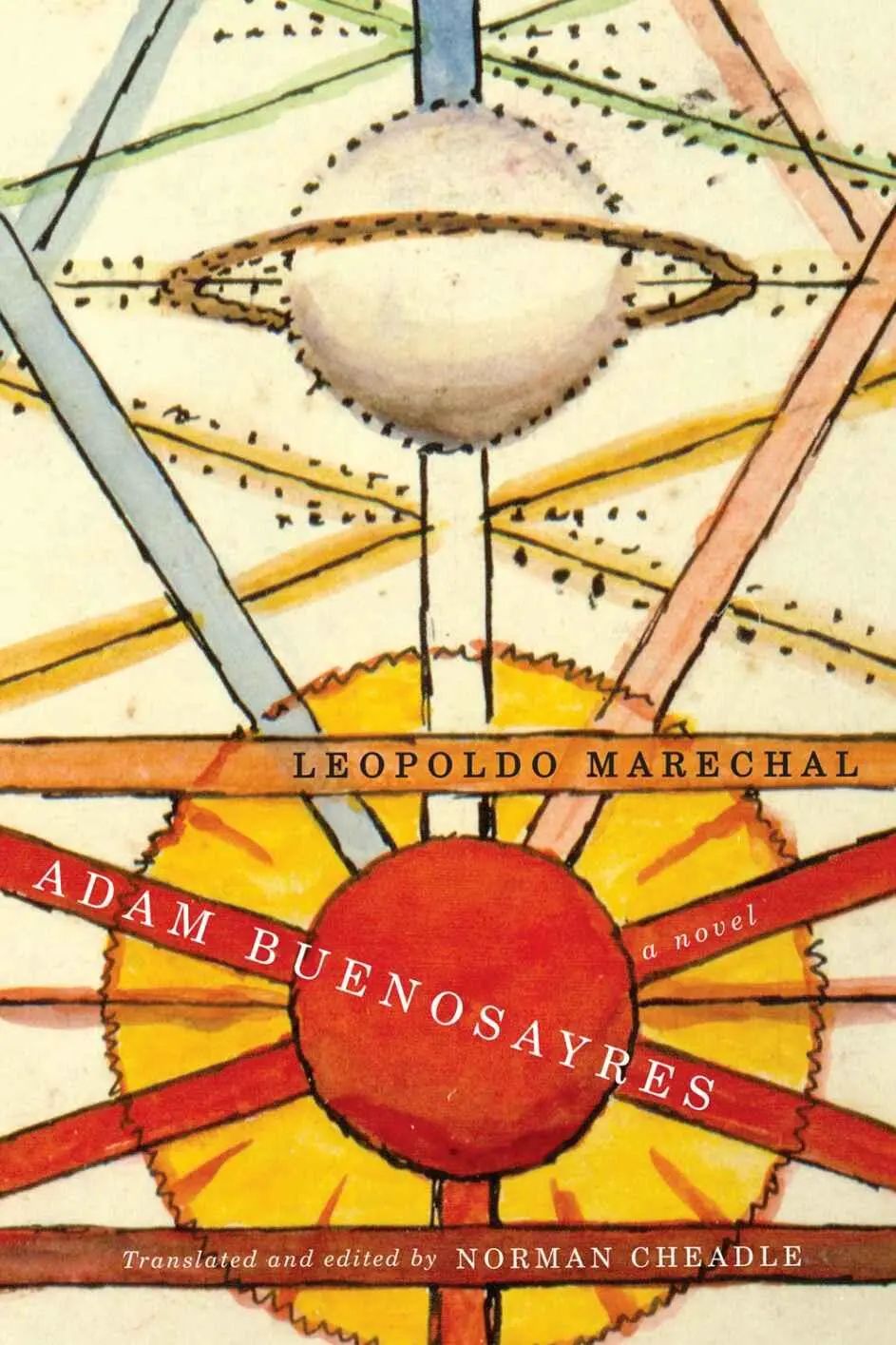
- Название:Adam Buenosayres
- Автор:
- Издательство:McGill-Queen's University Press
- Жанр:
- Год:2015
- ISBN:нет данных
- Рейтинг книги:5 / 5. Голосов: 1
-
Избранное:Добавить в избранное
- Отзывы:
-
Ваша оценка:
Adam Buenosayres: краткое содержание, описание и аннотация
Предлагаем к чтению аннотацию, описание, краткое содержание или предисловие (зависит от того, что написал сам автор книги «Adam Buenosayres»). Если вы не нашли необходимую информацию о книге — напишите в комментариях, мы постараемся отыскать её.
Adam Buenosayres — читать онлайн бесплатно полную книгу (весь текст) целиком
Ниже представлен текст книги, разбитый по страницам. Система сохранения места последней прочитанной страницы, позволяет с удобством читать онлайн бесплатно книгу «Adam Buenosayres», без необходимости каждый раз заново искать на чём Вы остановились. Поставьте закладку, и сможете в любой момент перейти на страницу, на которой закончили чтение.
Интервал:
Закладка:
— Brother! he howled. Brother Adam!
— Are you going to behave yourself?
— Yes, but let go of my wrist.
— I don’t trust you, Adam answered without letting go.
He loosened his vice-like grip, however, and the two of them, guard and prisoner, set out on the last stretch of their journey. Forty steps later, Samuel tried to rebel again, though with extraordinary meekness:
— After all, he began to say, I’m a free creature.
— But momentarily without judgment, concluded Adam.
— Super flumina Babylonis , Tesler declaimed, sighing. 13
Without saying anything more, he began to hum Bach’s Air on the G String . He had a beautiful bass voice, and Adam, in spite of himself, was won over by his prisoner’s song as he contemplated the cloudy sky overhead, the autumnal paradise trees, the storm insects swirling around the streetlights. They arrived at the house. With key in lock, Adam turned to Tesler.
— We must go up the stairs in silence, he said. Complete silence.
— Silent as the grave, Samuel gravely promised.
The stairwell was absolutely dark, and they had to feel their way up. Samuel went first; Adam, behind him, held his lower back to steady him. They were scarcely halfway up when Samuel, judging himself the very effigy of stealth, guffawed his satisfaction:
— How’s that, he asked in a thundering voice. Am I doing okay?
— Shhh! came Adam’s response from the shadows.
The last step brought them into the vestibule, which gave onto the rooms of each of the travellers. Adam entered Samuel’s room, Samuel trailing like a ghost, and switched on a dim little lamp. The philosopher then performed the following gestures: he blinked for an instant in the light like a dazzled owl, and let his sad eyes roam around the room, pausing on the books, the mournful blackboard, the disorderly table of his labours.
— What’s the use! he moaned at last, kicking over a column of greasy volumes.
Next, without the slighest preamble, he flew to the bed and sank into the heap of blankets, dressed just as he was, shoes and all. But Adam Buenosayres wouldn’t allow it. Dragging him out of bed, he stood Samuel up and removed his clothes and shoes, a difficult manoeuvre to which Samuel lent himself with much dignity. Adam got him into the famous kimono and only then let him go to bed.
— I’m thirsty, murmured the philosopher. 14
Adam handed him a pitcher of water, which Samuel gulped down avidly, feverishly. Then he fell back upon the pillows. Seeing him now in a restful posture, Adam closed the window, drew the grimy curtain, turned out the light, and made to leave the room. At the doorway, Adam paused to listen: the philosopher was laughing softly, apparently stirring under the covers. Then he gave a long sigh:
— Noumena! he muttered, already between two worlds. 15
Adam closed the door.
Philadelphia shall raise her domes and steeples beneath a sky beaming like the face of a child. As the rose among flowers, the goldfinch among birds, gold among metals, thus will reign Philadelphia, city of brothers, among the cities of this world. A pacific and joyous multitude will throng her streets: the blind man’s eyes will open to the light, the naysayer affirm what he formerly denied, the exile set foot on his native land, and the damned at last be free. In Philadelphia the bus conductors will offer a hand to women, help the elderly, stroke the cheeks of children. Men will not push and shove one another, nor leave the elevator door open, nor steal one another’s bottles of milk, nor turn up the radio full blast. The policemen will say, “Good day, sir! How do you do, sir?” And there will be neither detectives, nor moneylenders, nor pimps, nor prostitutes, nor bankers, nor slaughtermen. For Philadelphia will be the city of brothers, and will know the ways of heaven and earth, like the pink-throated doves that one day will nest in her tall towers, in her graceful minarets.
BOOK FIVE
Chapter 1
“Bringing him to such a sorry pass.” “That used to bring him to so sorry a pass.” “That to a pass so sorry…”
Adam Buenosayres awakes with that shred of sentence still hounding him like an imbecilic gadfly, as it has done all through his sleep. When his eyes open, he sees the figure of Irma by his side, her industrious hands coming and going over the breakfast tray.
— What time is it? he asks, infinitely discouraged.
— Ten-thirty, answers Irma.
“That to a pass so sorry…”
— Is it raining?
— Drizzling.
“And he’d told Irma her eyes were like two mornings together, or maybe even…” Enough! He sits up with a sudden urgency. His disoriented eyes pass over the empty room. Irma’s slipped away already? So much the better.
The first idea to become clear in his mind brings a taste of bile: at a given hour on that new day, he recalls, a series of ineluctable actions will have to be performed; his face will have to take its place within a fixed constellation of faces; and his voice will belong to a chorus of voices awaiting his own to rise in turn. Reflecting on this, he becomes aware that he can’t do it today, for in his will there is not a speck of life.
Mouth dry and bitter: yes, of course, last night’s binge. With the greatest economy of gestures, Adam Buenosayres sends a hand over to the tray, pours black coffee into the everyday mug, and slurps it down. Delicious. Then he puts on his old bathrobe, goes to the window, peers out. A foggy light, the same that fills his room, presses down upon the city, dampens rooftops, makes streets slick, and blurs horizons. It gives the impression of pulverized volcanic dust floating in the air and falling softly on everything. Adam studies the skeletal branches of the paradise trees, now leafless, though still clinging with greedy fingernails to the golden clumps of seed. Imagination. On a clothesline, across the street, hang two wet sheets and some grey underwear, whipping in the wind. And the wind also stirs the rich metallurgy of autumn among the dead leaves, carrying away heaps of gold and bronze. Yes, another metaphor! In the street, men and beasts challenge the fog and are soundlessly devoured by it, for, both inside and out, silence has spread like a tapestry. Good!
Pulling himself out of contemplation and the wild play of images, Adam goes over to his table, fills a broad-bowled pipe with tobacco, and lights up. Fleecy smoke rises to the ceiling: “Glory to the Great Manitou, for he has given humans the delight of oppavoc !” Then he goes back to the bed and gets horizontal: “Better it is to be seated than standing, recumbent than seated, dead than recumbent.” Cheery maxim!
Restored to his pleasant immobility (and immobility is a virtue of God, the unmoved mover), Adam Buenosayres recalls the episodes of the night before and his conduct in each of them. Evoking such a strange multiplicity of gestures, he is amazed. How many postures did he adopt, how many forms did his witching soul assume in the space of a single night! And among so many disguises, the true face of his soul… No! Adam resists giving in so soon to the pain of ideas: the light filling his room is too cozy, and the silence brought by the rain too beautiful. Light and silence, in pleasant brotherhood, made possible for him by an inchoate beatitude. Having denied intellect and will, he is left only with the play of memory. When the present no longer suggests anything to us and the future is colourless before our eyes, it is good to turn to the past; yes, to where it is so easy to reconstitute the beautiful, submerged islands of jubilance! A series of dead Adams rise up now from their tombs and say: Do you remember? The pipe, smoked on a nearly empty stomach, produces euphoria, twin of silence and light (“that’s why the dry leaf is sacred”). And the Adams gesticulate, there in the background, saying: Do you remember?
Читать дальшеИнтервал:
Закладка:
Похожие книги на «Adam Buenosayres»
Представляем Вашему вниманию похожие книги на «Adam Buenosayres» списком для выбора. Мы отобрали схожую по названию и смыслу литературу в надежде предоставить читателям больше вариантов отыскать новые, интересные, ещё непрочитанные произведения.








Обсуждение, отзывы о книге «Adam Buenosayres» и просто собственные мнения читателей. Оставьте ваши комментарии, напишите, что Вы думаете о произведении, его смысле или главных героях. Укажите что конкретно понравилось, а что нет, и почему Вы так считаете.