Leopoldo Marechal - Adam Buenosayres
Здесь есть возможность читать онлайн «Leopoldo Marechal - Adam Buenosayres» весь текст электронной книги совершенно бесплатно (целиком полную версию без сокращений). В некоторых случаях можно слушать аудио, скачать через торрент в формате fb2 и присутствует краткое содержание. Год выпуска: 2015, Издательство: McGill-Queen's University Press, Жанр: Классическая проза, на английском языке. Описание произведения, (предисловие) а так же отзывы посетителей доступны на портале библиотеки ЛибКат.
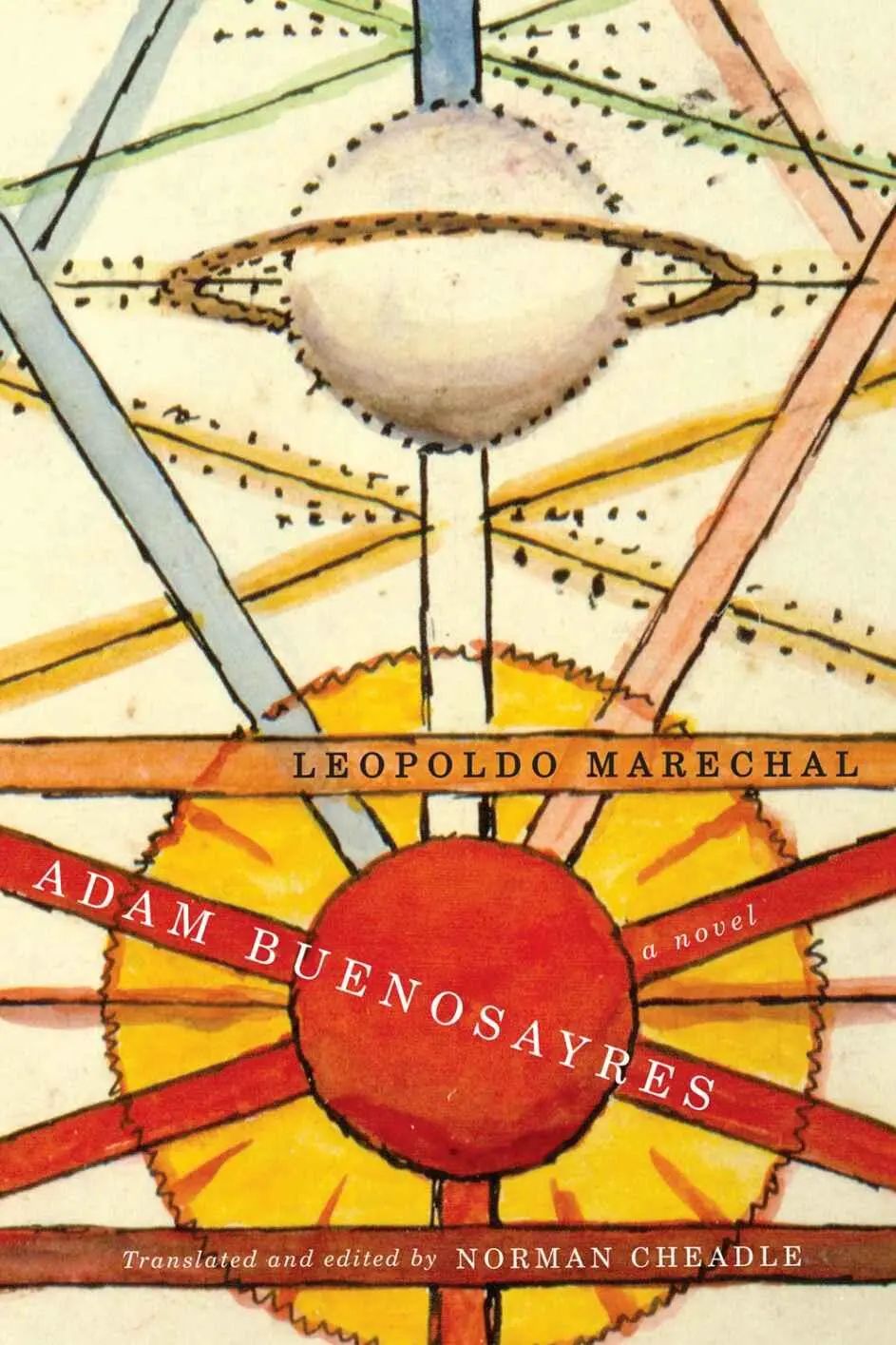
- Название:Adam Buenosayres
- Автор:
- Издательство:McGill-Queen's University Press
- Жанр:
- Год:2015
- ISBN:нет данных
- Рейтинг книги:5 / 5. Голосов: 1
-
Избранное:Добавить в избранное
- Отзывы:
-
Ваша оценка:
Adam Buenosayres: краткое содержание, описание и аннотация
Предлагаем к чтению аннотацию, описание, краткое содержание или предисловие (зависит от того, что написал сам автор книги «Adam Buenosayres»). Если вы не нашли необходимую информацию о книге — напишите в комментариях, мы постараемся отыскать её.
Adam Buenosayres — читать онлайн бесплатно полную книгу (весь текст) целиком
Ниже представлен текст книги, разбитый по страницам. Система сохранения места последней прочитанной страницы, позволяет с удобством читать онлайн бесплатно книгу «Adam Buenosayres», без необходимости каждый раз заново искать на чём Вы остановились. Поставьте закладку, и сможете в любой момент перейти на страницу, на которой закончили чтение.
Интервал:
Закладка:
— A theological race! Samuel proudly proclaimed.
— But terribly fallen, Adam objected.
The philosopher didn’t hear him. He was prevented by the rustic symphony of an early-morning cart with its squeaky wheels, the clop-clop of its little horse, its lamp mounted on the axle, its load of vegetables, its driver asleep at the reins.
— A just man! Samuel began to whimper, pointing at the sleeping man. Unbeknownst to himself, he fulfils the Pythagorean precept, arising before dawn…
— All right, all right, Adam interrupted him. More blubbering?
No, Samuel Tesler was not once more on the verge of tears. Something else was happening to him. Just as he’d recently gone from contrition to tears and from tears to metaphysical consolation, so too was his mutable heart slipping down the slope of a cloying tenderness. It had been prompted by the early-morning cart, which had put him in mind of Boaz, 3the sleeping man (back in the days when his race was bucolic!); by the sweetness of going home on the shores of the new day; and by the silent friend who walked with him, whose ineffable love story he alone knew and appreciated for its true worth. Hence, as both men walked along, Samuel tenderly squeezed the arm of Adam Buenosayres. Under cover of the silence enveloping them both, Samuel recalled the figure of a certain brat who was already good at putting on airs among the willowy women of Saavedra. And he said, in his soul, that only someone as naive as his friend Buenosayres could find in such a feeble creature the raw material of a Laura or a Beatrice. But his mental associations, moving until now in more or less calm neutrality, suddenly lurched toward displeasure and wrath when the image of Lucio Negri came to mind. He saw the quack doctor on the sky-blue divan, whispering into the ear of Solveig Amundsen, who listened to him with the air of an adolescent sphinx. A restrospective indignation pulled him up short:
— No! he blurted out and put a fraternal hand on Adam Buenosayres’s shoulder. If I were you, I’d put the boots to him.
— Who? asked Adam Buenosayres, completely in the dark, yet not at all surprised.
— He’s a damned beast! insisted Samuel. You should have seen him, strutting like a peacock in front of the brat.
— What brat? Adam asked again.
— Solveig.
“The sweet name profaned,” Adam said to himself. That was why gods and creatures concealed their true names: they jealously hid them from profanation and insult. And that’s why “the sweet name profaned” would never be read in his Blue-Bound Notebook.
— Fine, he grumbled. What’s it to me?
Samuel Tesler gave him a good shake:
— Brother! he cried. Love has to be defended!
Having said which, he drew himself up to his full stature, as though a helmet, a shield, and a lance were just being bestowed upon him so that he might defend love. Abruptly, without so much as a “here goes,” he danced away from his friend in a series of ornate hops. Flapping his arms in mimed flight, he shouted out the Latin conjugation:
— Amo, amas, amat, amamus, amatis, amant!
Hop by hop, he made it to the corner of Canning and Warnes. There, under a streetlight, the philosopher of Villa Crespo produced a wallet of uncertain shape, leather-type, and age, and stuffed with grimy bits of paper; out of the wallet he fished a dog-eared card and began to contemplate it with a great show of reverent devotion. He was still gazing at it when Adam Buenosayres caught up with him. With an effort, the philosopher pried himself out of his ecstatic delight and handed the card to his friend.
— That’s her! he murmured in a sigh that seemed to well up from the depths of his soul.
Adam glanced at the card: it was a snapshot of Haydée Amundsen. She was wearing the requisite bathing suit, showing off her natural endowments, and appeared determined — oh, yes! — to face the waves rolling in from a sea of adulation and already lapping at her feet. As he looked at the photo of Haydée Amundsen, Adam wondered what act of theft, guile, or imprudent generosity had deposited the photo in the philosopher’s wallet. When he turned again to Samuel, he saw him hugging a paradise tree and kissing it with great tenderness.
— Are you crazy? he asked.
— I love and am loved, explained Samuel devoutly.
And seeing the photo still in Adam’s hand, Samuel snatched it away, pressed it against his breast, and finally replaced it among the mysteries of his wallet.
— Have you spoken to her formally? Adam asked in a grave tone.
Samuel didn’t answer. He remained silent as the two of them crossed the intersection of the two arteries of Villa Crespo. Then they turned onto Warnes Street in the direction of Monte Egmont. Only then did the philosopher speak up; evidently, his soul had clouded over.
— Speak to her, sure, he grumbled. But what could I offer her? That’s the problem!
— Love doesn’t seek gain, said Adam sententiously. Or at least it shouldn’t.
— With her? Samuel laughed bitterly.
He took his friend by the arm.
— In the first place, began Samuel, you’ll admit that, physically, I’m no Adonis.
— No, indeed! Adam agreed fervently.
— I’m not a monster either! squawked Samuel, smarting at Adam’s enthusiastic corroboration.
— Who said you were?
— Fine. What I mean is, I don’t have the kind of movie-star good looks I’d need to conquer as frivolous a heart as Haydée Amundsen’s.
— Not exactly high praise for the girl, Adam pointed out to him.
— Hmm! Samuel said acridly. I wasn’t born yesterday; I know what the score is.
— On the other hand, Adam suggested, physical beauty isn’t everything.
— I was coming to that, said Samuel. Let’s admit that I’m somewhat intelligent.
— True.
— Very intelligent!
— Absolutely!
— What the heck! cried the philosopher. In this country of mulattos, a guy like me is a genius!
Far from contradicting him, Adam Buenosayres warned that such an obvious truth need not be broadcast at full volume in the street. And so the philosopher lowered his voice.
— Yes, yes, he said. So where was I?
— You were talking about your enormous intelligence.
— That’s right. But what good does it do me? Haydée Amundsen couldn’t care less about intellectual matters. As I have found out to my delight.
— What? laughed Adam.
— A splendid animal de luxe ! exclaimed Samuel, grinding his teeth. Then he added with venomous pleasure:
— Intellectual women, like that crazy Ethel, make me laugh my head off. An intellectual woman is against nature. Like a seal on a bicycle, or a gorilla demonstrating how to square the circle.
Adam laughed again, and the philosopher joined in with gusto.
— Am I right? he shouted. Do I reason well?
— Like a perfect piss-tank, Adam answered.
— I’m not pissed! protested Samuel. Right here and now I’ll do “the four” so you can see.
Stopping where he was, he balanced on one leg and prepared to cross it with the calf of his other leg to form the probatory numeral “4.” But Adam Buenosayres gave him neither time nor space to complete the manoeuvre and yanked him along.
— I believe you, he assured him. Let’s get back on topic.
— What conclusions did we come to? asked Samuel.
— I can see only one conclusion. Haydée Amundsen is impervious to both your physical charms and amazing intelligence. Dunque , all that’s left for you is the consolation of philosophy, like your buddy Boethius.
The philosopher gave a sinister little chuckle:
— There’s another possibility.
— What is it?
— The great temptation!
His voice grew harsh, as though filtered through a clenched jaw.
Читать дальшеИнтервал:
Закладка:
Похожие книги на «Adam Buenosayres»
Представляем Вашему вниманию похожие книги на «Adam Buenosayres» списком для выбора. Мы отобрали схожую по названию и смыслу литературу в надежде предоставить читателям больше вариантов отыскать новые, интересные, ещё непрочитанные произведения.










Обсуждение, отзывы о книге «Adam Buenosayres» и просто собственные мнения читателей. Оставьте ваши комментарии, напишите, что Вы думаете о произведении, его смысле или главных героях. Укажите что конкретно понравилось, а что нет, и почему Вы так считаете.