Leopoldo Marechal - Adam Buenosayres
Здесь есть возможность читать онлайн «Leopoldo Marechal - Adam Buenosayres» весь текст электронной книги совершенно бесплатно (целиком полную версию без сокращений). В некоторых случаях можно слушать аудио, скачать через торрент в формате fb2 и присутствует краткое содержание. Год выпуска: 2015, Издательство: McGill-Queen's University Press, Жанр: Классическая проза, на английском языке. Описание произведения, (предисловие) а так же отзывы посетителей доступны на портале библиотеки ЛибКат.
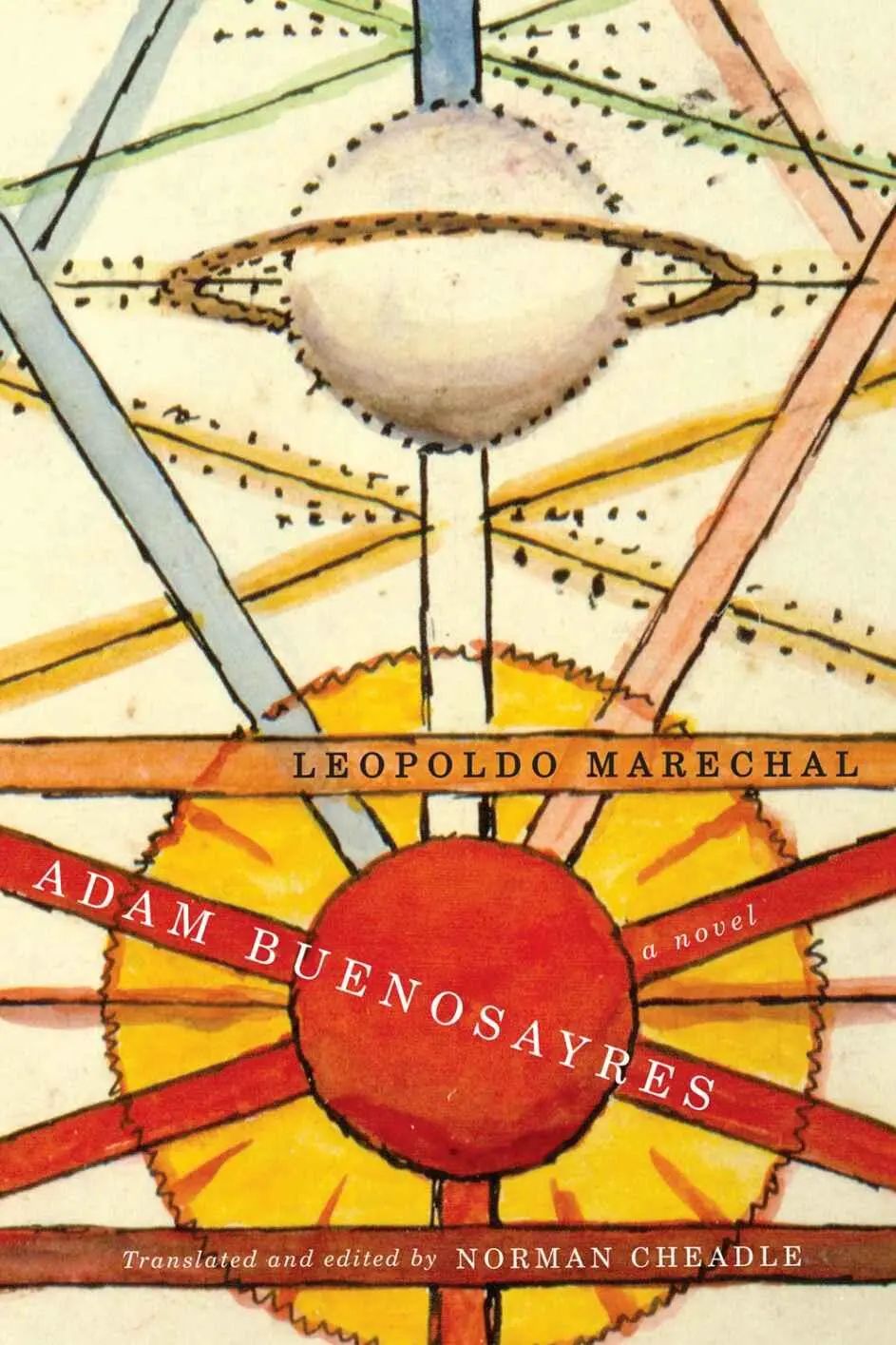
- Название:Adam Buenosayres
- Автор:
- Издательство:McGill-Queen's University Press
- Жанр:
- Год:2015
- ISBN:нет данных
- Рейтинг книги:5 / 5. Голосов: 1
-
Избранное:Добавить в избранное
- Отзывы:
-
Ваша оценка:
Adam Buenosayres: краткое содержание, описание и аннотация
Предлагаем к чтению аннотацию, описание, краткое содержание или предисловие (зависит от того, что написал сам автор книги «Adam Buenosayres»). Если вы не нашли необходимую информацию о книге — напишите в комментариях, мы постараемся отыскать её.
Adam Buenosayres — читать онлайн бесплатно полную книгу (весь текст) целиком
Ниже представлен текст книги, разбитый по страницам. Система сохранения места последней прочитанной страницы, позволяет с удобством читать онлайн бесплатно книгу «Adam Buenosayres», без необходимости каждый раз заново искать на чём Вы остановились. Поставьте закладку, и сможете в любой момент перейти на страницу, на которой закончили чтение.
Интервал:
Закладка:
— What condition? several voices asked him.
— That polygamy be re-established, Franky answered in a pious tone.
And he added euphorically:
— What the heck! The Republic needs a hundred million inhabitants, and we’ll provide them!
Franky’s motion was fervently endorsed by some, but provoked vague protests from others. Samuel Tesler leapt to his feet:
— Yes! he cried. Polygamy, like in the Old Testament!
Radiant, sublime, his mouth malignant and his eyes flashing, the philosopher of Villa Crespo initiated his final ballet. With one hand on his hip and the other fluttering in the air, he slowly pirouetted along the vestibule, at once grotesque and rhythmic, a dancing gargoyle.
— The phylogenetic dance! cried Franky, applauding furiously.
Doña Venus woke up with a start:
— No horse-play, she said. This is a decent establishment.
But Samuel Tesler had concluded the first figure of his dance and was launching into the second with a lively display of footwork that captivated the onlookers. So Doña Venus slid off her tripod like a ball of gelatine, stood up, and made for the philosopher:
— Shhh! she ordered him. That’s enough!
In vain! A furious maenad, a gargoyle gone crazy, Samuel began to dance circles around Doña Venus, enclosing her in an orbit of leaps, pirouettes, and contortions. Doña Venus, sphere of fat, began to rotate awkwardly on her own axis, trying to face the dancing demon who was circumscribing her ever more closely. Meanwhile, from her post on the cushion, Lulu kept up a steady stream of yapping as shrill as broken glass.
— Hoodlums! Doña Venus panted. Get out!
She lunged for the main door, jerked back the chain to open it, then turned to the assembled company who were already on their feet:
— Out! she shouted. Get out of here!
— It’s not such a big deal, Franky told her in a conciliatory tone.
He tried to stroke her round double chin. But Doña Venus deflected the hand that dared such impudence. And so Franky studied the woman in her entire volume. Finally deciding on the right spot, he smiled benevolently and gave her backside a resounding slap.
— Police! shrieked Doña Venus. Police!
She hiked up her skirt, exhibiting a repulsively fat thigh, then pulled from her stocking a metal whistle and started blowing on it for all she was worth. Little Lulu chimed in, croaking and wheezing as if in her death throes. And Jova, now out in the vestibule, added her cackle to the chorus as she asked in alarm: “What’s up? What’s going on?” It was time to make themselves scarce, and the men bolted down the hallway and out to the street. Schultz, Franky, Pereda, and Bernini took off to the right, toward Triunvirato Street. Adam ran after the philosopher of Villa Crespo, who had gone to the left and was running hell bent in headlong flight.
Chapter 3
He caught up with him only a hundred yards up the street, for the philosopher, after tearing full speed across the dangerously exposed intersection at Camargo Street, had finally stopped and was waiting in the deep shadows that the trees, under the glare of the lights, cast upon the sidewalk. Adam Buenosayres, in flight as well, found Samuel sitting on a doorstep, his gnomish legs ridiculously shrunken and his cyclopean thorax heaving and wheezing audibly.
— So? asked Samuel, as soon as he saw Adam arrive.
Adam Buenosayres, still panting, went to the curb, peered into the secret depths of the street, pricked up his ears, and listened for a long moment. Canning Street was still completely deserted; along its whole length, not the slightest sound disturbed the silence of the night.
— Nobody, he answered. Not a soul.
— What about the others? Samuel asked again.
— They disappeared.
At this unpleasant news, the philosopher began to declaim in a stentorian voice:
What’s become of my comrades
from the Cerrito and Ayacucho? 1
But Adam, shaking him by the shoulders, cut off his recitation of Bartolomé Mitre’s famous poem:
— Don’t raise a ruckus in the neighbourhood! he said. We’re going back to Monte Egmont Street.
— Hmm! Samuel grunted skeptically. I wonder what time it is.
— Four in the morning.
The philosopher tried to get up. After considerable tribulation, he at last got to his feet, took two or three uncertain steps, wobbled dangerously, and grabbed hold of an iron railing to keep from falling.
— What’s the matter now? Adam asked in incipient alarm.
Samuel chortled indulgently:
— The street’s spinning. It’s drunk, the poor thing!
— You’re drunk as a skunk, Adam upbraided him, not hiding his displeasure.
— Who? shot back Tesler, as though mortally offended. Me, drunk?
He wrenched himself free of Adam Buenosayres, who was trying to hold him up. Haughtily straightening up his torso, he said:
— Look at me now!
He began to walk rigidly, tripped again, ran into a tree and embraced its trunk, laughing like a lunatic. But then a terrible nausea shook him from head to foot, and the laughter froze on his lips.
— Listen up! he said. I’m going to launch a manifesto.
Adam ran to help and held his forehead covered in a cold sweat. Evidently, the philosopher’s wild dance in the vestibule, immediately followed by his mad dash, had agitated the spirits so liberally imbibed that night, which were now roiling chaotically inside him. Seeing how things stood, Adam mentally calculated how far he would have to drag that Silenus: two and a half blocks to Warnes Street; three long blocks from Warnes to Monte Egmont; and one more block to number 303. Not counting the stairway, which promised to be quite a challenge. Meanwhile, Samuel, for all his anguished heaves and sweats, couldn’t chuck it up.
— It’s no use, he admitted at last, straightening up and wiping his sticky forehead with a handkerchief. I’d need the ivory finger of the Romans.
Seeing that he was coming around, Adam took him by the waist, and together they set off at a stumbling sort of gait, a compendium, Adam reflected, of all the local movements described by Aristotle. Breathing with relish the night air whose freshness hinted at the coming dawn, the philosopher was obviously recovering the natural harmony of his physical constitution.
His soul, on the other hand, was growing perturbed and showing signs of a stormy contrition. Sighing deeply and heavily, Samuel Tesler cursed the hour when his own weakness and the influence of disastrous friendships had led him to such extreme craziness. In a single glance, he took in his present indignity and, putting his head on Adam Buenosayres’s shoulder, he wept a long while for his misspent youth. He turned finally to the silent friend standing by him in his grief and, breathing an effluvium of alchohol and stomach acids into his face, treated him to an incoherent monologue that ended in a somewhat laboured justification of his sin. After all, if one considered the matter dispassionately and from a philosophical point of view (and his friend Buenosayres, to whose indisputable equanimity he was appealing, was an expert judge in such intellectual niceties), what did his nocturnal drunkenness and his final sarabande mean? What else, he asked, if not a Dionysian move of liberation, demanded of him by his oppressed soul? Moreover, his race was very familiar with those exalted states of liberty, for the theme of bondage and escape resonated all too strongly in their history.
— And, he asked between two burps, isn’t my race a symbol of both terrestrial incarceration and ultimate liberation in life eternal?
In front of Baalzephon, at dawn’s early hour, the hard-hearted King, he of the vulture’s head, wept and grieved beside the Red Sea. By the sea that vomited up his bright and colourful cavalry, by the blood-coloured sea, wept the King. All those bronze chariots, all those upright horsemen, all those good horses with flashing skin and fiery nostrils! As one launches a stone from a catapult, he had thrown them after the fleeing slaves, like a rabid dart had he thrown them. That is why the King in his purple finery was weeping, the King of avian profile: for he saw the slave traversing the watery abode, and the slave went hand in hand with his God, and it was the terrible God who rolls up and unrolls the sea like a papyrus scroll. And the King had watched as horse and horseman, arms and chariot wheels, all foundered. That is why the King wept, in front of Baalzephon, hard by the blood-coloured sea. And on the other shore the slaves cried out their freedom: I shall sing unto the Lord — said the slaves by the beard of their prophet — I shall sing unto the Lord, for he hath triumphed gloriously; the horse and his rider hath he thrown into the sea . And the prophet sang: The Lord shall reign for ever and ever . 2And the slaves repeated it in jubilation. But the prophet turned his eyes to the desert, and in that terrible solitude he sought for the way to the land of milk and honey.
Читать дальшеИнтервал:
Закладка:
Похожие книги на «Adam Buenosayres»
Представляем Вашему вниманию похожие книги на «Adam Buenosayres» списком для выбора. Мы отобрали схожую по названию и смыслу литературу в надежде предоставить читателям больше вариантов отыскать новые, интересные, ещё непрочитанные произведения.










Обсуждение, отзывы о книге «Adam Buenosayres» и просто собственные мнения читателей. Оставьте ваши комментарии, напишите, что Вы думаете о произведении, его смысле или главных героях. Укажите что конкретно понравилось, а что нет, и почему Вы так считаете.