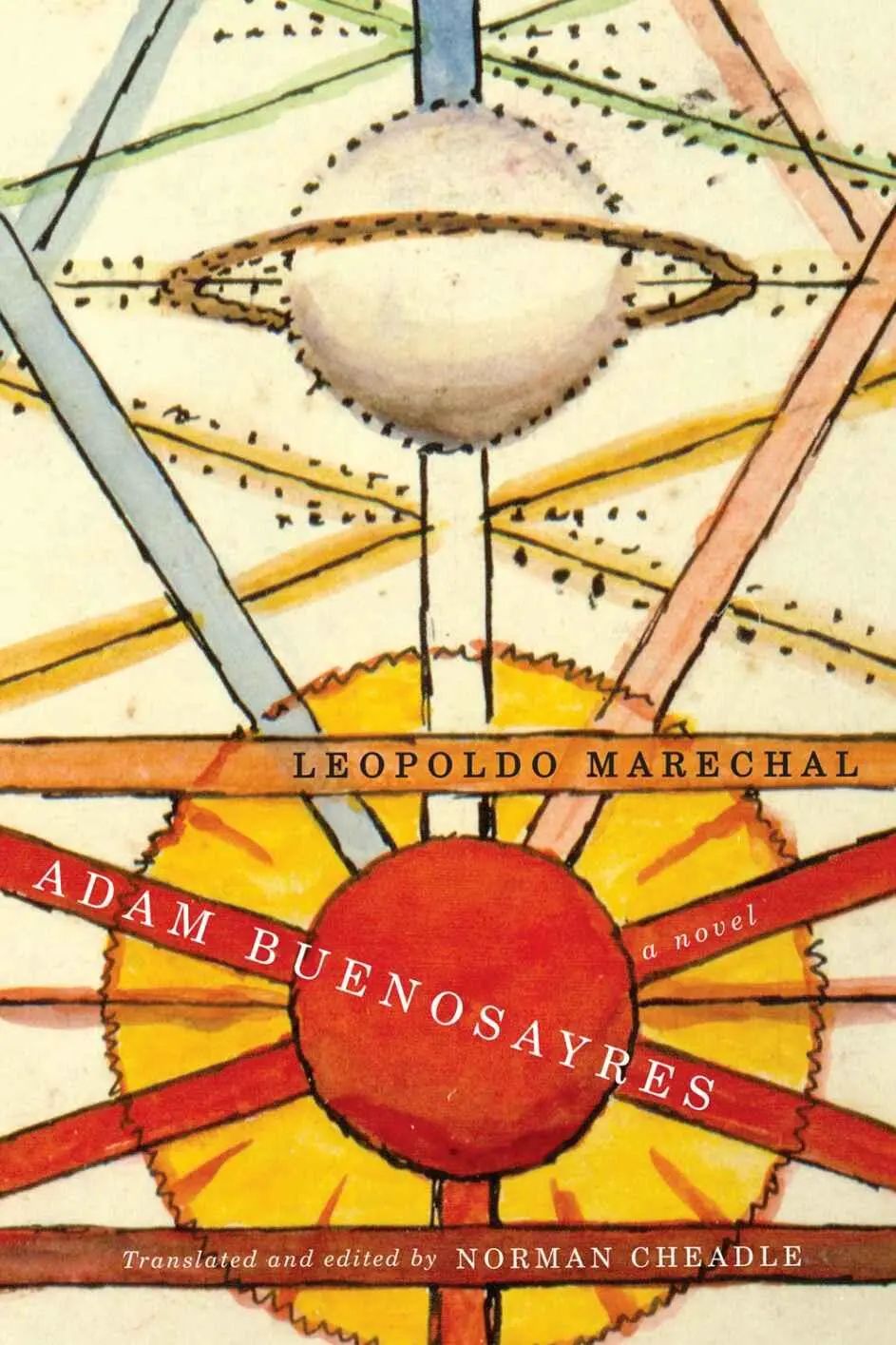
Leopoldo Marechal - Adam Buenosayres
Здесь есть возможность читать онлайн «Leopoldo Marechal - Adam Buenosayres» весь текст электронной книги совершенно бесплатно (целиком полную версию без сокращений). В некоторых случаях можно слушать аудио, скачать через торрент в формате fb2 и присутствует краткое содержание. Год выпуска: 2015, Издательство: McGill-Queen's University Press, Жанр: Классическая проза, на английском языке. Описание произведения, (предисловие) а так же отзывы посетителей доступны на портале библиотеки ЛибКат.
- Название:Adam Buenosayres
- Автор:
- Издательство:McGill-Queen's University Press
- Жанр:
- Год:2015
- ISBN:нет данных
- Рейтинг книги:5 / 5. Голосов: 1
-
Избранное:Добавить в избранное
- Отзывы:
-
Ваша оценка:
Adam Buenosayres: краткое содержание, описание и аннотация
Предлагаем к чтению аннотацию, описание, краткое содержание или предисловие (зависит от того, что написал сам автор книги «Adam Buenosayres»). Если вы не нашли необходимую информацию о книге — напишите в комментариях, мы постараемся отыскать её.
Adam Buenosayres — читать онлайн бесплатно полную книгу (весь текст) целиком
Ниже представлен текст книги, разбитый по страницам. Система сохранения места последней прочитанной страницы, позволяет с удобством читать онлайн бесплатно книгу «Adam Buenosayres», без необходимости каждый раз заново искать на чём Вы остановились. Поставьте закладку, и сможете в любой момент перейти на страницу, на которой закончили чтение.
Интервал:
Закладка:
In my poor old shack
vidalitá
there is no peace
ever since he’s been gone
vidalitá
the master of my soul. 14
Del Solar, in thrall to nostalgia for the north country, answered with this one:
Oh, to be a dog,
my little dove,
so as not to be able to feel,
Farewell, sweet life!
Dogs don’t take any offence,
my little dove,
they just sleep it all away,
Farewell, sweet life! 15
Franky Amundsen chimed in with this sentimental ditty:
An old woman was taking a leak
(so long, I’m on my way)
underneath a wagon
(who will be her love!)
and the oxen took off running
(so long, I’m on my way)
thinking it was a rainstorm
(who will be her love!). 16
But the contest would not have been complete without the voice of Luis Pereda. With fine grace, giving it his all, he threw to the winds the following verses:
From up yonder I have come /
(not a word of a lie)
stepping on the flowers
(let’s go, sweetie, under the walnut tree):
Since I’m a sensitve lad
(not a word of a lie)
I’m all worn out from love
(let’s go, sweetie, under the walnut tree). 17
Unfortunately, not all the adventurers of Saavedra had surrendered to such wholesome lyricism. Among the seven there was one who shut his ears to the Muses’ call, his attention taken up by base speculations of a scientific nature. I refer to the illustrious and never-sufficiently-praised pipsqueak Bernini. This man (if such we may call five-foot-nothing of indisputably human stature) had corrected the stingy hand Nature had dealt him in terms of physique by diligent devotion since childhood to the most curious of sciences. The two heterogeneous races responsible for his gestation fought within him, so he said, the most ferocious battle. While his Anglo-Saxon side tended toward a severe pragmatism manifesting in ghastly orgies of rationalism, his Latin side, thanks to a subliminal process invariably involving liquid spirits, impelled him to frequent fits of Dionysian frenzy that amounted to so many slaps across the left cheek of the goddess Reason. With one and the same bow, the young hero played medicine, history, geography, numismatics, sociology, aesthetics, and metaphysics. Word has it that when he read the Critique of Pure Reason , he had made Kant sweat bullets by scribbling marginal notes such as “You’re talking through your hat, old man” and “Gotcha there, Mannie old boy,” among other equally trenchant objections. However, those who admired the pipsqueak’s erudition had recently been lamenting his weakness for an unholy genre of statistics whose smuttiness was incompatible with scientific decorum. As I was saying, then, Bernini, oblivious of the others’ chatter, was mentally turning over some original conceit. And it was surely no mere trifle, for the mental exertion had Bernini breathing heavily, his arms jerking forward then dropping again, heels digging into the ground — signs of agitation soon noticed by his companions.
— Hey, what’s got into you? Del Solar finally asked him. Have you gone crazy?
The pipsqueak mumbled a few choice words in the night and concluded:
— That’s my business. Just thinking.
— Thinking, were you? said Franky. Assuming such a phenomenon is possible, what were you thinking?
— I won’t talk! growled Bernini resentfully. A while ago I wasn’t allowed to; I had to shut up, just when everybody else was running off at the mouth.
— None of that, Pereda joined in. Let him speak. Here everybody has a voice and a vote.
Franky’s laughter rattled in the darkness.
— That’s just what he wants! he exclaimed. I know that sly pipsqueak as if he were my own child.
— Fine, then, said Bernini, giving in to his buddies’ concern. I was thinking about how we’re walking across an ancient seabed.
— Hey, hey! shouted Franky. Watch out for the pipsqueak!
— The ground of the pampa, Bernini insisted, is a marine formation. The entire pampa is the vast floor of an ocean that at one time lapped up against the Andes, until it withdrew. 18
Two or three indignant voices exploded in the blackness:
— Have an eye for the pipsqueak!
— That hasn’t been proven!
— The pipsqueak’s spouting nonsense!
— And it’s not merely the scientific aspect of the theory that interests me, Bernini concluded. It’s something else.
— What else? Schultz wanted to know.
— The voice of the sea will be present when the Spirit of the Earth makes itself heard.
Hostile shouts and Homeric laughter greeted Bernini’s latest sally.
— He’s coughed it up! Franky exclaimed in astonishment.
— What has our famous pipsqueak coughed up? Del Solar inquired.
— The Spirit of the Earth. He had it in his craw!
Whatever their purpose when they set out on their journey, the explorers should never have uttered, in that dark place and at such an hour, words with the magical power to spring open the invisible portals of mystery. Until that moment, despite numerous irreverent slips of the tongue, the expeditionaries had faced nothing out of the ordinary. But the extraordinary figure that suddenly appeared before them now was not of this world. Monstrous offspring of the night, it looked like the ghost of a giant peludo , an enormous armadillo radiating a vivid phosphorescent light. The excursionists might well have succumbed to incurable awe, if not for the pipsqueak Bernini who, thanks to his Anglo-Saxon side, identified the beast as the famous Glyptodon, a dinosaur indigenous to our prehistoric pampas.
The creature was paleontologically old. Its cracked carapace was encrusted with the salt of a thousand centuries that formed a second shell as tough as the original. Protruding from the carapace, four gigantic legs ended in dirty, bitten toenails. The Glyptodon’s ridiculously small head was held aloft with much dignity. But what most amazed the aventurers was the monster’s scar-filled face: a toothless mouth, nostrils scabby with antediluvian snot, and two little eyes peering out through fossilized rheum with a faraway look, as though adrift in memories of barbarous geological sorrows.
Asked by the astrologer Schultz whether it was mortal, immortal, or an intermediary being, the Glyptodon promptly self-identified as the selfsame Spirit of the Earth just summoned by the High Priest Bernini. Schultz inquired after the purpose of its advent. The Glyptodon replied that his sole object was to correct the error committed just now by the High Priest, whose theories about the pampa’s loess betrayed a macaronic erudition picked up from dime-store manuals. Vacillating between indignation and respect, the High Priest Bernini asked how he had erred. By inventing a marine origin for the pampa’s topsoil deposits, came the Glyptodon’s response.
— And what proof is there to the contrary? challenged Bernini.
— The absence of horizontal strata left by any transgression or regression of the sea.
— What about the fossil remains? insisted a stung Bernini.
— And the schistic-crystalline sediment? shot back the Glyptodon, unyielding.
Defeated and humiliated, the High Priest Bernini withdrew from the fray. Then Schultz beseeched the monster, by the god Erebos and the night, by the soul of Darwin and the shade of Ameghino, 19to reveal to us sad wanderers the authentic origin of the pampa’s loess. The Glypdoton muttered he’d have been spared the bother if his High Priest Bernini had read the work of Roveretto, Bayer, Richthofen and Obermayer, 20instead of wasting his time skulking around the shabby secondhand bookstores on Corrientes. 21After a professorial pause, the Glypdoton declared the Aeolian origin of that loess:
Читать дальшеИнтервал:
Закладка:
Похожие книги на «Adam Buenosayres»
Представляем Вашему вниманию похожие книги на «Adam Buenosayres» списком для выбора. Мы отобрали схожую по названию и смыслу литературу в надежде предоставить читателям больше вариантов отыскать новые, интересные, ещё непрочитанные произведения.











Обсуждение, отзывы о книге «Adam Buenosayres» и просто собственные мнения читателей. Оставьте ваши комментарии, напишите, что Вы думаете о произведении, его смысле или главных героях. Укажите что конкретно понравилось, а что нет, и почему Вы так считаете.