Leopoldo Marechal - Adam Buenosayres
Здесь есть возможность читать онлайн «Leopoldo Marechal - Adam Buenosayres» весь текст электронной книги совершенно бесплатно (целиком полную версию без сокращений). В некоторых случаях можно слушать аудио, скачать через торрент в формате fb2 и присутствует краткое содержание. Год выпуска: 2015, Издательство: McGill-Queen's University Press, Жанр: Классическая проза, на английском языке. Описание произведения, (предисловие) а так же отзывы посетителей доступны на портале библиотеки ЛибКат.
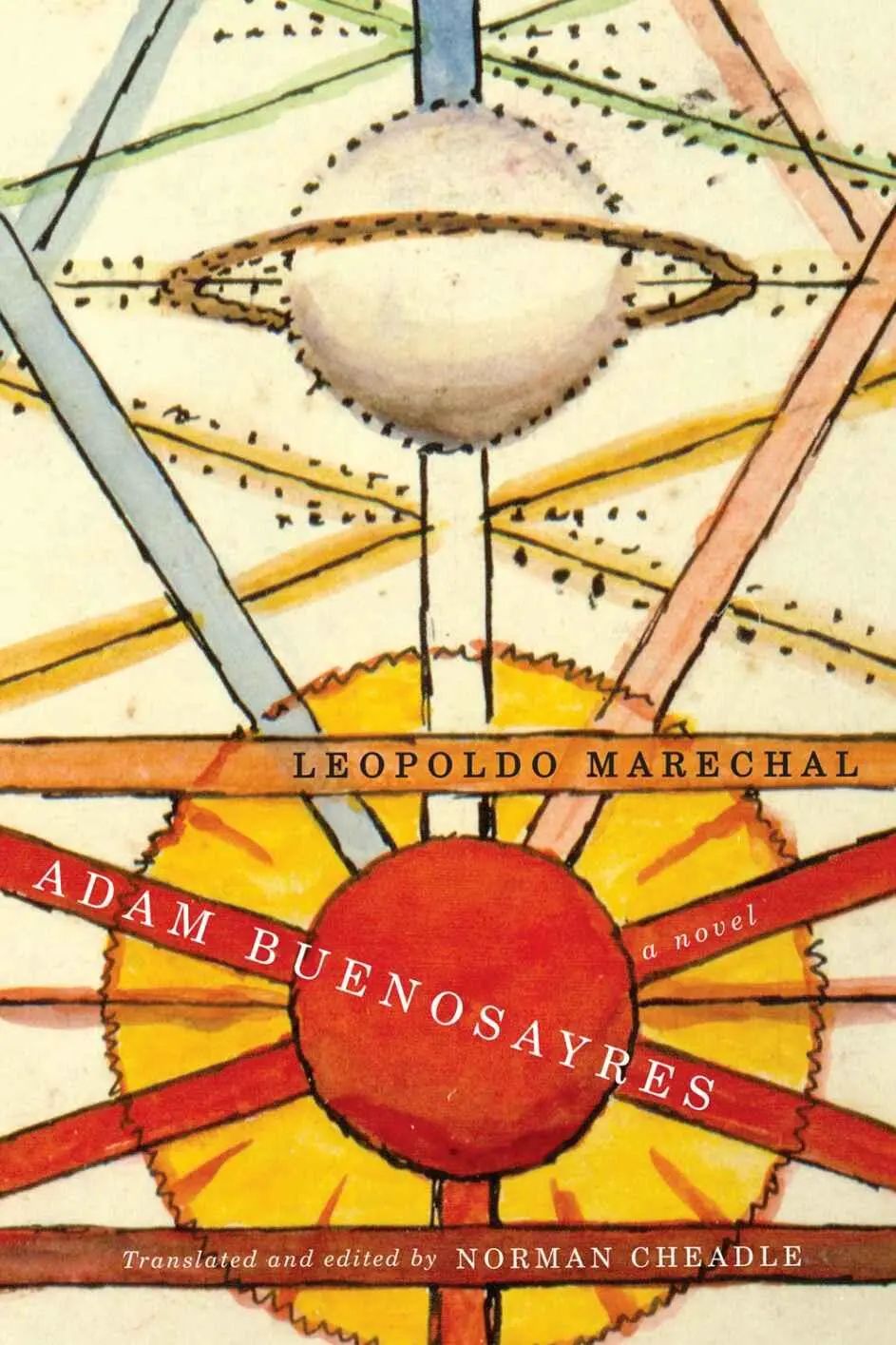
- Название:Adam Buenosayres
- Автор:
- Издательство:McGill-Queen's University Press
- Жанр:
- Год:2015
- ISBN:нет данных
- Рейтинг книги:5 / 5. Голосов: 1
-
Избранное:Добавить в избранное
- Отзывы:
-
Ваша оценка:
Adam Buenosayres: краткое содержание, описание и аннотация
Предлагаем к чтению аннотацию, описание, краткое содержание или предисловие (зависит от того, что написал сам автор книги «Adam Buenosayres»). Если вы не нашли необходимую информацию о книге — напишите в комментариях, мы постараемся отыскать её.
Adam Buenosayres — читать онлайн бесплатно полную книгу (весь текст) целиком
Ниже представлен текст книги, разбитый по страницам. Система сохранения места последней прочитанной страницы, позволяет с удобством читать онлайн бесплатно книгу «Adam Buenosayres», без необходимости каждый раз заново искать на чём Вы остановились. Поставьте закладку, и сможете в любой момент перейти на страницу, на которой закончили чтение.
Интервал:
Закладка:
— The origins of our Native Americans! he snorted resentfully. We’d do better to think about their final destiny, or dedicate a moment of respectful reflection to their memory.
— What bee have you got in your bonnet now? asked Franky Amundsen, the raspberry artist.
— Weren’t they the natural masters of the pampa? Bernini mourned. What right did the white man have to invade their land and exterminate them like savage beasts?
Franky hugged the pipsqueak and stamped his forehead with a reverential kiss.
— A heart of gold! he explained. The most exquisitely sensitive dwarf of them all!
— A bleeding heart, Schultz corrected. If he knew anything about history or metahistory, he wouldn’t lament that violent clash between two races — the one’s time had come, and the other had a mission.
— That’s pure militarism! cried Bernini.
— A Teutonic brute! said Franky. All these Krauts have heads shaped like mortar shells.
But the astrologer was not backing down.
— The world is renewed through the spear of Mars, he announced. It’s the spear that destroys in order to rebuild.
— No! No! protested voices in the dark.
— Yes! Yes! agreed others.
And then it happened that Bernini finally took leave of his Anglo-Saxon side and gave free rein to his Latin side: he began to weep inconsolably.
— Poor Indians! he sobbed. Exterminated down to the last one, right here on the very ground we’re standing on.
A vigorous drumroll, as of a hundred horses pounding toward them; a hundred throats howling in the night; a hundred unanimous cries of Winca! Killing! Winca! All this mixed together suddenly assaulted the alert ears of the heroes, and they turned on their heels, ready for flight. But they stayed right where they were, for the same din was coming at them from all directions, as if they were encircled by a threatening chorus: Winca! Killing! Winca! 29Still recovering from their initial surprise, they saw a figure on horseback come galloping full tilt toward them out of the night. Rider and mount both gave off a greenish, ghostly, otherworldly light. But it was the horseman, naked as Hercules, who really looked menacing; he was twisting and turning atop his mount like a gesticulating demon. Within five paces from the adventurers, he pulled up savagely on the reins, his horse digging all four hooves into the soil. Then, brandishing above the seven enemy heads a spear adorned with flamingo feathers, he howled: Bicú, picué, tubú, picá, linquén, tucá, bicooooo? Not one of the seven responded, so the Indian shouted again, perhaps translating his first question: “Cursèd wincas , by whose permission passing here?” And then he threatened: “ Winca passing here, winca paying.” Then one of the heroes, obeying a sudden flash of insight, took the flat, shiny flask out of his pocket and showed it to the savage: “ Winca tricking!” roared the rider, not bothering to hide his suspicion. “What being inside shiny gualicho ?” 30Without a word, the anonymous hero uncorked the flask and passed its neck beneath the Indian’s nose. The latter was transfigured, almost ecstatic: “ Peñí , brother!” he exclaimed. In view of his manifestly ardent desire to establish contact with the magic bottle, the astrologer Schultz asked him to tell his name first. The savage proudly introduced himself: “Me, Chief Paleocurá.” 31Ignoring the group’s astonishment, Chief Paleocurá hopped down from his mount, went to the hero with the bottle, took him in a bear hug and lifted him into the air, shouting for all he was worth: “ Aaaaaah! ” A hundred invisible phantasms, tapping their mouths with their hands, howled in chorus: “ Ah, wah, wah, wah, wah, wah! ” The same ceremony was repeated with the rest of the expeditionaries. The greetings finally over, Paleocurá said with rustic diplomacy: “Giving shiny gualicho , then passing.” The bottle was surrendered by acclamation. Quickly, the chief raised it to his lips, then leaned back to stare at the stars for a good five minutes. “ Yapay! ” he shouted at last, handing the bottle back to its legitimate owner. “ Yapay! ” the latter responded, and took a swig every bit as astronomical. The Native chief exchanged the same toast with each and every one of the explorers. Then he returned the empty bottle, leapt onto his horse in a single bound, saluted with his spear, and trotted off. Presently, the drumbeat of a hundred invisible horses was swallowed by the night.
Del Solar found Bernini’s lament for the extinction of the Natives unjustifiable and anachronistic. After all, that race had more to do with the pre-history than with the history of Argentina. But before that aboriginal race died out — and this is the main thing — its withered vine produced a painful new shoot. In a heroic perpetuation of its blood, it bequeathed the nation a crucial type, a magnificent warrior. At these observations, a single image leapt to the minds of the adventurers, and a single word to their lips: The Gaucho!
— The gaucho, Del Solar assented mournfully. Whether he be the child of love or hate (who knows!), we see him labouring on the foundations of the nation, in the dark, yes, but with the worthy darkness of foundations supporting the exterior grace of the architectural whole.
— Good image, acknowledged Adam Buenosayres as an expert. 32
— Too literary, Bernini objected.
— Obviously plagiarized, Franky Amundsen remarked slanderously.
For all that, the majority of the heroes adopted a respectful attitude and yielded unreservedly to the emotion of that memory. But the group harboured two men whose hearts, hardened perhaps by the glacial pole of metaphysics, showed no signs of melting: they were Samuel Tesler and the astrologer Schultz.
— Pestilential literature! grumbled Samuel. They’ve invented an incredible fable around a pathetic half-breed. The gaucho glorified by legend never existed.
— Never existed? shouted Pereda, righteously indignant. Why, from the travellers of colonial times up to the nineteenth-century chroniclers…
— There’s no need to go back that far, Adam interrupted. I’ve seen the gaucho, back in Maipú. The gaucho of legend, with his chiripá , his calfskin boots, and his great big soul: my friend Liberato Farías, the horsebreaker! 33
But at this point Schultz intervened decisively:
— I’ll admit the gaucho existed, he declared. But if he was anything like the way he’s described in poetry, rebelling against all law and order, a thuggish drifter with no respect for hierarchy, then I think it’s a good thing he disappeared. 34
Lord, what a fuss the criollista faction made upon hearing such outrageous blasphemy!
— If the gauchos have died out, Del Solar yelled at him, it’s because gringo immigrants like you killed them off!
— The defeat of Santos Vega, intoned Adam mysteriously.
A distant strumming of guitars came to the ears of the explorers; a tremor of tearful strings seemed to come wafting on the wind from some distant horizon, snaking through the air like a musical shiver. And suddenly a great hush fell, as though the entire plain were breathlessly listening through a thousand invisible ears. The strains of the mysterious vihuela quickly grew stronger, or nearer, like a song mounted on a galloping horse. Soon a human voice could be heard, interwoven with the thrumming strings. It was a ghostly voice singing dark, unintelligible words that nevertheless pierced the heroes’ souls like the daggers of melancholy; sweet words as of long-ago mornings; lachrymose words to be shed on the tomb of a long-lost love; battle cries like lances erect beneath the noonday sun, or like repressed sobs erupting from the sound chamber of a body or guitar; and a rustic idyll now lost in the South; and the sadness seeping like bitter juice from the plump fruit of southern skies. All this was expressed by the nocturnal canto; and in sympathy the domed ether hummed, the stars drew nearer, the wild grass trembled, and the orb grew silent. At one moment, the song exploded like a tempest overhead; the travellers looked up in dread and saw high in the Eastern sky the figure of a rider on his mount, shimmering as if forged from burnished metal. His arms cradled a vihuela, which though mute seemed the source or centre of the marvellous song. A unanimous cry of recognition flew forth from seven throats:
Читать дальшеИнтервал:
Закладка:
Похожие книги на «Adam Buenosayres»
Представляем Вашему вниманию похожие книги на «Adam Buenosayres» списком для выбора. Мы отобрали схожую по названию и смыслу литературу в надежде предоставить читателям больше вариантов отыскать новые, интересные, ещё непрочитанные произведения.





Обсуждение, отзывы о книге «Adam Buenosayres» и просто собственные мнения читателей. Оставьте ваши комментарии, напишите, что Вы думаете о произведении, его смысле или главных героях. Укажите что конкретно понравилось, а что нет, и почему Вы так считаете.