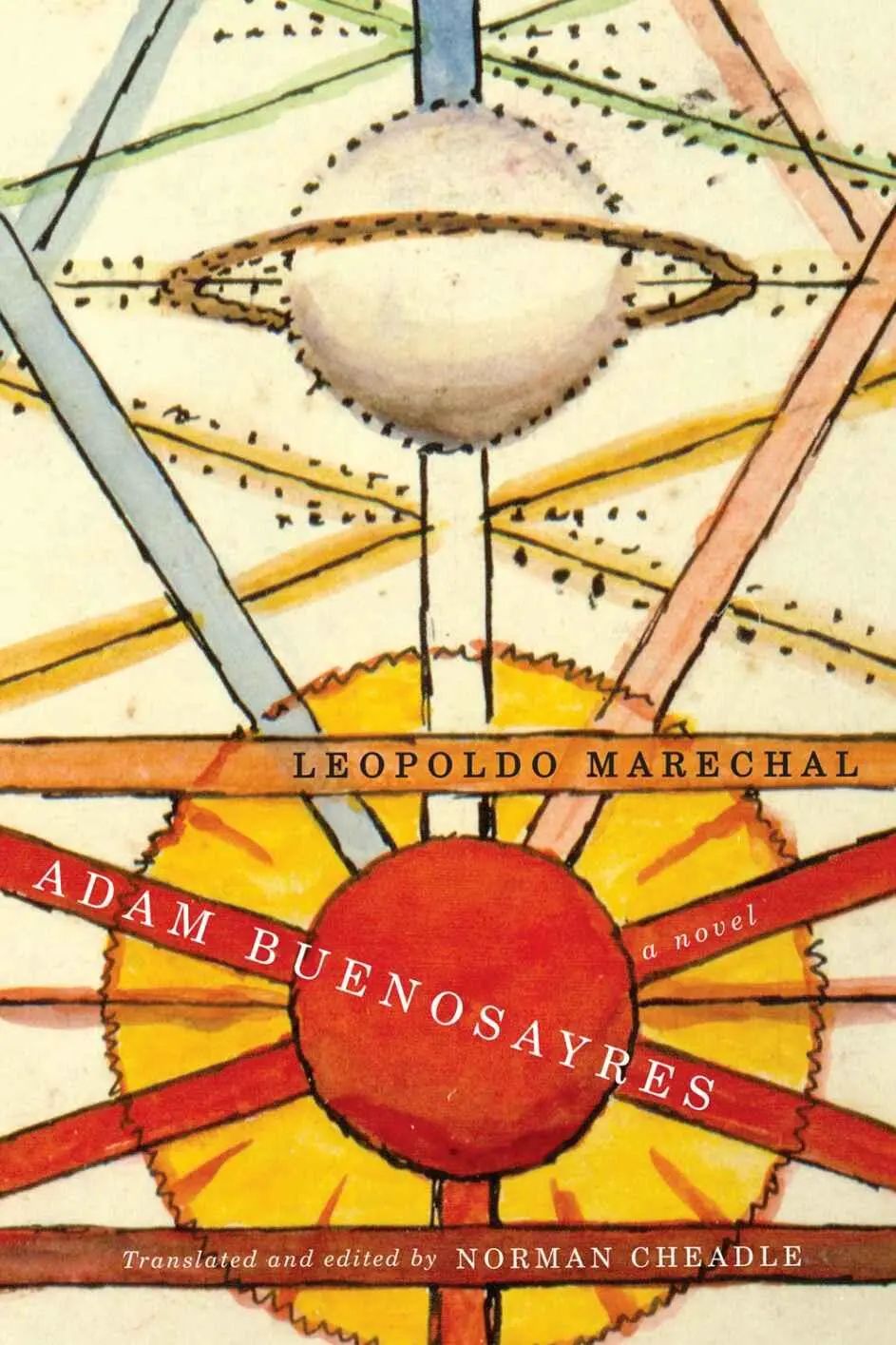
Leopoldo Marechal - Adam Buenosayres
Здесь есть возможность читать онлайн «Leopoldo Marechal - Adam Buenosayres» весь текст электронной книги совершенно бесплатно (целиком полную версию без сокращений). В некоторых случаях можно слушать аудио, скачать через торрент в формате fb2 и присутствует краткое содержание. Год выпуска: 2015, Издательство: McGill-Queen's University Press, Жанр: Классическая проза, на английском языке. Описание произведения, (предисловие) а так же отзывы посетителей доступны на портале библиотеки ЛибКат.
- Название:Adam Buenosayres
- Автор:
- Издательство:McGill-Queen's University Press
- Жанр:
- Год:2015
- ISBN:нет данных
- Рейтинг книги:5 / 5. Голосов: 1
-
Избранное:Добавить в избранное
- Отзывы:
-
Ваша оценка:
Adam Buenosayres: краткое содержание, описание и аннотация
Предлагаем к чтению аннотацию, описание, краткое содержание или предисловие (зависит от того, что написал сам автор книги «Adam Buenosayres»). Если вы не нашли необходимую информацию о книге — напишите в комментариях, мы постараемся отыскать её.
Adam Buenosayres — читать онлайн бесплатно полную книгу (весь текст) целиком
Ниже представлен текст книги, разбитый по страницам. Система сохранения места последней прочитанной страницы, позволяет с удобством читать онлайн бесплатно книгу «Adam Buenosayres», без необходимости каждый раз заново искать на чём Вы остановились. Поставьте закладку, и сможете в любой момент перейти на страницу, на которой закончили чтение.
Интервал:
Закладка:
— Santos Vega, the payador !
Thus invoked, the phantasmal horseman stopped and turned to the men of Saavedra, who waited expectantly. But the ghost’s face, momentarily brightening, clouded over once more. His noble head turned in the night, tracing a long, slow movement of negation. Then, spurring his mount, the apparition galloped away to the west. 35When the adventurers were about to take off after him in pursuit, a spiteful laugh rang out behind their backs.
– ’Tain’t no use, gentlemen! came a voice. That good ol’ boy won’t be singin’ no more here on earth!
Turning around, the men saw a phosphorescent character, ridiculously decked out gaucho-style, standing there in an insolent sort of attitude, his craggy and malignant face inspiring an apprehension impossible to gainsay. He was sporting a wildly embroidered chiripá , a thick leather belt studded with more gold coins than a Basque milkman’s moneybox, a silk shirt, and a great knife that seemed to skewer him like a roasting spit.
— And why won’t Santos Vega sing? Del Solar asked him, moved to the marrow of his bones.
— Go on with ya! responded the figure. I licked him fair and square, guitar against guitar.
A lightbulb suddenly lit up in the heads of the expeditionaries.
— Juan Sin Ropa!
Looking back and forth between the group and the troubador fading into the distance, the figure laughed again:
— At yer service, pardners, he assented in his odious, sarcastic drawl.
But Adam Buenosayres, full of wrath, shouted right in his face.
— You lie, varmint!
And turning to the group, he thundered:
— This man is no good old boy! He’s the devil incarnate! 36
Would that he had never said it! When he heard that name, the figure commenced contorting and sizzling like a denizen of hell, and a terrible stench of sulphur and gunpowder filled the air. As the startled heroes backed away, they noticed other sinister clues confirming the identity of the spectral gaucho: his eyes flashed like two electrical storms at night; his broad-brimmed hat sported an ominous cock’s feather; worse still, his blunt-toed calfskin boots formed two cloven hooves. It was enough to justify any amount of alarm.
— Cross, Devil! Cross, Devil! Franky began to exorcize, tracing rapid crosses in the air.
Juan Sin Ropa let out a vaudeville guffaw.
— Now don’t get sceer’t on me, fellers! he said. I didn’t come to buy yer souls. Y’already sold ’em!
But the astrologer Schultz was not about to have the wool pulled over his eyes. The demon there before them, he said with almost aggressive disdain, was no imperial Lucifer; nor was he Prince Beelzebub, nor the Grand Duke Astarot, nor Prime Minister Lucifuge, nor General Satanachia, nor Lieutenant Fleurety, nor Brigadier Sargantanás, nor Field Marshal Nebiros. No, he was but a lowly tipstaff called Anthrax, a kitchen boy, a poor devil without a pot to piss in — the wretch! So where did he get off with his talk of buying souls? When Juan Sin Ropa muttered something between his teeth, Schultz told him he was to answer any questions put to him, and threatened to stuff him into a bottle of Scotch whisky if he refused. Seeing him nice and tame now, Del Solar got up the courage to ask a question:
— What really happened in your payada with Vega? How did you beat him?
— He was an innocent, still wet behind the ears! replied Juan Sin Ropa. Easiest job the Boss ever giv’ me. Well, we duked it out, verse for verse, and Vega wasn’t half bad. But, hey, us devils’ve got the edge when it comes to pickin’ guitar — tougher fingernails, eh.
— So what did the Boss stand to gain by defeating a poor gaucho? Adam Buenosayres wanted to know.
— Don’t kid yerselves, that there gaucho was a bit of tricky business, Juan Sin Ropa assured them. What with his lack of ambition, his down-to-earth simplicity, and his guitar and lil’ ol’ horse, we were runnin’ the risk of a new age of innocence bein’ established in these here parts, just when the Boss was on the eve of universal victory and the nations of the world was gettin’ down on all fours to kiss his royal upite . (Here, Juan Sin Ropa gave himself a pat on the behind.)
From the shadows came a snicker of incredulity, and the pipsqueak Bernini spoke up.
— Baloney! he laughed. Everybody knows the legend means something else. In reality, Santos Vega is barbarism and Juan Sin Ropa is progress; it’s about progress defeating barbarism. 37
— Good old pipsqueak! celebrated Franky Amundsen in treacherous adulation.
— Am I right? Bernini asked him.
— As usual!
— Was that a pipspeak just spoke? inquired Juan Sin Ropa, incredulous. If he was a few inches taller, I’d teach him the word “Progress” is the name I use when I’m travellin’ incognito.
At this point Del Solar, the folklore expert, intervened to set the record straight on the gaucho myth under discussion. In his view, it should be understood quite literally.
— Juan Sin Ropa, he declared, is the naked gringo who defeated Santos Vega in a fight our countryman didn’t understand: the struggle for life.
No sooner had he said this than Juan Sin Ropa began the first of his mutations. The flamboyant gaucho dissolved, and there appeared in his stead a big, burly, red-headed fellow wearing a checked shirt and trousers, and yellow boots. Completing his get-up were a gaudy knife and a riding whip, its grip almost entirely adorned with silver. The adventurers felt a wave of sympathy as they immediately recognized the smiling image of the Cocoliche . 38
— Sono venuto a l’Argentina per fare l’America , he declared. E sono in America per fare l’Argentina . 39
— Aha! cried Del Solar. Just as I thought! Aren’t you the gringo tavern owner who robbed the local folks of their land with your sharp practice and mortgages?
Cocoliche stretched out his arms to display his big, calloused hands.
— Io laboro la terra , he said. Per me se mangia il pane . 40
Hostile laughter mixed with words of encouragement celebrated the Cocoliche’s comeback.
— The gringo is right on that score, Pereda admitted.
— He’s a tavern owner! insisted Del Solar. All he cared about was getting rich!
And now the Cocoliche in turn metamorphosed into an old man whose patriarchal beard shone like polished brass. His gaze seemed to open up vast horizons; he was wearing a vicuña-wool poncho and a dark chiripá . Adam Buenosayres trembled like a leaf when he recognized the authentic effigy of his grandfather Sebastián.
— Not always, young feller, retorted the grandfather, looking at Del Solar with friendly eyes. A hundred times I crossed the pampa in my horse-drawn cart; a hundred times I smuggled loads across the river in my whale boat. I ploughed the virgin land and raised flocks. And now, even the land where my bones lie mouldering, I can’t call my own.
— It’s absolutely true! exclaimed Adam Buenosayres, succumbing to his third fit of tears.
But Del Solar wouldn’t give in.
— An exception. Honourable, but rare.
The discussion became general around this subject, which touched them all to the quick. And the legendary figure of Juan Sin Ropa, having already undergone two mutations, now took on the physiognomy of all peoples, the rampant aspect of all ambitions, the sadness of all exiles, the colour of all hopes. In the form of Mister Chisholm, he offered them a shiny locomotive in exchange for our fourteen provinces. Then, as Uncle Sam, he tempted them with the glory of becoming one more star in his illustrious top hat and letting them feature in a cowboy movie. Next, he appeared as the Wandering Jew and offered to buy up everything from their boots to the Southern Cross. Finally, in the guise of a derby-hatted Frenchman from Marseilles, he proposed they refine their culture, cuisine, and ars amandi . Through it all, each of the heroes defended his own cause and cast aspersions on the others. Just when their ardent spirits were threatening to spill into the terrain of Mars, the seven expeditionaries of Saavedra witnessed the arrival of a naked horseman, a radiant halo over his brow; as he drew nearer, he exuded an exquisite scent as of a glorified body. 41
Читать дальшеИнтервал:
Закладка:
Похожие книги на «Adam Buenosayres»
Представляем Вашему вниманию похожие книги на «Adam Buenosayres» списком для выбора. Мы отобрали схожую по названию и смыслу литературу в надежде предоставить читателям больше вариантов отыскать новые, интересные, ещё непрочитанные произведения.







Обсуждение, отзывы о книге «Adam Buenosayres» и просто собственные мнения читателей. Оставьте ваши комментарии, напишите, что Вы думаете о произведении, его смысле или главных героях. Укажите что конкретно понравилось, а что нет, и почему Вы так считаете.