Leopoldo Marechal - Adam Buenosayres
Здесь есть возможность читать онлайн «Leopoldo Marechal - Adam Buenosayres» весь текст электронной книги совершенно бесплатно (целиком полную версию без сокращений). В некоторых случаях можно слушать аудио, скачать через торрент в формате fb2 и присутствует краткое содержание. Год выпуска: 2015, Издательство: McGill-Queen's University Press, Жанр: Классическая проза, на английском языке. Описание произведения, (предисловие) а так же отзывы посетителей доступны на портале библиотеки ЛибКат.
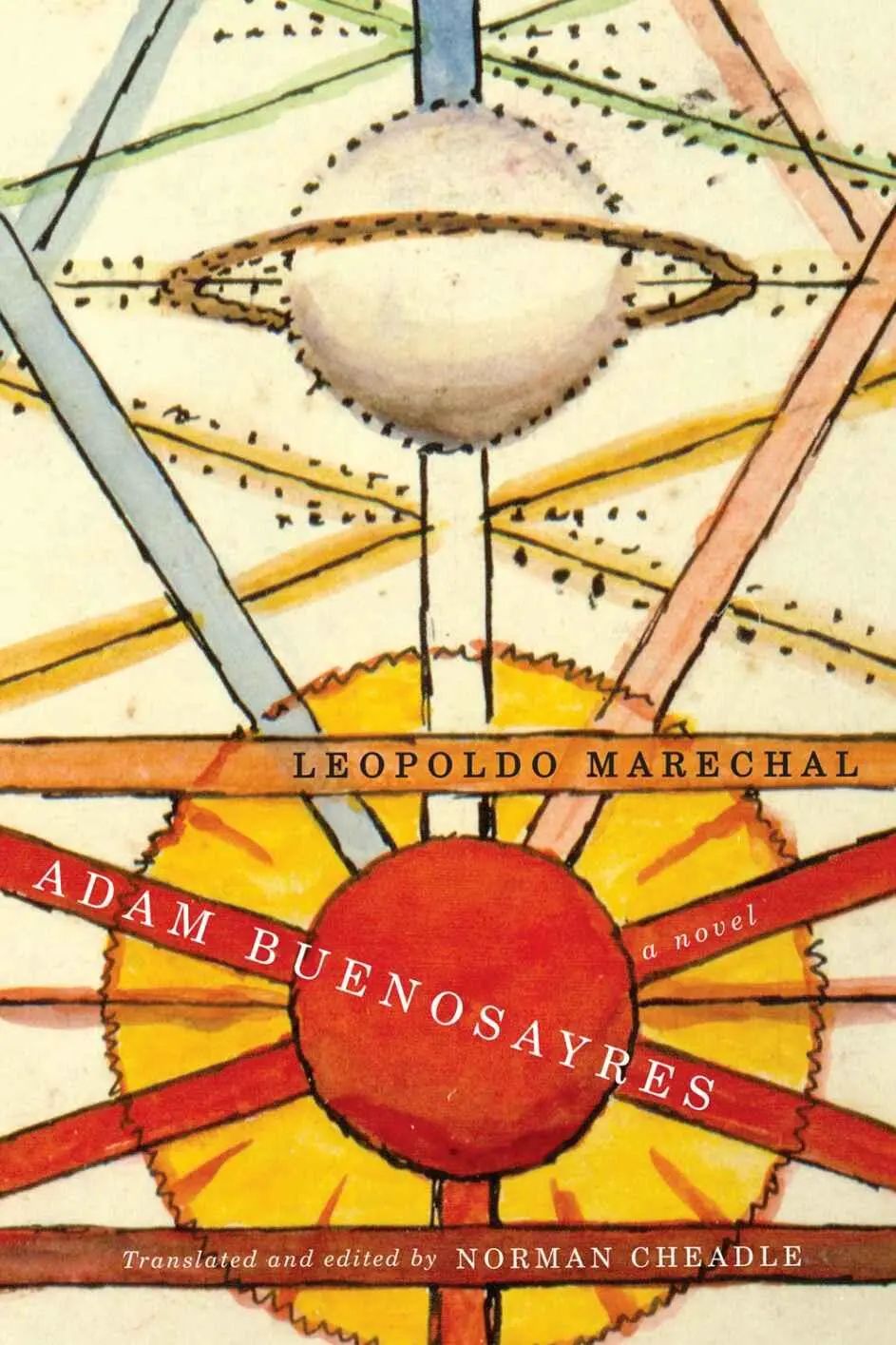
- Название:Adam Buenosayres
- Автор:
- Издательство:McGill-Queen's University Press
- Жанр:
- Год:2015
- ISBN:нет данных
- Рейтинг книги:5 / 5. Голосов: 1
-
Избранное:Добавить в избранное
- Отзывы:
-
Ваша оценка:
Adam Buenosayres: краткое содержание, описание и аннотация
Предлагаем к чтению аннотацию, описание, краткое содержание или предисловие (зависит от того, что написал сам автор книги «Adam Buenosayres»). Если вы не нашли необходимую информацию о книге — напишите в комментариях, мы постараемся отыскать её.
Adam Buenosayres — читать онлайн бесплатно полную книгу (весь текст) целиком
Ниже представлен текст книги, разбитый по страницам. Система сохранения места последней прочитанной страницы, позволяет с удобством читать онлайн бесплатно книгу «Adam Buenosayres», без необходимости каждый раз заново искать на чём Вы остановились. Поставьте закладку, и сможете в любой момент перейти на страницу, на которой закончили чтение.
Интервал:
Закладка:
The imperious invitation of their leader, Del Solar, to get moving again cut short the two men’s effusions. The expeditionaries obeyed, responding instinctively to the worry in the guide’s voice. Something had happened. Shortly beforehand, wanting to get away from the odious squabble, Del Solar had resolutely set off into the night. Once alone, he noticed a dog barking his head off nearby, and all the canines for twenty miles around were starting to yap in response. Judicious guide, he realized that the group’s hullabaloo was putting them in danger of arousing the wrath of the wilderness. He called Luis Pereda over and confided his fears. The two of them peered anxiously into the dark, and horrible shapes seemed to be sliding ominously toward them. Their hair stood on end. Del Solar cried out in alarm, and Pereda began to whistle the tango “La Chacarita.” 6This was a sure sign of distress, for he hardly ever whistled it, except at night in certain barrios, La Paternal or Villa Soldati, 7walking the streets deep in meditation on the future incarnations of the Buenos Aires taita .
Brought to heel by their guide, the seven men advanced in silence now, eyes peering left and right. A strange ill humour was coming over the group, and a certain nervousness, which peaked when Samuel began to speak again. The philosopher, grave and mysterious, intoned that it didn’t surprise him that the night was getting aggressive, for its silence had been profaned by their vain and puerile chatter. For a while now, he added, certain clues — pointless to reveal them, given the abysmal ignorance of his audience — had given him to understand that they were in a sacred place, whose dangerous nature he couldn’t divulge for now. However, just to give them a taste of what was in store, he warned that the dog barking in the night might well be Cerberus, guardian of the gates of Hades. The impressionable men did not find his observations at all reassuring, and they let him know as much. To top it off, Bernini, carried away perhaps by some folkloric reminiscence, alarmingly suggested that the dogs, whose barking was growing louder, might be chasing a lobisome , or werewolf, the legendary seventh son who used to leave his human form and morph into a barking monster to prowl the night in search of his unspeakable banquet. 8But eventually Franky Amundsen, his urbanity outraged, solemnly declared that he pissed on the sacred silence and on the venerable night and, moreover, on the very spot they were traversing just now; and as for the scary monster, he went on, everyone should just relax, because in case of attack all they had to do was remove the shoe from one of the philosopher’s feet, peal off his sock, and toss it straight at the monster’s snout — an extravagant procedure, if you like, but infallible and authorized by many classical tales. Now, whether by sheer coincidence or as a result of that threat, it so happened that as soon as Franky finished speaking, the ghostly dog stopped barking. The group’s dread turned to astonishment, astonishment gave way to relief, and relief spawned the glory of Franky Amundsen, who thenceforth was held to be a great enchanter and conjuring expert. Unfortunately, that glory quickly lost its lustre when Franky, carried away by excessive pride, formally gave notice of his intention to put the boots to all the ghouls of the night, whether they came at him one at a time or all at once.
— Recklessness! exclaimed the philosopher in metaphysical indignation. You bunch of animals, do you realize where we are?
— Up the bloody creek without a paddle! answered a grouchy Pereda.
— Hmm! mused Samuel. And what if this were a battlefield?
His words were met by impatient growls and incredulous jeers. But the philosopher raised an imperious arm skyward.
— Listen! he exclaimed, ecstatic. Up there, way up high! What do you hear?
Six noses turned upward, tracing a forty-five-degree arc in the shadow, and twelve ears listened attentively.
— Nothing! Bernini said after a few moments. You can’t hear a thing.
— Poor earthly ears! Samuel mumbled testily. You need more than ears to hear the Battle of the Angels.
Although not entirely unexpected, the philosopher’s obscure revelation nonetheless provoked irresistible curiosity in some, skepticism among others, and shock in most of them. Franky Amundsen worried out loud that he must be going deaf, since a while ago the voice of the River Plate had escaped him and now the angels’ fisticuffs were eluding his auditory sense. Luis Pereda confessed his interest in the dubious skirmish on high because, if true, it would confirm the existence of angelic taitas gathered in a celestial ’hood. Del Solar, for his part, expressed his displeasure in tough-talking criollista mode, formally threatening that he was “outtahere” if the others didn’t quit goofing around. But Schultz and Adam clamoured to hear more on the subject; Samuel, thus encouraged, demanded silence and got it. He raised his arm to point at the lights of the city, still visible on the horizon.
— There lies Buenos Aires, he told the group. Two million souls…
— Two and half million, Bernini the statistician corrected him.
— I’m talking in round numbers, grunted Samuel. Two million souls caught up, most of them unawares, in a terrible supernatural fight. Two million souls in battle. They fall down here, get up again there, succumb or triumph, oscillating between the two metaphyical poles of the universe.
— Obscure, said Franky.
— Very obscure, Bernini concurred.
But the astrologer Schultz and the poet Adam understood.
— I was talking about a fight here on earth, Samuel continued, an invisible and silent fight. It’s not only men who engage in this metaphysical combat. The true battle is decided above, in the sky over the city: the battle between the angels and the demons who contend for the souls of porteños . Listen! It’s right here, in this suburban wasteland!
— Unforeskinned knave! Franky chipped in. Didn’t we agree that it’s only the fat-assed angels who live around here?
— What fat-assed angels? asked Samuel, disconcerted.
— Schultz’s angels, the ones that are supposed to hatch new neighbourhoods in the Buenos Aires of the future. Hey, just imagine the butts on those broody little angels!
A squall of hilarity shook the group of adventurers. Even Tesler, forgetting his solemnity, let go a guffaw that echoed deep in the night. But the astrologer Schultz, affable as always, explained that his incubator angels could easily exist alongside Samuel’s martial angels, since both types were under the sign of action, the only difference being that his, Schultz’s, were more faithful to the creative aspect of that entity qualified as angelic, according to the Oriental doctrine he professed. And as for the culeiform observation of our friend Franky, he continued, it betrayed the grossest kind of anthropomorphism; only an uncultivated mind, like our friend Franky’s, could attribute human form to an angel. Shamed to the marrow of his bones, Franky asked what form Schultz assigned to his hatching angels. Schultz replied that he’d conceived them in the form of an upright cone whose radius was equal to its height, a design that ensured a base adequate to incubation purposes. But, he added with some reserve, he’d already surpassed his own theory and was currently working out another one, truer and less conventional. When Franky humbly beseeched him for some hint as to his new theory, the astrologer flatly refused, wrapping himself in a silence no one dared disturb.
But there was one among those men who could no longer contain his irritation. Luis Pereda, furiously pacing back and forth in the dark, thundered that he’d had it up to here with angels. The nation’s literature had been suffering an epidemic of angels, he averred, and all this angelic blather was getting to be a royal pain in the arse, etcetera, etcetera. Samuel Tesler responded, threateningly, by asking if the literature of the suburbs that he and his sectarians were promoting wasn’t even more pestilential. Pereda retorted that criollo literature was grounded in Buenos Aires reality, whereas all that angelic junk was like second-hand costume jewellery. Samuel Tesler then called him a blind agnostic and accused him of denying the existence of pure intelligence, because what was truly non-existent was the universe of taitas and compadritos he’d been glorifying with an enthusiasm worthy of a better cause. At this blasphemy, Pereda staggered in the night as if knifed in the back; it was all he could do to stammer that he’d soon show Tesler a couple of nenes who’d knock his socks off.
Читать дальшеИнтервал:
Закладка:
Похожие книги на «Adam Buenosayres»
Представляем Вашему вниманию похожие книги на «Adam Buenosayres» списком для выбора. Мы отобрали схожую по названию и смыслу литературу в надежде предоставить читателям больше вариантов отыскать новые, интересные, ещё непрочитанные произведения.










Обсуждение, отзывы о книге «Adam Buenosayres» и просто собственные мнения читателей. Оставьте ваши комментарии, напишите, что Вы думаете о произведении, его смысле или главных героях. Укажите что конкретно понравилось, а что нет, и почему Вы так считаете.