Leopoldo Marechal - Adam Buenosayres
Здесь есть возможность читать онлайн «Leopoldo Marechal - Adam Buenosayres» весь текст электронной книги совершенно бесплатно (целиком полную версию без сокращений). В некоторых случаях можно слушать аудио, скачать через торрент в формате fb2 и присутствует краткое содержание. Год выпуска: 2015, Издательство: McGill-Queen's University Press, Жанр: Классическая проза, на английском языке. Описание произведения, (предисловие) а так же отзывы посетителей доступны на портале библиотеки ЛибКат.
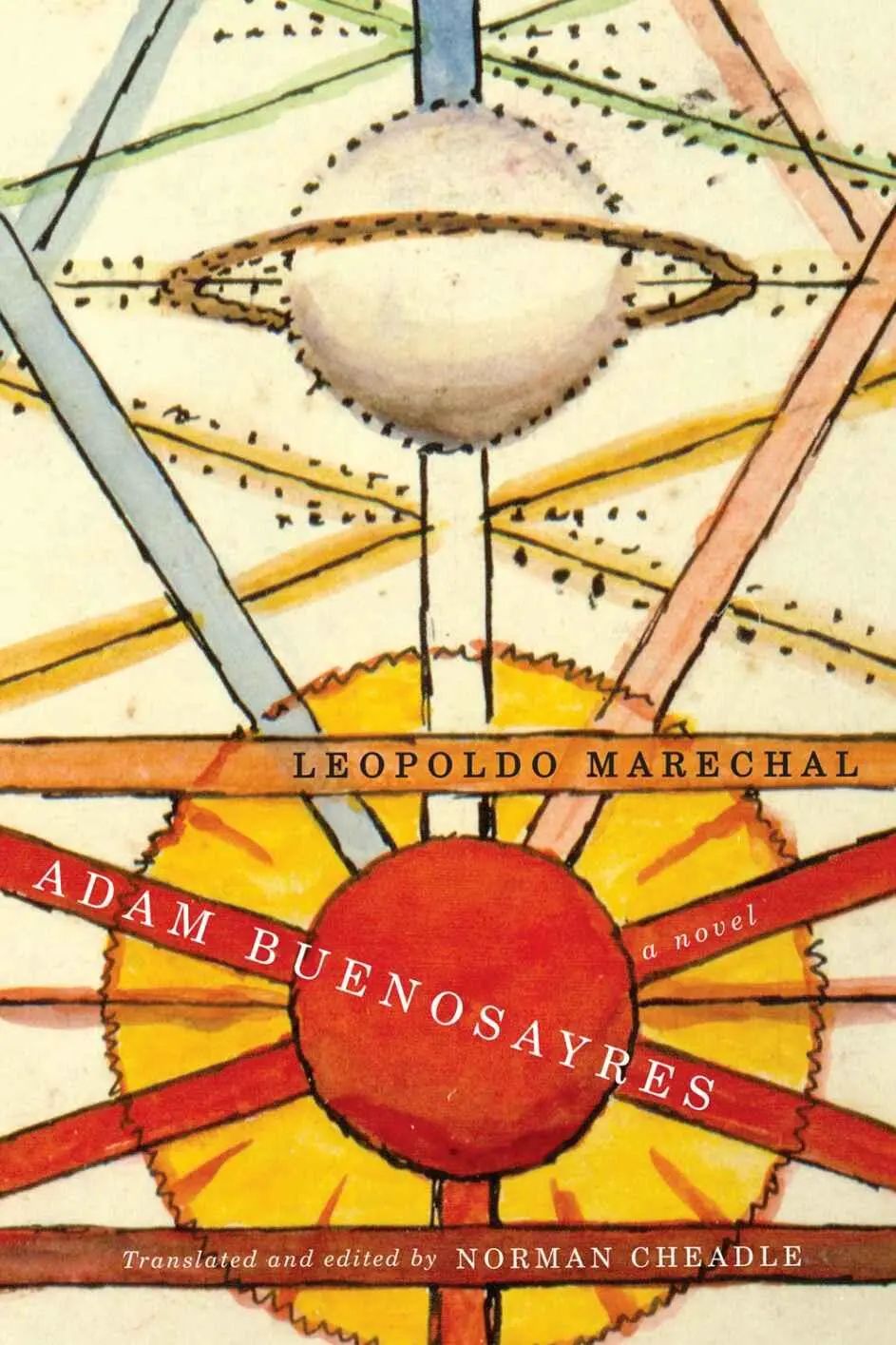
- Название:Adam Buenosayres
- Автор:
- Издательство:McGill-Queen's University Press
- Жанр:
- Год:2015
- ISBN:нет данных
- Рейтинг книги:5 / 5. Голосов: 1
-
Избранное:Добавить в избранное
- Отзывы:
-
Ваша оценка:
Adam Buenosayres: краткое содержание, описание и аннотация
Предлагаем к чтению аннотацию, описание, краткое содержание или предисловие (зависит от того, что написал сам автор книги «Adam Buenosayres»). Если вы не нашли необходимую информацию о книге — напишите в комментариях, мы постараемся отыскать её.
Adam Buenosayres — читать онлайн бесплатно полную книгу (весь текст) целиком
Ниже представлен текст книги, разбитый по страницам. Система сохранения места последней прочитанной страницы, позволяет с удобством читать онлайн бесплатно книгу «Adam Buenosayres», без необходимости каждый раз заново искать на чём Вы остановились. Поставьте закладку, и сможете в любой момент перейти на страницу, на которой закончили чтение.
Интервал:
Закладка:
The voice belonged to a strange-looking fellow, long of torso and short in the legs. His voice, laugh, and body language clearly announced that the atmosphere of mental asylums and the intensive use of straitjackets had played some part in his murky past. The guide, perhaps aware of this, let the question go by without reacting.
— The trail starts here, he said. We just follow it straight ahead until we get to the ditch and the teetery plank. From there, I’m sure we’ll be able to see the lights of the house.
— Hell’s bells! growled a voice, jesting and skeptical. I’ll eat my hat if this joker doesn’t get us up to our balls in mud.
— So what if he does? the short-legged fellow argued facetiously. It’s the mire of the suburbs. Sacred mire!
Ignoring the sarcasm, the man with the jesting, skeptical voice sketched a gesture of resignation in the air.
— All right, he said. If we must, then let’s get a move on. We’re not going to stand around here all bloody night.
He began to walk toward the prickly-pear hedge. But he immediately turned around and cast an inquisitive glance over his taciturn companions.
— By the belly of the whale! he exclaimed. Where have they got to now, that scurvy astrologer and that swine of a bard?
The two personages so grossly described were not far off, their shadowy profiles readily visible some twenty paces away. One of them stood out, for his form rose cyclopean in the night, his stature denoting not the insolent pride of the material world but his serene command of occult wisdom, key to the enigma of the Three Worlds. The other was skinny, unprepossessing, altogether nondescript, were it not for his slouched broad-brimmed hat, which looked like a funnel of the style that in days of yore had covered heads lousy with metaphors. What were they doing over there, standing face to face, far from their comrades-in-arms at the very moment when the code of solidarity most urgently beckoned them? The fact was that, shortly beforehand, the cyclopean man had scented in the dark the baleful odour of hemlock. He’d so informed the man in the funnel-shaped hat, whereupon both had set out in search of the plant, sniffing the air like bloodhounds. Once they’d found it, the began to chew on the deadly leaves, whereupon a swarm of classical reminiscences softened their hearts, the sudden upswelling of an ancient emotion bringing them close to tears, especially when the pathetic image of Socrates flashed up in memory. Generous souls! There they would have stayed all night long, savouring the bittersweet mystery of death, had not a chorus of strident voices called them back to the reality of this world.
— Schultz! Buenosayres! We’ve found the opening!
The astrologer Schultz and Adam Buenosayres — for these were the names of the hemlock-eaters — retraced the steps separating them from their friends. A kind of irrepressible nervousness came over the group as they were about to set off. Some scrutinized the blackness stonewalling them with its sphinx-like hermeticism. Others glanced back at the metropolis they were deserting and watched its lights winking at them from afar. To be sure, all those men, porteños by birth or by vocation, had bid a long and ceremonious farewell to the marvellous city. Every single dive on Colodrero Street between Triunvirato and Republiquetas, each and every one of the noisy pubs and welcoming cantinas that offer a zinc countertop to the thirst and fatigue of the traveller — all had received the adieu of those magnanimous heroes, whose religiosity forbade them to undertake any adventure without first beseeching the favour of the gods on high by means of an enthusiastic libation of aguardiente from Catamarca, guindado from Montevideo, caña from Paraguay, zingani from Bolivia, grappa from Cuyo, pisco from Chile, and other liquors suitable for so pious a liturgy. Now there was nothing for it but to leave. And leave they would, any minute now, albeit on legs not entirely steady, and with tongues a tad thick, but with a serene valour proof against any obstacle.
The signal to advance was given. The seven men marched toward the prickly pears. One by one, the adventurers slipped sideways through a narrow opening in the thorny tangle. Their leader was the first to embark on the path of danger, followed by the short-legged man and the jester. Hard on their heels came two heroes who had so far remained silent: one of them, robust, swayed like a wild boar gone blind; the other was not quite pint-sized. These five made up the group’s vanguard; the astrologer Schultz and Adam Buenosayres brought up the rear.
They’d all crossed the line now into the land of adventure. Before them, the land sloped away gently, coated in an armour of aggressive bushes, all barbs and quills. But the seven men hardly noticed them, so powerful was their exaltation before that Argentine night, the purity of its gloom, the firmness of its flesh: it seemed to fuse heaven and earth, man and beast, in a single block of darkness. Their eyes soon tired of trying to penetrate the obscurity below. But when they raised their gaze aloft, a sacred dread filled their hearts before the vision of stars clustered in the sky like the thousand eyes of a blinking Argos. It was an ancient terror that rained down from above, and a silence so deep, one seemed to hear the dew distilled in the flasks of the night trickling down to earth. From that point forth, the explorers were enflamed by a kind of telluric rapture: it was a mad cutting-loose from all worldly ties, the soul’s release into the realm of marvels. Ah, but little did they suspect in their exalted state that soon, only three hundred metres away, the supernatural was to give the Saavedran adventurers quite a fright when, crossing the abyss on the wobbly plank, they would hear the tremulous croak of the toad-swans.
The first to show signs of poetic delirium was Adam Buenosayres. Stopping suddenly, he demanded silence:
— Hark! he exlaimed. Listen!
Six anxious faces surrounded him forthwith.
— What’s up? they asked in alarm.
— There! replied Adam, extending his arm toward the horizon. Listen to it! It’s the song of the River!
— What river? growled the jester.
— The Silver River! declaimed Adam, exhilarated. The eponymous river, as Ricardo Rojas would say. The river has raised his venerable torso over the waters. His brow is wreathed in water hyacinths. He sings a song of mud, his mouth full of mud, his beard dripping mud! 1
General laughter was heard in the night. But the jester proffered a brutal curse:
— We’re done for now! he announced. The bard’s pissed as a newt!
But Adam insisted:
— He who has not heard the voice of the River will never understand the sadness of Buenos Aires. The sadness of clay in search of a soul. 2The idiom of the River!
Choked up by a fit of weeping, he couldn’t go on. His head fell against Schultz’s chest, there to be succoured by the astrologer’s gentle hand. (Schultz later avowed having experienced the distinct impression of clasping a broad-brimmed hat wracked by sobs.) Later, everyone would realize that a recent disappointment in love had provoked that unexpected tearful outburst.
— The problem isn’t with the river, the pint-sized hero began to say. If we resist the temptation to wax lyrical and just open our eyes…
But a flaccid, mollusc-like hand touched his back. It was the robust man who swayed like a blind boar.
— Hold it right there, he said, his breath an effluvium of caña quemada . I gather that Buenosayres was offering us a poetical-alcoholical-sentimental version of the River.
— I repeat: the problem is not the river, insisted the pint-sized fellow with an insolence far exceeding what might be expected from his scant bulk.
Читать дальшеИнтервал:
Закладка:
Похожие книги на «Adam Buenosayres»
Представляем Вашему вниманию похожие книги на «Adam Buenosayres» списком для выбора. Мы отобрали схожую по названию и смыслу литературу в надежде предоставить читателям больше вариантов отыскать новые, интересные, ещё непрочитанные произведения.







Обсуждение, отзывы о книге «Adam Buenosayres» и просто собственные мнения читателей. Оставьте ваши комментарии, напишите, что Вы думаете о произведении, его смысле или главных героях. Укажите что конкретно понравилось, а что нет, и почему Вы так считаете.