Leopoldo Marechal - Adam Buenosayres
Здесь есть возможность читать онлайн «Leopoldo Marechal - Adam Buenosayres» весь текст электронной книги совершенно бесплатно (целиком полную версию без сокращений). В некоторых случаях можно слушать аудио, скачать через торрент в формате fb2 и присутствует краткое содержание. Год выпуска: 2015, Издательство: McGill-Queen's University Press, Жанр: Классическая проза, на английском языке. Описание произведения, (предисловие) а так же отзывы посетителей доступны на портале библиотеки ЛибКат.
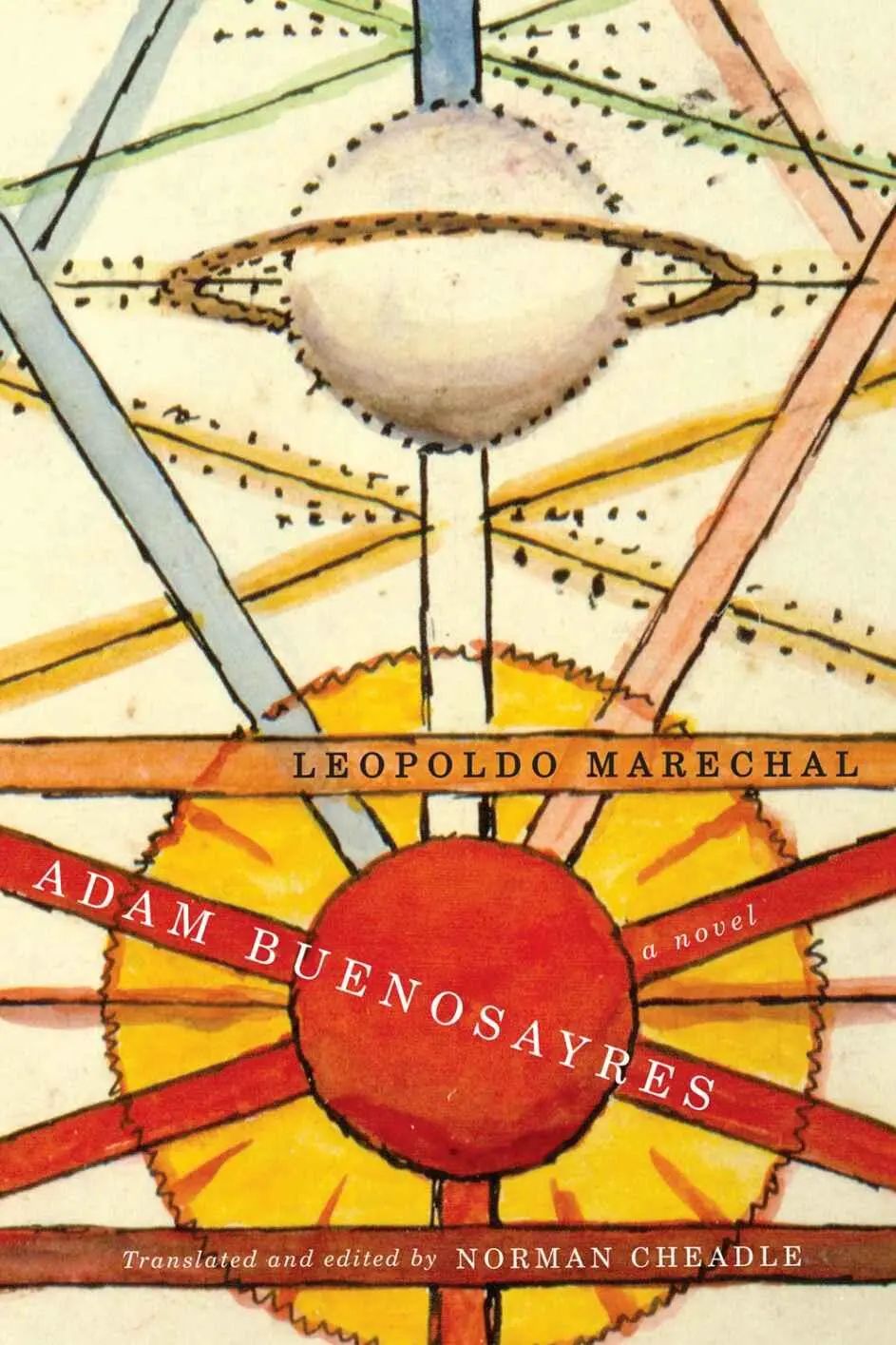
- Название:Adam Buenosayres
- Автор:
- Издательство:McGill-Queen's University Press
- Жанр:
- Год:2015
- ISBN:нет данных
- Рейтинг книги:5 / 5. Голосов: 1
-
Избранное:Добавить в избранное
- Отзывы:
-
Ваша оценка:
Adam Buenosayres: краткое содержание, описание и аннотация
Предлагаем к чтению аннотацию, описание, краткое содержание или предисловие (зависит от того, что написал сам автор книги «Adam Buenosayres»). Если вы не нашли необходимую информацию о книге — напишите в комментариях, мы постараемся отыскать её.
Adam Buenosayres — читать онлайн бесплатно полную книгу (весь текст) целиком
Ниже представлен текст книги, разбитый по страницам. Система сохранения места последней прочитанной страницы, позволяет с удобством читать онлайн бесплатно книгу «Adam Buenosayres», без необходимости каждый раз заново искать на чём Вы остановились. Поставьте закладку, и сможете в любой момент перейти на страницу, на которой закончили чтение.
Интервал:
Закладка:
Meanwhile, the waltz was attaining its peak in splendour. The dancers, in the grip of vertigo, traced absurd trajectories and spun like coloured tops. Bravo! Ruty Johansen’s fingers were playing like the devil. At this point, Adam Buenosayres noticed his Blue-Bound Notebook lying — insulted, belittled! — on the sky-blue divan. And suddenly, his soul began to faint and his mind to stray into dangerous labyrinths of wrath. Orlando Furioso! 41Like the fabulous chivalric knight, Adam too is fleeing into mild dementia. He’s in his underwear, like Sir Lancelot of the Lake, and he’s running down the streets of Villa Crespo pursued by ubiquitous jeers and catcalls. Two endless streams of tears flow from his eyes to his mouth, two bitter rivers from which he drinks day and night. The mob points at him. Kids pelt him with their slingshots. The malevos on street-corners clobber and spit on him. Toothless hags empty chamberpots on his head as he passes. Ferocious females throw old boots and rotten fruit. Adam falls, gets up, keeps on running, falls down again! But on the third day a tremendous fury displaces his passive madness. Now he’s ripping a paradise tree out of the pavement of Gurruchaga Street. From its gigantic trunk he fashions his mace. Hell and damnation! The multitude recoils with frightful howls. Too late now! Adam’s mace is carrying out its mission of total destruction: skulls are cracking like nuts; the wake of the furious lover’s passage is strewn with bodies in twisted postures; black blood flows into the tannery’s sewers, which swallow it with a sinister glug-glug. Now where are all the insolent faces, the malignant eyes, the jeering teeth! The big sleep has descended on all eyelids, everyone seems comatose in Gurruchaga Street! No, not everybody. The survivors have slunk into their hovels, their dark cellars, their zinc kitchens. But Adam’s fury can no longer be reined in. Now he tackles the buildings. Beneath his formidable mace, walls crack and tumble, roofs cave in with a frightful din. A cloud of red dust rises from the ruins and obscures the light. Amid the rubble can be heard muffled moans, death rattles, a tangle of prayers and curses. By noon Adam is feeling hunger pangs. He storms into the corral of Arizmendi the Basque, disembowels his three auburn cows, and wolfs down the steaming entrails. Then he goes back to his task of devastation. Villa Crespo is nought but a pile of rubble! But in the late afternoon, Adam finds himself in front of the Church of San Bernardo. The hero brandishes his mace, as though about to raze the temple with a single blow. Upon raising his wrathful eyes, he sees the Christ with the Broken Hand, and the weapon falls at his feet. Adam backs away, filled with dread. For, in the palm of his lacerated hand, the statue is showing him a heart of stone, and the stone heart is bleeding… Enough!
Enough! cries Adam Buenosayres to himself. A mad weaver of smoke! No need to glance at the salon’s mirror to know his face was contorted and his eyes wild. He took a look around. Did anyone notice his dementia? He could relax; the tertulia was still wheeling to the strains of the “Blue Danube.” The bewitched souls were conjoined in a single rhythmn, a single rapture. And Adam was immobile in the centre of the round, as he was yesterday, as always. Until when?
Suddenly Adam Buenosayres was inspired to do the strangest thing. Whether out of mortal anguish or some liberating impulse, he wafted as though in a dream to the circle of dancers. Approaching Señora Ruiz, he gallantly offered his arm and invited her to dance. Astonishingly, Señora Ruiz accepted, and the two of them executed the first steps of a danse macabre . Hip! Hip! Adam was dancing with a skeleton. Hurrah! His hands clasped a rickety ribcage, and the breath of his funereal partner (a sad smell of catacombs) blew straight onto his face. Fine! Adam spun madly, clinging to a handful of bones. As he turned round and round, his perceptions came in snatches: whirling bright faces, vivid gestures, bits of laughter, shreds of conversation, flouncing skirts, lights that rolled and tumbled, along with bodies, souls, smoking heads. Hurrah! Hurrah! There was fire in the feet of the dancers, and the whole salon danced as if possessed. Bravo! Outside, the city was dancing beneath a million lights. In the immensity of space danced planet Earth.
BOOK THREE
Chapter 1
In the city of Trinity and its port, Santa María de los Buenos Aires, there is a frontier zone where burg and wilderness meet in an agonistic embrace, like two giants locked in single combat. Saavedra is the name cartographers have assigned to that mysterious region, perhaps in order to hide its true name, which must not be uttered. “The world is preserved through secrecy,” affirms the Zohar . And it is not for all and sundry to know the true names of things.
The traveller who turns his back on the city and directs his gaze toward that landscape will soon be overcome by a vague sense of dread. There, from rough and chaotic ground, arise the last spurs of Buenos Aires, primitive mud huts and corrugated iron shacks teeming with tribes that hover on the frontier between city and country. There, bride of the horizon, the pampa shows her face and extends her boundless breadth westward beneath a sky bent on demonstrating its own infinity. During the day, sunlight and the happy buzz of the metropolis obscure the true face of the suburb. But at nightfall, when Saavedra is no more than a vast desolation, its feral profile is unveiled, and the traveller may suddenly find himself staring into the very face of mystery. In that hour, at ground level, you can hear the palpitations of a darkling life. Shrill hoots cut the air, voices hail one another in the distance; the silence, thus suddenly disturbed like the surface of a pond shattered by a stone, restores itself instantly, deeper than ever. The zone is dotted with bonfires; they greet one another across wide spaces, converse in their igneous idiom. And human faces blow on burning coals, silhouettes arrive and exchange greetings, hands turn great spoons in pots filled to the brim. The old folks of Saavedra say that when the moon is out and the sky turns ashen, it is not uncommon to see will-o’-the-wisps flickering around an abandoned shack, the parapet of a well, or the twisted roots of an ombú. They’re ghosts of the dead, still tied to the earth by some cursèd lasso. Errant flames darting senselessly to and fro as if buffeted by some implacable wind, they can be snuffed out in mid-air by the recitation of a short prayer. But on nights when the moon is new, the supernatural irrupts under another sign; the sleepless hobo, tossing on his bed of paper bags in his sad tin-can shelter, will hear a sudden distant roar that rapidly approaches, growing gigantic and thunderous. Soon he perceives the din of horses pounding on the drum of hard earth, their neighing chorus, the clash of lance upon lance, ferocious war whoops, a total pandemonium menacing as though a bloodthirsty squadron were galloping through the night. Hardly will he have drawn his knife and placed blade against sheath to make the sign of the cross, when the phantom malón flies over his roof with the force of a hurricane.
At ten o’clock on the night of Thursday, April 28, 192–, seven adventurers halted at the edge of the dread region we’ve just named. Their leader and guide, prudent but resolute, advanced a few steps, seemingly in search of a trail in the line of prickly-pear cactus that formed a border between street and badlands.
— Here’s the entrance, he muttered at last, turning to his squad at rest.
A mocking laugh rent the darkness.
— What about the dead man’s house? asked the laugh’s companion voice. We were heading for the house of a dead man.
Читать дальшеИнтервал:
Закладка:
Похожие книги на «Adam Buenosayres»
Представляем Вашему вниманию похожие книги на «Adam Buenosayres» списком для выбора. Мы отобрали схожую по названию и смыслу литературу в надежде предоставить читателям больше вариантов отыскать новые, интересные, ещё непрочитанные произведения.









Обсуждение, отзывы о книге «Adam Buenosayres» и просто собственные мнения читателей. Оставьте ваши комментарии, напишите, что Вы думаете о произведении, его смысле или главных героях. Укажите что конкретно понравилось, а что нет, и почему Вы так считаете.