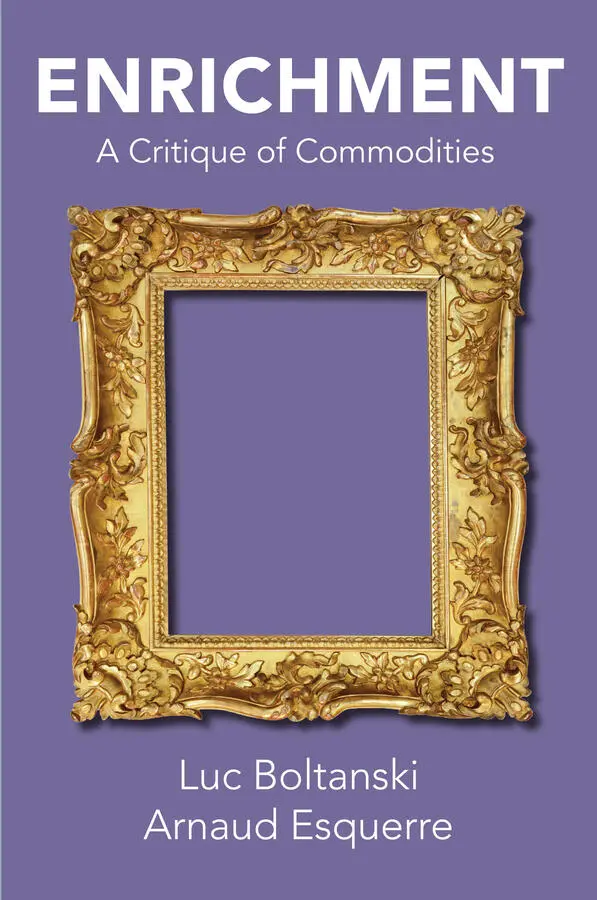
Luc Boltanski - Enrichment
Здесь есть возможность читать онлайн «Luc Boltanski - Enrichment» — ознакомительный отрывок электронной книги совершенно бесплатно, а после прочтения отрывка купить полную версию. В некоторых случаях можно слушать аудио, скачать через торрент в формате fb2 и присутствует краткое содержание. Жанр: unrecognised, на английском языке. Описание произведения, (предисловие) а так же отзывы посетителей доступны на портале библиотеки ЛибКат.
- Название:Enrichment
- Автор:
- Жанр:
- Год:неизвестен
- ISBN:нет данных
- Рейтинг книги:4 / 5. Голосов: 1
-
Избранное:Добавить в избранное
- Отзывы:
-
Ваша оценка:
Enrichment: краткое содержание, описание и аннотация
Предлагаем к чтению аннотацию, описание, краткое содержание или предисловие (зависит от того, что написал сам автор книги «Enrichment»). Если вы не нашли необходимую информацию о книге — напишите в комментариях, мы постараемся отыскать её.
Enrichment — читать онлайн ознакомительный отрывок
Ниже представлен текст книги, разбитый по страницам. Система сохранения места последней прочитанной страницы, позволяет с удобством читать онлайн бесплатно книгу «Enrichment», без необходимости каждый раз заново искать на чём Вы остановились. Поставьте закладку, и сможете в любой момент перейти на страницу, на которой закончили чтение.
Интервал:
Закладка:
By relying on these underlying structures, the actors can reflect on the relation between two types of heterogeneous entities – things on the one hand, prices on the other – whose union constitutes commodities as such, instead of simply receiving this assemblage synthetically and passively submitting to its effects. But to understand the way a rational actor can seek to grasp the relation between things and their prices, we must take into account a third type of entity, which we shall designate by the term actors use – the indigenous term, as it were – namely, the polysemic term of value. It is in fact very generally the substance of a thing that is understood to constitute its “value”; in this sense, the relation between the thing and its price becomes subject to reflection, whether it is a matter of critiquing the price or justifying it. Rather than taking value as a property of things that is at once substantive and mysterious – a way of looking at things that has permeated classical economics and that continues to operate – we shall treat value as an arrangement for justifying or critiquing the price of things. The structures we shall seek to identify divide up the universe of commodities by distributing the entire set of marketable objects among various ways of justifying (or critiquing) their prices – that is, among different ways of assigning value to things. We shall see that the diverse methods for establishing value present differential relations that result from permutations of basic oppositions so that we can describe them as a transformation group in Lévi-Strauss’s sense. 3This makes it possible to reconcile the homogeneity of the cosmos of commodities (which encompasses every entity to which a price is attached when it changes hands) with the diversity of objects that comprise it, on the basis of the way that price is justified.
It is by being attentive to the dynamics of capitalism that we shall seek to connect the two approaches, historical and analytical, that have guided our work. We shall look at capitalism through the lens of commerce rather than focusing on the changes that have affected production and thus also labor – changes that, along with increased unemployment, have been the primary focus of analyses of capitalism. In this project we have benefited greatly from (re)reading Fernand Braudel, whose seminal book on capitalism puts commodities and commerce at the heart of his analyses; these entities are similarly central to studies – especially those of Giovanni Arrighi – that have sought to extend Braudel’s perspective into the present day. Commodity structures have to be analyzed in historical terms precisely because they have been inserted into the dynamics of capitalism and into the link between order and disorder that is the driving force behind capitalism. On the one hand, capitalist accumulation has to be able to rely on shared expectations, and thus on commodity structures, in particular so as to limit transaction costs. On the other hand, the very logic of that accumulation means that capitalism must constantly shift its position in order to benefit from the commodification of new objects, thereby subverting its own structures.
Because it depended most notably, in an initial phase, on the development of industry, capitalism had to shift its position so as to draw the greatest possible benefit from the commodification of new objects, as opportunities to profit from the exploitation of industrial labor began to diminish. The formation of the commodity structures we see today can thus be linked to the development of an enrichment economy. The existence of a plurality of forms for making things valuable, forms that are at once isomorphic and differentiated, allows diverse things to change hands with the hope that they will be sold each time at the highest possible price so as to generate the greatest possible profit, or at least to limit losses. If there were only one way to refer to the value of things in order to justify their prices, a great number of objects that are exchanged for high prices today would find themselves depreciated. The diversification of commodity structures goes hand in hand with diversification of the gaps that commodities come to fill. In this way commodity structures tend to shape both specific things and the lack of these things, so that they are maintained in order to avoid their being neither entirely objective nor entirely subjective. It is in this respect that they contribute in a major way to shaping what is called reality, inasmuch as reality depends on what Wittgenstein called language games, linguistic maneuvers that allow actors to grasp experience through reflection.
To carry out our project, we have navigated among several different disciplines, methods, and fields of inquiry. Our displacements were not premeditated but, rather, imposed on us, as it were, by the logic of a study whose specific object became clear to us only gradually, as the findings that seemed to answer the questions we were asking brought forth new questions, drawing us toward new investigations.
With regard to disciplines, then, we followed a path that led us from sociology and anthropology toward various strands of history (the history of art, the history of technology, political and social history), political philosophy, and, especially, economics. In this last field, which is no more unified than sociology and which encompasses quite diverse tendencies (schools that disagree even about the label “economics”), our readings and borrowings led us sometimes toward works situated more or less within the neoclassical tradition and sometimes, instead, toward works associated with heterodox or critical approaches; the differences among these works appeared less clear-cut to us on the level of documentary or even theoretical contributions than on the level of institutional affiliations and conflicts between schools. It seemed to us that the most striking difference separating the “orthodox” from the “heterodox” outlooks had to do in particular with the relation that these varying styles of economics maintained with sociology: the former sought to defend the autonomy of economics – an autonomy marked most notably by the space given to translating models into one or another of the languages stemming from mathematics – while the latter did not hesitate to draw upon data produced by the other social sciences.
Our primary concern has been to disentangle ourselves from the often difficult relations maintained between sociology and anthropology on the one hand and economics on the other. Thus, at times, sociologists and anthropologists are led to neglect economics (as if relations of symbolic exchanges had an autonomous existence entirely distinct from relations of exchanges of goods); at other times, they tend to seize hastily upon models originating in economics and apply them to their own objects and thereby to justify decisions on economic policy concerning those objects; in still other instances, they are inclined to develop a critical attitude toward economics in general, as if sociology and anthropology alone had access to some truth about human relations that the science of economics, tainted by inhumanity, could not grasp. While critique is by no means absent from our work, it is aimed at contemporary capitalism and not at economics as such. Our intention has thus been to extend the efforts of scholars – undoubtedly more numerous in a not-so-remote past than they are today – who have worked toward unifying the social sciences, contesting all forms of disciplinary orthodoxy. Today, in our view, this effort must entail moving beyond the tensions between, on the one hand, approaches inherited chiefly from positivism (which are frequent in economics) and, on the other hand, approaches that stem principally from constructionism (more frequent in sociology). We have sought to move forward along this path by developing a pragmatic structuralism . This approach makes it possible to combine a social history with an analysis of the cognitive skills that actors use in order to act.
Читать дальшеИнтервал:
Закладка:
Похожие книги на «Enrichment»
Представляем Вашему вниманию похожие книги на «Enrichment» списком для выбора. Мы отобрали схожую по названию и смыслу литературу в надежде предоставить читателям больше вариантов отыскать новые, интересные, ещё непрочитанные произведения.












Обсуждение, отзывы о книге «Enrichment» и просто собственные мнения читателей. Оставьте ваши комментарии, напишите, что Вы думаете о произведении, его смысле или главных героях. Укажите что конкретно понравилось, а что нет, и почему Вы так считаете.