Luc Boltanski - Enrichment
Здесь есть возможность читать онлайн «Luc Boltanski - Enrichment» — ознакомительный отрывок электронной книги совершенно бесплатно, а после прочтения отрывка купить полную версию. В некоторых случаях можно слушать аудио, скачать через торрент в формате fb2 и присутствует краткое содержание. Жанр: unrecognised, на английском языке. Описание произведения, (предисловие) а так же отзывы посетителей доступны на портале библиотеки ЛибКат.
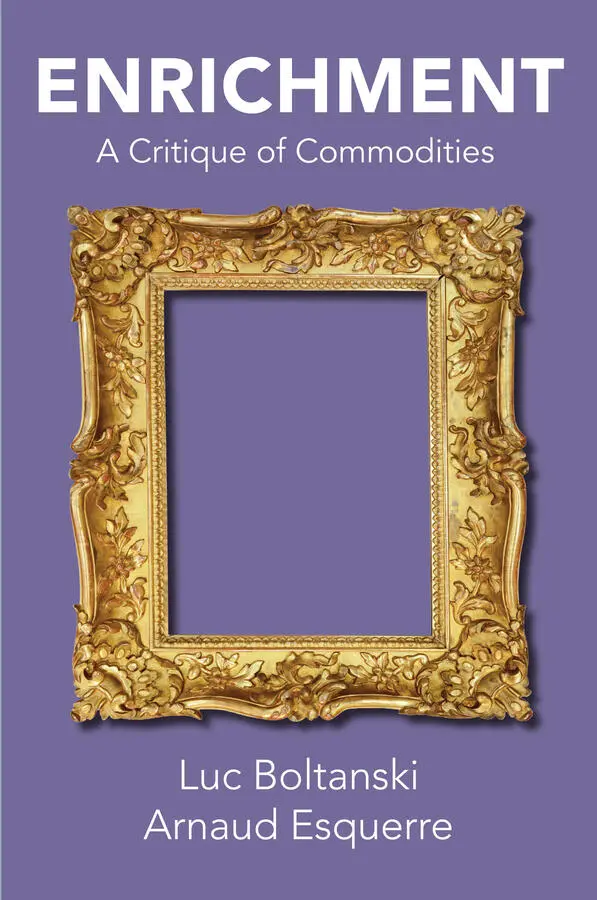
- Название:Enrichment
- Автор:
- Жанр:
- Год:неизвестен
- ISBN:нет данных
- Рейтинг книги:4 / 5. Голосов: 1
-
Избранное:Добавить в избранное
- Отзывы:
-
Ваша оценка:
Enrichment: краткое содержание, описание и аннотация
Предлагаем к чтению аннотацию, описание, краткое содержание или предисловие (зависит от того, что написал сам автор книги «Enrichment»). Если вы не нашли необходимую информацию о книге — напишите в комментариях, мы постараемся отыскать её.
Enrichment — читать онлайн ознакомительный отрывок
Ниже представлен текст книги, разбитый по страницам. Система сохранения места последней прочитанной страницы, позволяет с удобством читать онлайн бесплатно книгу «Enrichment», без необходимости каждый раз заново искать на чём Вы остановились. Поставьте закладку, и сможете в любой момент перейти на страницу, на которой закончили чтение.
Интервал:
Закладка:
We learned a great deal from the interventions and discussions that took place during the seminar “Valeur, prix et politique,” organized by Christian Bessy at the ENS-Cachan during 2012–15, as well as during the seminar “Art/Valeur,” co-organized in particular by Patrice Maniglier in 2014–16 at the Musée du Quai Branly, which gave us the opportunity to present our work at the École supérieure des beaux-arts of Montpellier in October 2015. We also presented our work and had useful exchanges at the seminar “Anthropologie à Nanterre” of the Laboratoire d’ethnologie et de sociologie comparative (LESC) in December 2013 at the Université Paris-Ouest Nanterre; during a Max Po lecture at Sciences Po in Paris, at the initiative of Olivier Godechot, in December 2014; and during a session of the seminar “Exercer la domination” at the ENS-Ulm in May 2016, at the initiative of Pierre Alayrac.
A nearly complete version of the manuscript was discussed during a day-long conference devoted to it on Monday, 4 July 2016, at the LESC at the Université Paris-Ouest Nanterre; we thank the laboratory for welcoming us, and we are particularly grateful to our readers, who are at once colleagues and friends, for their comments: Pierre Alayrac, Guillaume Couffignal, Sophie Cras, Laurent Jeanpierre, Jeanne Lazarus, Patrice Maniglier, Ismaël Moya, and Cyprien Tasset. We have also benefited greatly from observations by Bruno Cousin and Olivier Favereau and from the support of IRIS and its director Marc Bessin. Patrice Maniglier has been a constant interlocutor, accompanying and enriching our thinking, especially by making connections with philosophy, as Guillaume Couffignal has done with mathematics.
To carry out our investigation we called on numerous informants: antique dealers, craftsmen, artists, business executives, entrepreneurs, collectors, auctioneers, art critics, conservators, curators, top government officials, elected officials, and staff members of local collectivities. We thank them here for their trust and their availability.
Finally, this book would not have existed without the generosity and friendship of our editor, Éric Vigne.
This English version was built on a close and productive collaboration between the authors and the translator. We thank Catherine Porter for her careful questioning and her unfailing responsiveness as we worked together to adapt the text to a new audience.
Translator’s Note
This translation (excluding the Appendix) was prepared in close collaboration with the authors, whom I thank for their endless patience in responding to my questions. The English-language text includes some updated statistics, some information added for the benefit of anglophone readers, and a small number of corrections to the original. All translations from the French not otherwise credited to a named or unnamed translator are my own.
Foreword
Charles Sabel
Sociology is at its most instructive and broadly useful when it struggles to make sense of the relation between the large structures that constrain our behavior by defining markets and institutions and the way our practical, everyday understandings of justice and fairness can both reproduce and challenge, even transform, those constraints. Sociology is at its most daring and self-sacrificing when, going further, it attempts to understand this relation with both the structures and the practical criteria of judgment in motion – when, in other words, it attempts to combine the macro- and micro-sociology of the present to bring together two terms whose poverty, especially in combination, already hints at the inevitability of partial failure. No one has pursued this audacious and invaluable program more masterfully than Luc Boltanski. Beginning with Les Cadres (1982), and passing through On Justification (2006), with Laurent Thévenot, On Critique (2011) and The New Spirit of Capitalism (2018), with Eve Chiapello, to Enrichment (2020), with Arnaud Esquerre, translated here, he and his co-authors have produced an extraordinary, analytically innovative chronicle of the relentless changes in contemporary capitalism. Reading the present work together with its immediate predecessor may serve to convey the promise yet also some potential limits of this approach as the continuing transformation of capitalism verges on crisis.
The New Spirit of Capitalism looked ahead to the dissolution of the bureaucratic rigidity of Fordist mass production, then well underway. The firm has been replaced as the unit of organization by the project group: a team assembled, ad hoc, under the guidance and inspiration of a managerleader to respond to the needs of a customer. As markets shift, teams are recombined; careers are made by acquiring in each team enough expertise and experience to be recruited to the next. Together the shifting collaborations of teams and the circulation of workers yields a networked economy with open boundaries. Those who don’t qualify for entrance or promotion have no function or place in this reticular capitalism. They are excluded.
But these emergent structures are deeply ambivalent judged from the vantage point of the “projective city,” as Boltanski and Chiapello (adapting the general term developed in Boltanski’s earlier collaboration with Thévenot) call the model of justice particular to the “neo-management” of flexibility. The variant, like all such models, links criteria for judging the fairness of individual transactions that we reflexively invoke in deciding to make an exchange and judgments about compatibility of the actions of the powerful with the foundations of our social and political order. The capitalism of projects disarms the first kind of critique, not least because it responds to familiar objections to wage labor. Thus the spontaneous creativity of the project team and the prospect of a career of ceaseless exploration offer possibilities for self-actualization excluded by the routines of Fordist hierarchies – possibilities previously best embodied in the artist’s flamboyant, disdainful rejection of capitalist regimentation. Questions about the fairness of hourly compensation are moot because project team members manage their own time. If they are exploited it is through self-exploitation. For such reasons, Boltanski and Chiapello argue, parts of the labor movement and the socialist government of François Mitterrand championed the new developments instead of rallying against the precariousness they create. In celebrating talent, energy, and daring as the conditions of success, networked capitalism damps criticism most insidiously in insinuating that the excluded, by their want of endowments and initiative, if not by their vices, have all but marginalized themselves.
But the powerful in the projective city are not only obligated to respect fair terms of trade. They must also use the influence and authority derived from trading to sustain the public goods or commons on which the whole political and social community depends; to use their power selfishly, only to augment it, is a breach of the social contract that constitutes a moral order. From this perspective, the neglect of the excluded is not a regrettable oversight or a resigned acknowledgment of the incorrigible inequities of life but a breach of fundamental obligations. It is here that the critique of structure finds a handhold, but no more and just barely. Boltanski and Chiapello are rightly circumspect about the form and strategy of opposition. They remind us that the work of criticism, like the labor of Sisyphus, no sooner done, must be done again.
The picture, cheerless enough, changes abruptly and for the grimmer in Enrichment . The rise of new competitors, beginning with China, has blocked the renewal of industrial capitalism in its historic heartlands. Some countries, above all France, with its primitive accumulation of cultural objects from the time of the Revolution and its continuing association with good taste, respond by abandoning Fordist manufacturing. Instead they turn to production of luxury and artisanal goods, enriched (in one sense of the book’s polysemous title) by narratives establishing their authenticity through connection to a past, or by pointing to some other exceptional feature that distinguishes them from standard specimens of their type. Again progressive reforms help undermine the solidarities they were intended to reinforce. In the period of the projective city, a set of laws designed to buttress traditional collective bargaining (the Lois Auroux), helped legitimate precarious employment by recognizing the (initially) exceptional cases in which it would be allowed. In the same way, the “cultural democracy” of Jack Lang, minister of culture under Mitterrand, was supposed to favor celebration of creativity outside the museums and opera houses. Now, combined, with more expressly self-interested legal changes, such as new protections in intellectual property law for forms of production variously associated with particular places, they help make the nation’s own history for France today what coal once was for Great Britain: fuel for capitalism.
Читать дальшеИнтервал:
Закладка:
Похожие книги на «Enrichment»
Представляем Вашему вниманию похожие книги на «Enrichment» списком для выбора. Мы отобрали схожую по названию и смыслу литературу в надежде предоставить читателям больше вариантов отыскать новые, интересные, ещё непрочитанные произведения.












Обсуждение, отзывы о книге «Enrichment» и просто собственные мнения читателей. Оставьте ваши комментарии, напишите, что Вы думаете о произведении, его смысле или главных героях. Укажите что конкретно понравилось, а что нет, и почему Вы так считаете.