Luc Boltanski - Enrichment
Здесь есть возможность читать онлайн «Luc Boltanski - Enrichment» — ознакомительный отрывок электронной книги совершенно бесплатно, а после прочтения отрывка купить полную версию. В некоторых случаях можно слушать аудио, скачать через торрент в формате fb2 и присутствует краткое содержание. Жанр: unrecognised, на английском языке. Описание произведения, (предисловие) а так же отзывы посетителей доступны на портале библиотеки ЛибКат.
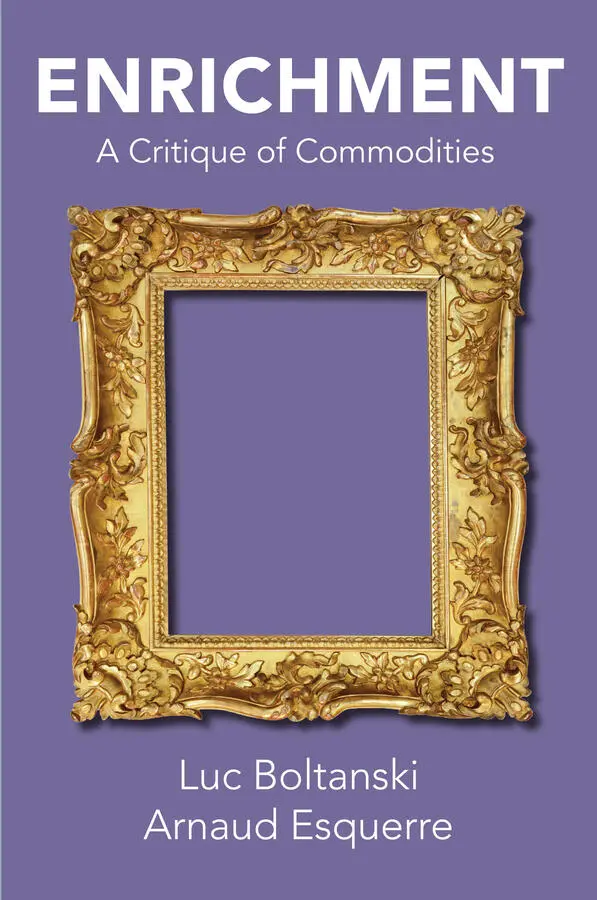
- Название:Enrichment
- Автор:
- Жанр:
- Год:неизвестен
- ISBN:нет данных
- Рейтинг книги:4 / 5. Голосов: 1
-
Избранное:Добавить в избранное
- Отзывы:
-
Ваша оценка:
Enrichment: краткое содержание, описание и аннотация
Предлагаем к чтению аннотацию, описание, краткое содержание или предисловие (зависит от того, что написал сам автор книги «Enrichment»). Если вы не нашли необходимую информацию о книге — напишите в комментариях, мы постараемся отыскать её.
Enrichment — читать онлайн ознакомительный отрывок
Ниже представлен текст книги, разбитый по страницам. Система сохранения места последней прочитанной страницы, позволяет с удобством читать онлайн бесплатно книгу «Enrichment», без необходимости каждый раз заново искать на чём Вы остановились. Поставьте закладку, и сможете в любой момент перейти на страницу, на которой закончили чтение.
Интервал:
Закладка:
But while a preface is perhaps a place to formulate such questions and speculations, it is certainly not the place to pretend to conclusions. Besides, you likely have this book before you because you already have these sorts of questions, and many others, in mind, along with provisional answers. You already sense how little the critiques we have speak to the problems we face, and yet how we struggle to fashion even those. So you knew too that criticism is a labor of Sisyphus. As encouragement and consolation, therefore, it may help to recall Camus’ observation (from an essay published in 1942, the very darkest of times) that, in the hour of returning down the slope to push the boulder up again, Sisyphus was fully conscious of the task before him, most human in his consciousness, and, yes, happy in his humanity.
Introduction
Social actors, whether they are buying or selling, are constantly immersed in the universe of commodities. Indeed, their experience of what they conceive to be reality depends to a large extent on this universe, often more than they would care to admit. The order of commodities –things in circulation – emerges in a process through which each thing is assigned a price in monetary terms every time it changes hands. At the same time, the things in question remain diverse, so that the universe of commodities is perceived not as an opaque totality – that would make it impenetrable – but as a structured whole. Reference to the structures of this whole makes it possible to identify each of the things exchanged. In addition, because social actors have internalized a tacit competence for dealing with these structures, they are able to orient themselves in the universe of commodities: they can participate in commerce, and, most importantly, they can pass judgment on the relationship between things and their prices.
Nevertheless, these structures, along with the relations they institute between things, their prices, and the value attributed to them, draw on differences anchored in space and in history. They are modified over time in keeping with shifts in the form of capitalism. In most contemporary societies, capitalism imposes its straitjacket on commerce in things; in this regard, Walter Benjamin’s analyses offer a striking framework for contrasting the structures of merchandise that subtend trade in much of twenty-first-century Europe, and perhaps in the world, with those of the nineteenth century. In “Paris, Capital of the Nineteenth Century,” Benjamin nourished his meditation on history and his critique of a commodity-focused representation of civilization with a reflection on merchandise in the era of triumphant capitalism. Commodities are manifested in the immediacy of perceptible presence and indissociably – he says – as “phantasmagoria” to which strollers, flâneurs , yield, seeking “refuge in the crowd.” 1Benjamin stressed the forms taken by the world city, radically new forms at the time, in which were concentrated not only finance, luxury, and fashion but also the revolutionary bohemian life emblematized by Auguste Blanqui, along with industry and, above all, the proletariat. Benjamin’s primary interest lay in showing how beings in this context – persons and things existing in a common space – embodied a radical break with the past. This break, marked by the creation of industrial and financial capital, was manifested concretely in the destruction brought about in Paris by Baron Haussmann’s reforms and the concomitant reorganization of the urban fabric. The age of the “commodity fetish” sought to base its legitimacy on a futuristic staging of the benefits of technology; blind trust in “progress” was the instrument by means of which historians identified with victors. “And all rulers are the heirs of prior conquerors. Hence, empathizing with the victor invariably benefits the current rulers.” 2
But the figure of the flâneur , when transposed to twenty-first-century Paris, is immersed in an entirely different reality. This new reality is no less capitalist than the one faced by Benjamin’s flâneur . However, “luxury” no longer boasts of being “industrial.” On the contrary, it strives to make us forget that its roots lie in a specific framework of production, one all the more easily brushed aside in that it is largely delocalized, confined to the orbits of other, faraway “world cities.” Capitalist accumulation is ongoing and even intensifying, but it relies on new economic arrangements and is associated with a diversification of the cosmos of commodities that depends on the modalities according to which value is assigned to them. The present study aims to describe this transformation, which is particularly apparent in the countries that have been the cradles of European industrial power, and above all in France; we shall analyze the way commodities are distributed among several different forms of valuation – that is, according to the way the price attached to a given commodity is justified or critiqued.
Our work will thus be oriented in two directions, whose relations we shall try to characterize. The first is chiefly historical. The object of this aspect of our study is an economic change that, since the last quarter of the twentieth century, has profoundly modified the way wealth is created in the countries of Western Europe. These countries have been marked both by deindustrialization and by an increased exploitation of certain resources that, without being entirely new, have taken on unprecedented importance. In our view, the scope of the change becomes apparent only when domains generally considered separate are brought together – most notably the arts, especially the plastic arts, and other cultural manifestations, trade in ancient objects, the creation of foundations and museums, the luxury industry, heritage creation, and tourism. We shall try to show that the constant interactions among these different domains make it possible to understand the way each one produces profits. Our argument will be based on their common exploitation of an underlying stratum that is purely and simply the past .
We shall use the term “enrichment economy” to designate this type of economy, playing on the ambiguity of the word “enrichment.” On the one hand, we use the word in the sense in which one speaks of enriching a metal, enhancing a lifestyle or a cultural asset, showcasing an article of clothing, or bringing together a set of objects in a collection, to emphasize the fact that this economy is based less on the production of new things than on an effort to enrich things that already exist, especially by associating them with narratives. On the other hand, the term “enrichment” refers to one of the specific characteristics of this economy, namely, that it draws upon trade in things that are intended above all for the wealthy and that thus also constitute a supplementary source of enrichment for the wealthy people who deal in them. It seems to us that this enrichment economy and its effects have to be taken into account if we are to grasp the transformations of contemporary society and some of the tensions that permeate it.
Our second orientation is more analytical. It seeks to comprehend how very diverse forms of commodities can give rise to transactions that, at least in most instances, will strike the actors who participate in them – either as purveyors or as customers – as normal activities, more or less in keeping with previously constituted expectations. By the term “commodity,” we designate everything to which a price is attached when its ownership changes hands. Given its phenomenal diversity, if the cosmos of commodities were not structured by modes of organization that are partly implicit, it would be hard to understand how the actors could orient themselves in it. The commercial dexterity of the various actors is quite uneven, to be sure, and depends on their experience as buyers or sellers. Nevertheless, without a minimal degree of competence, actors would simply be lost and unable to make their way in the world, given the importance that the role and the quantity of commercial transactions have taken on in modern societies. It is in this sense that we shall speak of commodity structures .
Читать дальшеИнтервал:
Закладка:
Похожие книги на «Enrichment»
Представляем Вашему вниманию похожие книги на «Enrichment» списком для выбора. Мы отобрали схожую по названию и смыслу литературу в надежде предоставить читателям больше вариантов отыскать новые, интересные, ещё непрочитанные произведения.












Обсуждение, отзывы о книге «Enrichment» и просто собственные мнения читателей. Оставьте ваши комментарии, напишите, что Вы думаете о произведении, его смысле или главных героях. Укажите что конкретно понравилось, а что нет, и почему Вы так считаете.