Luc Boltanski - Enrichment
Здесь есть возможность читать онлайн «Luc Boltanski - Enrichment» — ознакомительный отрывок электронной книги совершенно бесплатно, а после прочтения отрывка купить полную версию. В некоторых случаях можно слушать аудио, скачать через торрент в формате fb2 и присутствует краткое содержание. Жанр: unrecognised, на английском языке. Описание произведения, (предисловие) а так же отзывы посетителей доступны на портале библиотеки ЛибКат.
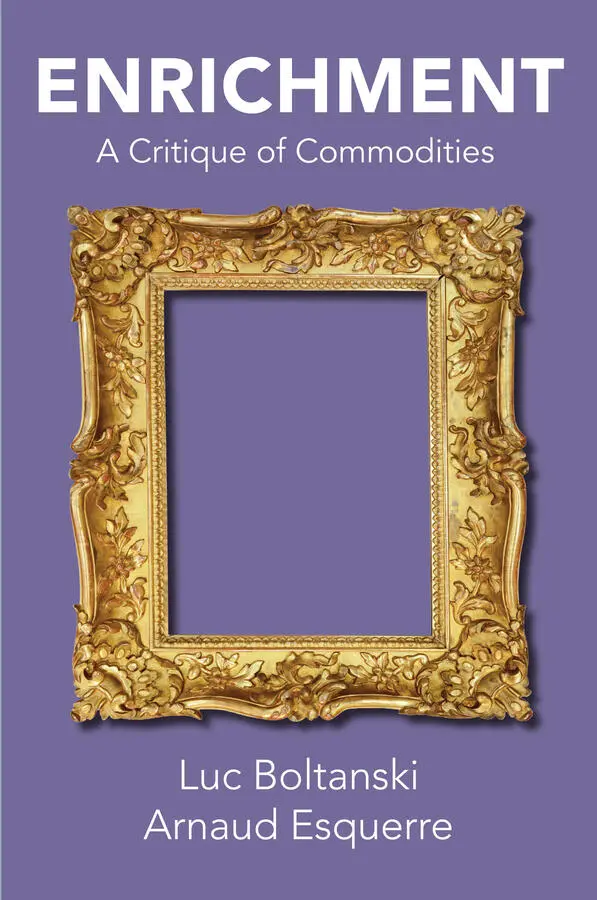
- Название:Enrichment
- Автор:
- Жанр:
- Год:неизвестен
- ISBN:нет данных
- Рейтинг книги:4 / 5. Голосов: 1
-
Избранное:Добавить в избранное
- Отзывы:
-
Ваша оценка:
Enrichment: краткое содержание, описание и аннотация
Предлагаем к чтению аннотацию, описание, краткое содержание или предисловие (зависит от того, что написал сам автор книги «Enrichment»). Если вы не нашли необходимую информацию о книге — напишите в комментариях, мы постараемся отыскать её.
Enrichment — читать онлайн ознакомительный отрывок
Ниже представлен текст книги, разбитый по страницам. Система сохранения места последней прочитанной страницы, позволяет с удобством читать онлайн бесплатно книгу «Enrichment», без необходимости каждый раз заново искать на чём Вы остановились. Поставьте закладку, и сможете в любой момент перейти на страницу, на которой закончили чтение.
Интервал:
Закладка:
As far as our methods of inquiry are concerned, we have been highly eclectic in our choices, operating like gleaners, as it were. Although we have occasionally included examples from other countries to show that we are talking about a process that can be disseminated, we have focused on the case of France, which is unquestionably one of the countries in which the transformations we have sought to bring to light are most clearly manifested. Our sources were numerous and wideranging. We collected sets of existing statistics; we conducted formal or informal interviews, both with informants invested with institutional authority and with so-called ordinary actors, such as artists, or collectors of various things ranging from works of contemporary art to football club insignia; we went through reams of documents produced for commercial or self-promotional purposes that we found either in print form or on the Internet; we analyzed marketing manuals for luxury items, tourism, art, and culture; and we undertook to produce an ethnography of places where the formation of an enrichment economy in France could be grasped “in real time” (for example, in the Aubrac region or in Arles).
The pages that follow are thus the result of a sort of artisanal approach that was once frequently practiced in the social sciences – and in social anthropology or in history more than in sociology – but that tends to be condemned today, even though it offers great advantages in terms of freedom and especially flexibility. Since our project was free of any constraints that might have been imposed by dependence on outside financing, it could be continually redefined and reoriented in response to the results obtained. It is too often forgotten that, by limiting oneself to work based on “big data,” one rediscovers an object that has already been socially constructed, and one rules out the possibility of introducing both the cognitive behavior of actors and the social changes that have not yet been subject to taxonomic identification or to technical and institutional recognition.
The process of collecting materials was all the more demanding in that what gradually turned out to be our key objects of inquiry – that is, on the one hand, the formation of an economy of enrichment and, on the other, the current state of commodity structures and of the skills that allow actors to orient themselves in this economy – have not in either case yielded, up to now, outcomes that would allow for a global, and in particular a statistical, overview. There are no data-processing or administrative centers that would collect, sift, and shape data covering the entire set of domains that must be taken into account, as we see it, if one is to grasp features in contemporary socio-economic developments that we believe to be very important. Thus we have had to criss-cross a large number of areas, from contemporary art to the luxury industry, from the national patrimony to tourism, and so on. Each of these areas calls for further study; our book as a whole can be read as an invitation to work in a new field of research. Our hope, then, is that the task will be taken up again by others who will be able to flesh out the results and further develop the hypotheses presented here.
Notes
1 1. Walter Benjamin, “Paris, Capital of the Nineteenth Century,” trans. Howard Eiland, in Walter Benjamin: Selected Writings, ed. Howard Eiland and Michael Jennings, vol. 3 (Cambridge, MA: Harvard University Press, 2002), pp. 32–49.
2 2. Walter Benjamin, “On the Concept of History,” trans. Edmund Jephcott and Howard Eiland, ibid., vol. 4 (Cambridge, MA: Harvard University Press, 2003), p. 391.
3 3. For details, see chapter 4, note 1.
1 The Age of the Enrichment Economy
The deindustrialization of Western Europe
In the last quarter of the twentieth century, in Western societies, mass production was no longer viewed as the only way – perhaps not even as the principal way – to maximize profits and accumulate wealth. For capitalism, too, the extension beyond mass production proved to be a necessity imposed by the requirement of profit as the possibilities opened up by that form of production, initially considered virtually infinite, seemed to reach their limits. While the standard form was not abandoned, the extension of capitalism entailed financialization and – in the realm of the production and/or commercialization of objects – the redrawing of geopolitical maps. Certain “emerging” countries took over responsibility for mass production as the primary path to enrichment (the accumulation of wealth), while some countries that had been among the powerhouses of world capitalism in the nineteenth and twentieth centuries concentrated on finance and on developing high-tech goods in order to retain power – from a distance – over the manufacturing of the most common goods, insofar as these were products derived from technological innovations. However, the latter countries also turned toward a much more intensive commodification of domains that had long remained more or less on the margins of capitalism.
The geographic expansion of capitalism redistributed – toward countries in which the labor force was abundant and ill-organized and in which wages were therefore low – a number of standard production sites, although the conception and sales of the objects produced remained for the most part under the control of companies headquartered in Western countries, which were still at the heart of world capitalism. Among other effects, these transfers accelerated the deindustrialization of Western Europe. Deindustrialization in the first decade of the twenty-first century is a well-studied phenomenon affecting Western economies, France’s in particular. 1Industrial employment reached a peak in 1974, with more than 5,900,000 salaried workers. In the early 2010s, this sector lost a little more than 40 percent of its personnel. During the same period, what statisticians define more broadly as the “productive sphere” decreased from 48 percent of all jobs to 35 percent. 2This drop affected almost all areas: mining, metallurgy, machinery, ship-building, textiles, and so on, excluding only certain high-tech sectors such as aeronautics and the nuclear, pharmaceutical, and weapons industries. 3The sectors that included intermediate goods and common consumer products were particularly affected. Their decline, which began as early as the 1960s and 1970s in the textile and leather-working areas, went on to affect manufacturing as a whole.
By “deindustrialization,” however, we do not mean the shift to a “post-industrial” society that was often predicted by sociologists in the 1960s. 4That prophecy has not been fulfilled on a global scale. On the one hand, many domains that had long remained on the margins of the industrial world – such as small businesses, education, health, and personal services – are run today (even those that do not depend on the private sector but are under state control) according to management methods that originated in the major worldwide companies and are subject to accounting norms developed in industry, a development that has been facilitated by the spread of computer technologies. But, above all, European societies make more use than ever of products of industrial origin – mobile phones, for example, or personal computers – that now count among the most common household appliances. The commodities in circulation are more numerous than ever before, but they are manufactured elsewhere. During the same period, in France, internal consumption almost doubled in global added value, as did commercial services, while the industrial sector declined by nearly two-thirds. Among economists, the explanations for this process of deindustrialization have been subject to intense debate. It is hard to determine how much importance to attribute, on the one hand, to the outsourcing of certain functions that had long been assumed by companies but were not directly productive and, on the other hand, to the increase in labor productivity. But it is quite probable that the most important factor is the importation of objects manufactured in countries with cheaper labor (depending on the sector, from 9 percent to 80 percent of the manufactured items sold in France are imported) 5and in which the workforce is neither well organized nor well protected. This is especially the case in Far Eastern countries such as China and Vietnam, but also in post-communist Eastern European countries, for example in Slovenia, Romania, and Bulgaria.
Читать дальшеИнтервал:
Закладка:
Похожие книги на «Enrichment»
Представляем Вашему вниманию похожие книги на «Enrichment» списком для выбора. Мы отобрали схожую по названию и смыслу литературу в надежде предоставить читателям больше вариантов отыскать новые, интересные, ещё непрочитанные произведения.












Обсуждение, отзывы о книге «Enrichment» и просто собственные мнения читателей. Оставьте ваши комментарии, напишите, что Вы думаете о произведении, его смысле или главных героях. Укажите что конкретно понравилось, а что нет, и почему Вы так считаете.