Luc Boltanski - Enrichment
Здесь есть возможность читать онлайн «Luc Boltanski - Enrichment» — ознакомительный отрывок электронной книги совершенно бесплатно, а после прочтения отрывка купить полную версию. В некоторых случаях можно слушать аудио, скачать через торрент в формате fb2 и присутствует краткое содержание. Жанр: unrecognised, на английском языке. Описание произведения, (предисловие) а так же отзывы посетителей доступны на портале библиотеки ЛибКат.
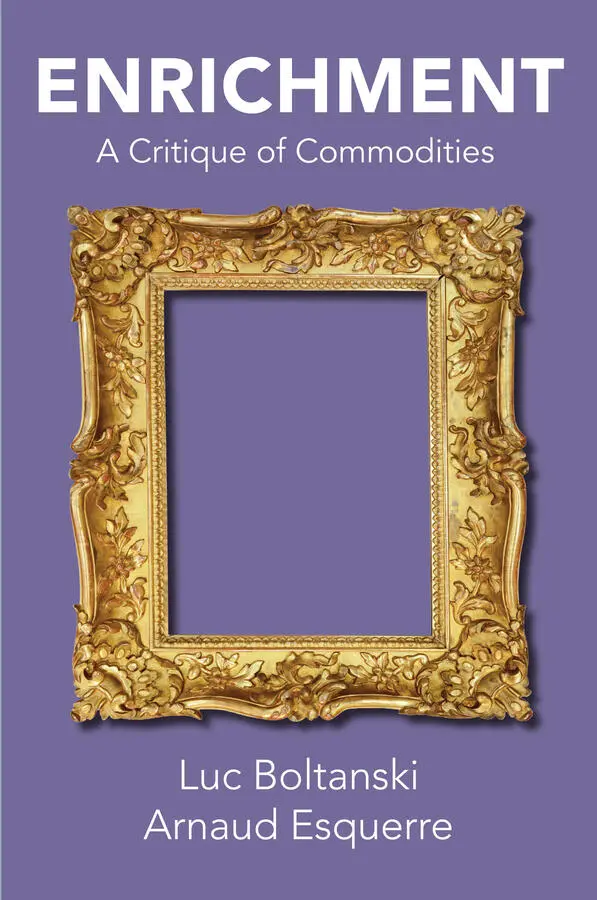
- Название:Enrichment
- Автор:
- Жанр:
- Год:неизвестен
- ISBN:нет данных
- Рейтинг книги:4 / 5. Голосов: 1
-
Избранное:Добавить в избранное
- Отзывы:
-
Ваша оценка:
Enrichment: краткое содержание, описание и аннотация
Предлагаем к чтению аннотацию, описание, краткое содержание или предисловие (зависит от того, что написал сам автор книги «Enrichment»). Если вы не нашли необходимую информацию о книге — напишите в комментариях, мы постараемся отыскать её.
Enrichment — читать онлайн ознакомительный отрывок
Ниже представлен текст книги, разбитый по страницам. Система сохранения места последней прочитанной страницы, позволяет с удобством читать онлайн бесплатно книгу «Enrichment», без необходимости каждый раз заново искать на чём Вы остановились. Поставьте закладку, и сможете в любой момент перейти на страницу, на которой закончили чтение.
Интервал:
Закладка:
The analytic focus of the book shifts accordingly. In the projective city, value was created in production. The morally inflected language of exchange was therefore shared among different categories of producers – social classes broadly conceived – and embedded in a model of justice including them in a single community. In the capitalism of enrichment, value is created through narratives that link only buyers and sellers. The rich tourists who come to France to consume its cultural and culinary patrimony in situ and the foreign elites who buy LVMH products at home (all enriched, in another of the title’s meanings, by the inequalities of financialization and globalization) share a language of evaluation with the maker of artisanal knives or the owner of a gallery offering collectable art. They can scarcely be said to constitute a community even among themselves, and still less with others in their respective home countries, from whom they are more and more distanced by their enrichment. The concept of the city has no place here; and, in its absence, critique loses even the tenuous handhold it had before. It is evoked only fleetingly. The state, having been complicit in the emergence of new forms of production, might be held to account for their consequences; the history of France belongs to all the French. Yet the authors suggest that they themselves find this insufficient. The book closes with a carefully qualified reflection on the potential for great disruptions – “when reality is confronted with major changes that put experience in direct contact with the world” – to call into question the master narratives that link our judgments of exchange and structure.
What has happened?
The first and most conspicuous explanation is simply that the facts have changed, foreclosing even the scant possibilities for critique and protest that remained until now. If Boltanski and Esquerre are silent on these subjects it is because there is nothing to say. This would bring their work into proximity with Wolfgang Streeck’s recent writing on the defeat of the left by a renascent capitalism that, having freed itself of the constraints of the postwar pact with social democracy, is running the table.
But there is despair and despair. However much Streeck may be personally outraged by this outcome, it costs him nothing theoretically to acknowledge it. In his kind of social science the relation among productive groups or social class was always a strategic game, usually resulting in one equilibrium or another. If there is an unexpected, decisive victory, the scientist-observer declares the game over. Sooner or later the players come to the same realization and retire with their payoffs.
Boltanski and his co-authors are not traveling so light. Enmeshed in the structures of their day, social actors play by the prevailing rules of the game and judge whether, in the large and in the small, they are fairly applied; the observer sees the interplay of rule following and revision and the changing motives for it. But the participants can’t simply turn off their faculties of judgment when judgment tells them outcomes are unacceptable. Those faculties are rooted in and expressive of our very humanity. To abandon them would be to sacrifice ourselves utterly, and for an unknown and unintelligible purpose. There is not a word in Enrichment to suggest that adversity will, or could, drive us to that. It is never game over with our honor, our dignity, our indignation, and our hope and imagination, even when we know we have lost.
Perhaps then it is the focus on commercial relations – the shared language of buyers and sellers – that explains the continuing commitment to the actors’ moral agency and yet the absence of extended discussion of the potential resistance to the new form of capitalism. Attention to the relation between buyers and sellers might thus improve our understanding of novel sources of value and kinds of evaluation while diverting our gaze from the dissatisfaction of the broader population excluded from enriched exchange.
This observation points in turn to the risks of assuming, generally, a close relation between the immediate experience of evaluation and the generation of criticism of capitalist structures and, conversely, assuming that absent such a relation criticism is not possible. Under relatively stable conditions, such as the first postwar decades, there is good reason for these assumptions. For stability brings a shared understanding both of the public goods needed to maintain the productive and social order and of roughly who is owed what in exchange. But as capitalism, under the pressure of competition and protest, changes direction, these relations break down. Public goods are ill-defined and their provision contentious, as are the terms of exchange. It becomes difficult even to discern, as we see in the arc of Boltanski’s work, who is participating in the economy and what it means to participate. The terms of exchange are too ambiguous and incomplete to suggest clues about the nature of the emerging structures, and the structures too fluid to point to reliable terms of exchange.
Under these circumstances an analytic response – the one pursued in The New Spirit of Capitalism and Enrichment – is to identify those terms and structures in each new configuration that are mutually supportive and, on the basis of this accord, to define new types of capitalism. The risk is that understandings based on emerging agreements will ignore, like the agreements themselves, the embryonic disaccord from which indignation and protest spring.
But facing the same ambiguity of terms and fluidity of structure, the actors’ practical response is to look to allies outside the sphere of exchange to articulate new understandings that make sense – including moral sense – of the confusion. In a word, the actors turn to politics: the marketplace politics of politicians and parties but also to the backstage politics of institutional and legal reforms, successful and botched, and to the fumbling adjustment of established policies and programs to new conditions. It is a mistake, or, rather, an artifact of many kinds of retrospective analysis, to conclude that this jumble of initiatives and accommodations simply clears the way for and helps support new capitalisms. The same pile of discordant bric-à-brac can be the source of renewed conceptions of markets, public powers, and public goods that make exchange among individuals and groups morally intelligible and therefore legitimate again. Politics is always also a fight about which usage will prevail, and in moments of general breakdown, like the present, these stakes are sensed by all. When moral protest disappears from the sphere of exchange, or seems excluded from it, it is often on the way to such political fights.
Let me put this point generally, as my own reading of the thrust of Boltanski’s reading of the last decades of capitalist development and critique of it: in times of crisis and confusion, the only way to understand structures is to see them as mutable and in motion – that is, not as structures at all; and the only way to grasp the potential of these mobile and mutable structures is to see them in the light of possible political alternatives, each associating a distinct group of allies with a bundle of institutional reforms in a constellation prefiguring new terms of exchange. This perspective, venturing further, is at once analytic and practical, or, if you like, cognitive and moral. It is the vantage point from which the observer can best understand what matters and why, and the moral agent can find and help create the rudiments of order amid tumult. In the terms Boltanski develops in On Critique , the turn to politics allows the actors to escape the necessarily local limits of their practical judgments without yet requiring they have access to the “overarching” or “totalizing” understanding of structures that some kinds of sociology and social criticism claim to possess.
Читать дальшеИнтервал:
Закладка:
Похожие книги на «Enrichment»
Представляем Вашему вниманию похожие книги на «Enrichment» списком для выбора. Мы отобрали схожую по названию и смыслу литературу в надежде предоставить читателям больше вариантов отыскать новые, интересные, ещё непрочитанные произведения.












Обсуждение, отзывы о книге «Enrichment» и просто собственные мнения читателей. Оставьте ваши комментарии, напишите, что Вы думаете о произведении, его смысле или главных героях. Укажите что конкретно понравилось, а что нет, и почему Вы так считаете.