Luc Boltanski - Enrichment
Здесь есть возможность читать онлайн «Luc Boltanski - Enrichment» — ознакомительный отрывок электронной книги совершенно бесплатно, а после прочтения отрывка купить полную версию. В некоторых случаях можно слушать аудио, скачать через торрент в формате fb2 и присутствует краткое содержание. Жанр: unrecognised, на английском языке. Описание произведения, (предисловие) а так же отзывы посетителей доступны на портале библиотеки ЛибКат.
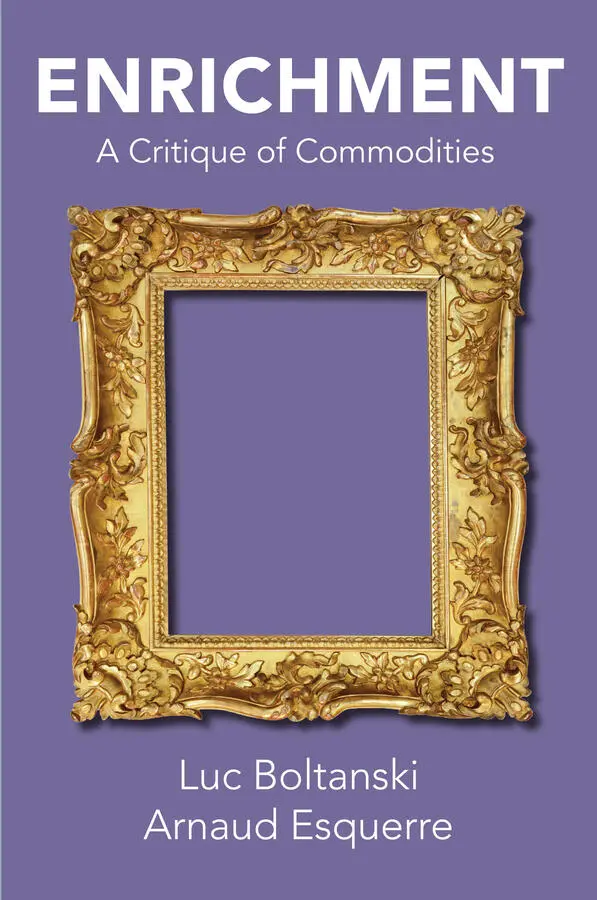
- Название:Enrichment
- Автор:
- Жанр:
- Год:неизвестен
- ISBN:нет данных
- Рейтинг книги:4 / 5. Голосов: 1
-
Избранное:Добавить в избранное
- Отзывы:
-
Ваша оценка:
Enrichment: краткое содержание, описание и аннотация
Предлагаем к чтению аннотацию, описание, краткое содержание или предисловие (зависит от того, что написал сам автор книги «Enrichment»). Если вы не нашли необходимую информацию о книге — напишите в комментариях, мы постараемся отыскать её.
Enrichment — читать онлайн ознакомительный отрывок
Ниже представлен текст книги, разбитый по страницам. Система сохранения места последней прочитанной страницы, позволяет с удобством читать онлайн бесплатно книгу «Enrichment», без необходимости каждый раз заново искать на чём Вы остановились. Поставьте закладку, и сможете в любой момент перейти на страницу, на которой закончили чтение.
Интервал:
Закладка:
The expansion of cultural activities
Another indicator that an economic sphere of enrichment is taking shape is the development of a particular domain that involves numerous activities generally brought together under the term “cultural.” These include the performing arts and artistic or graphic pursuits, but also publishing, ancient artifacts, museums, and organized special events, festivals, and salons. The fact that these cultural domains are in constant interaction with those we have just identified (luxury, heritage, tourism) helps make them hard to circumscribe. As we have seen, culture in the broad sense is understood as a major force for attracting tourists; at the same time, many cultural activities and sites are economically dependent on tourism. The extension of heritage creation in France is concentrated around sites and monuments that belong to the regional or national patrimony; their constitution and maintenance count as cultural activities. In addition, films and television series whose financing is partly conditioned on their localization in France promote an image of sites such as castles and landscapes associated with the most touristic regions. 72During the last twenty years, too, we have witnessed a rapid and significant growth in the connections – especially the financial ties – that unite the vast and fuzzy domain of culture with that of the luxury economy. Companies specializing in fashion and fashion accessories – those that make watches, jewelry, perfume, and so on, but also the hotel and restaurant industries – contribute considerably to highlighting a territory in view of attracting tourists, and these same companies, especially the major producers of luxury goods, play a growing role in financing cultural and artistic activities, injecting capital that compensates for the relative decrease in state funding and other public support. In exchange, these businesses benefit from an aesthetic authority that increases the prestige of their brands and augments the advantageous profit margins generated by the sale of their products.
Despite the blurring of boundaries and the absence of focused statistical studies, since the activities and professions considered as the heart of the vast and fuzzy domain of culture are overseen in France by an ad hoc government ministry, there are accounting frameworks that allow us to follow the most stabilized aspects of this domain and, in particular, its evolution over the last twenty years. As it happens, the statistics produced by this ministry show a significant increase in the economic role of culture in the global economy and in the number of persons employed in the cultural domain. And this is the case even though these studies unquestionably fail to take into account the entire set of activities that we have tried to characterize in a provisional way; in addition, the studies do not always focus on the same types of activity. 73Thus one study carried out at the request of the Ministry of Culture and Communication, 74designed to measure the added value of the entire cultural sphere in 2011, estimated it to be 57.8 billion euros, or 3.2 percent of overall added value in France – as much as the agricultural sphere when agrobusiness is included (and the amount rose to 44 billion euros in 2013, according to another source from the same ministry). 75And these figures do not take indirect economic benefits into account – for example, the benefits that accrue when cultural activities incite increased tourism. In terms of value added between 1995 and 2013, the growth in cultural activities was particularly significant in audiovisual productions, performing arts, visual arts, and heritage creation; growth in these sectors doubled or even tripled.
The domain of culture in France is divided between a commercial sector, which involves audiovisual productions in particular 76(39.4 percent of the value added in the production of cultural commodities in 2013), and a smaller non-commercial sector, under the aegis of central or regional government agencies; the role of this sector is especially pronounced in the performing arts and heritage sites (respectively 42.6 percent and 41.3 percent of the value added in non-commodity cultural products the same year). 77The non-commodity share in cultural activities could not have developed to such an extent without the support of the French government and, above all, of regional authorities. On the whole, this support remains at a high level, despite a certain stability or even a slight decrease in spending that reflects an effort to limit or lower public spending in general, especially since the 2008 economic crisis. In communes 78with more than 10,000 inhabitants, cultural expenses per inhabitant more than doubled between the early 1980s and the 2000s (reaching 8 percent of the budget), with an average increase of 1.7 percent per year, devoted mainly to investment. The commitment to culture was much larger in volume (about three times higher) in cities with populations of over 100,000, where cultural expenses accounted for nearly 10 percent of their budgets. Financial support came from a complex network of subsidies from overlapping territorial authorities (regions, departments, communes, groups of communes). Spending on culture in France was directed, in decreasing order, to local cultural activities, libraries, musical expression, museums, 79theater, and the maintenance of heritage sites. At the departmental level, spending on culture was particularly high in zones marked by the type of development geographers call “residential” along the western seaboard and in the southern region, to the detriment of the northern and northeastern industrial zones. 80
The growth in the cultural sectors tracked by the Ministry of Culture and Communication is even more impressive if we consider it in terms of employment. According to the sources cited above, this sector employs around 700,000 people, or roughly 2.5 percent of the active workforce, and it has seen growth of more than 50 percent since the early 1990s (as contrasted with 16 percent for the workforce overall). This growth has been particularly apparent in the professions associated with theater and the other performing arts, stimulated by recent legislation governing intermittent employment (+95 percent), but it is also perceptible in the literary professions (+58 percent) and in the visual and graphic arts (+44 percent). In this last category, the increase in the number of people employed (+123 percent) has been very pronounced in the plastic arts, fashion, and the decorative arts (graphic artists, stylists, designers). But it is also noteworthy for painters (+21 percent) and photographers (+20 percent). In addition, the people employed in the various cultural sectors share basic characteristics that distinguish them clearly from the overall workforce averages. They are younger (47 percent are under forty, as compared with an overall average age of forty-four); they are more often employed in large cities, more often born in other European countries (an effect no doubt related in particular to the role of translators in the literary professions), and are generally from a much higher social class (49 percent have a father from a middle-class background). While these cultural professions employ increasing numbers of women (the proportion rose from 39 percent in the early 1990s to 43 percent in 2011), men remain dominant, especially in the fields of art and architecture, and the proportion of women is lower than in the workforce overall, where it has reached 48 percent. But it is especially in terms of educational level that the difference between people employed in cultural fields and the overall workforce, already considerable at the beginning of the period, has increased since 1991. In 2011, 44 percent of the employees in cultural fields had at least three years of post-baccalaureate education. Highest in the literary professions (66 percent), this quite elevated educational level is also often found in people working in professions to which access has long been less constrained in France by diploma requirements, for example actors (31 percent) and plastic artists (39 percent). Finally, we must point out one other defining characteristic of people working in the cultural realm, a characteristic having to do with their employment status. Nearly 30 percent have the status of independent (freelance) workers, triple the percentage of freelance workers in other fields, and even when workers in the cultural sector are salaried employees their positions are often precarious: 30 percent have short-term contracts – twice as many as the workforce average – and 26 percent work part-time, often less than half-time, and often with quite irregular work hours. 81
Читать дальшеИнтервал:
Закладка:
Похожие книги на «Enrichment»
Представляем Вашему вниманию похожие книги на «Enrichment» списком для выбора. Мы отобрали схожую по названию и смыслу литературу в надежде предоставить читателям больше вариантов отыскать новые, интересные, ещё непрочитанные произведения.









Обсуждение, отзывы о книге «Enrichment» и просто собственные мнения читателей. Оставьте ваши комментарии, напишите, что Вы думаете о произведении, его смысле или главных героях. Укажите что конкретно понравилось, а что нет, и почему Вы так считаете.