Luc Boltanski - Enrichment
Здесь есть возможность читать онлайн «Luc Boltanski - Enrichment» — ознакомительный отрывок электронной книги совершенно бесплатно, а после прочтения отрывка купить полную версию. В некоторых случаях можно слушать аудио, скачать через торрент в формате fb2 и присутствует краткое содержание. Жанр: unrecognised, на английском языке. Описание произведения, (предисловие) а так же отзывы посетителей доступны на портале библиотеки ЛибКат.
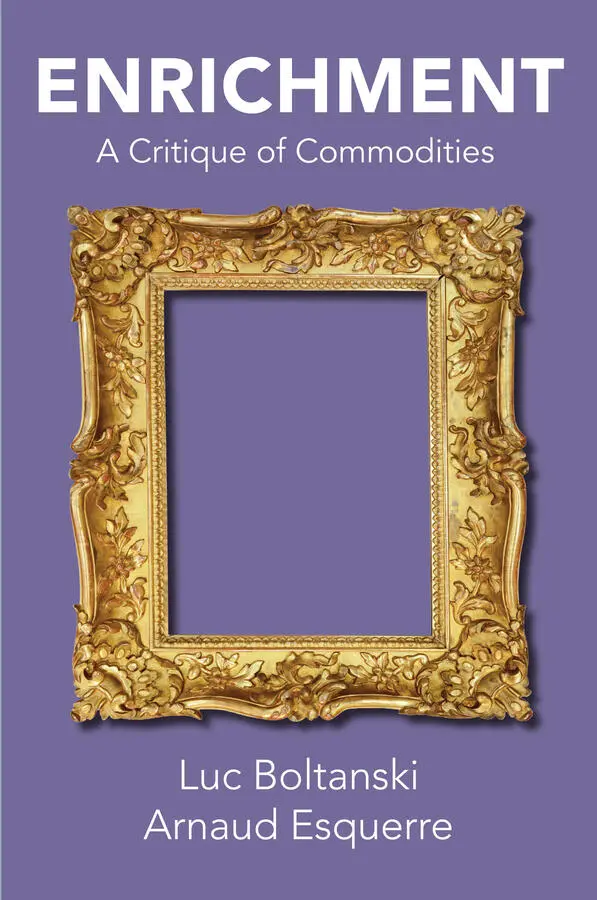
- Название:Enrichment
- Автор:
- Жанр:
- Год:неизвестен
- ISBN:нет данных
- Рейтинг книги:4 / 5. Голосов: 1
-
Избранное:Добавить в избранное
- Отзывы:
-
Ваша оценка:
Enrichment: краткое содержание, описание и аннотация
Предлагаем к чтению аннотацию, описание, краткое содержание или предисловие (зависит от того, что написал сам автор книги «Enrichment»). Если вы не нашли необходимую информацию о книге — напишите в комментариях, мы постараемся отыскать её.
Enrichment — читать онлайн ознакомительный отрывок
Ниже представлен текст книги, разбитый по страницам. Система сохранения места последней прочитанной страницы, позволяет с удобством читать онлайн бесплатно книгу «Enrichment», без необходимости каждый раз заново искать на чём Вы остановились. Поставьте закладку, и сможете в любой момент перейти на страницу, на которой закончили чтение.
Интервал:
Закладка:
The increase in the number of tourists, both French and foreign, has played an important role in exacerbating regional inequalities in development. Indeed, outside of Paris, only the Côte d’Azur and Alps regions are widely known internationally and meet the expectations of a wealthy clientele, welcoming them in palatial lodgings that are lacking in the surrounding areas. The regions in which a “residential economy” has developed have experienced growth in the number of jobs available (often in the domestic service sector), stimulated by population increases in the territory. And this latter growth has benefited not only from increased numbers of second homes but also from increased tourism, involving both people just passing through and those whose presence is intermittent but regular. By contrast, certain other areas have more difficulty attracting tourists – areas that are saddled with former or still active industrial spaces, for instance – because they do not fit the description of regions that public authorities seek to promote.
Tourism is the point of intersection among the various domains we have mentioned. Favorable to the increase in luxury commerce, the expansion of tourism during the last twenty years has also been one of the most important factors in heritage creation in France. High-end tourism benefits from the transformation of an ever-increasing number of buildings into historical monuments and of spaces into “sites of memory.” This transformation, which could be called “staging for tourism,” takes place through a shift from “raw” places to places endowed with a story , one that is usually developed by professional historians and that offers visitors an “experience” 61as soon as it is staged; digital technologies help to produce an “augmented reality.” The effectiveness of these stories makes it possible to attract tourists to spaces that may not be intrinsically very attractive, not well endowed with either monuments or sunshine, but that are, for example, sites of former battlegrounds, especially those from the First World War.
In this spirit, many studies in the field of tourist management seek to highlight the “cultural assets” of a country such as France, where tourist facilities are expensive, so as to distinguish their own country from less expensive ones: not only those of the southern hemisphere, which are reputed, according to this marketing logic, to have “nothing to offer but sea and sun,” but also those of Southern Europe, which can boast of both cultural offerings and an attractive climate. 62To “mass tourism,” which has undergone a process of standardization inspired by industrial norms, marketing agencies thus contrast “cultural tourism,” associated with the definition of “world heritage,” whose conception and promotion have benefited from the interest of major international organizations – for example, UNESCO, the World Tourism Organization, and the International Council on Monuments and Sites (ICOMOS) – and which has been associated with the definition of “world heritage.” 63Constructed in opposition to “mass tourism,” which is denigrated on the basis of its indifference to “cultural” properties and the fact that, given a favorable climate, its touristic offerings can be realized almost anywhere provided sufficient investments are made, “cultural tourism” is supposed to add to the features generally associated with tourism – comfort, availability, and security – personal involvement and experience, a sense of adventure, surprises, unexpected encounters, and so on, characteristics that have nourished the imagery of “travel” since the Romantic era. 64Initially organized around the “cult” of “historical monuments,” seen as concentrations of culture, the notion of cultural tourism has been extended to a much broader range of places by the use of the term “culture” in a sense close to the one it has in ethnology and folklore studies. According to that logic, attested by the Cultural Tourism Charter developed by ICOMOS in 1999 (replacing the 1976 charter focused on monumentality), cultural tourism is linked to an expansive definition of patrimony, so that it now includes “all aspects considered proper to a society and an environment,” with a stress on the themes of diversity (including biodiversity) and identity. 65
The marketing of cultural tourism has closely followed this institutional turn, and it is no longer oriented exclusively toward officially recognized sites or “monuments”; while these have the advantage of making it less possible to substitute other products for those on offer and thus limiting the competition, they are relatively few in number. Tourist agencies have definitively expanded the term “culture.” Thus, in a brochure published by the Malaga Chamber of Commerce designed to promote cultural tourism in the Mediterranean region, we find this definition: “Cultural tourism means traveling to places that are different from one’s usual residence, motivated by the desire to know, understand, and study other cultures: a voyage rich in experiences through cultural activities.” 66In the case of international tourism, one of the goals of cultural tourism is to increase the proportion of profits that go to service providers from the destination country in relation to the proportion destined for the companies – generally based in the country of origin – that organize the trip or the visit. While a tourist staying in a vacation camp or traveling entirely under the auspices of an international tourism company contributes little to the destination country, tourists seeking “authentic” cultural experiences must move about in a more autonomous fashion, so that their expenses will be distributed throughout the territory they visit.
Seen in this context, ordinary objects can take on value and arouse interest among tourists, all the more so if their “traditional” production is on display during visits to workshops or businesses; this then becomes “craft tourism,” promoted in France by the Association pour la visite d’entreprise (Association for Visits to Businesses). 67This process of valorization is appropriated more and more often by community members who adopt for themselves the perspective initially brought to bear on them by external observers and make an effort to shape their everyday practices and objects accordingly. They may revert to making things in the ancestral manner, both to affirm a reconstructed identity 68and to sell their products to tourists; the latter, in search of authenticity and exoticism, are looking for objects that can be brought home and added to collections. 69Hence the trend in lesser-known or quite unexpected places toward “greeters,” who offer tourists individualized visits in which the greeters’ personal stories and the community’s history are merged.
Responding to the demand for security is a central concern for cultural tourism, for security is also a primordial economic requirement. The task has two principal aspects. The first, a more or less conventional aspect, consists in keeping the most heavily visited places free of deviants deemed potentially dangerous, unpleasant, or even morally disturbing – such figures as pickpockets and beggars, Roma, mentally ill persons, itinerants, drug addicts, or alcoholics. But, beyond that, more generally, places celebrated for their beauty, charm, or traditional character must keep at a distance everyone who might affect their quality, which is associated with a certain “lifestyle” and a certain “know-how”: poor foreigners need to be excluded, for example, and even the poor in general, at least when they are not “typical” of the locality. But security questions affect the workings of a tourist economy even more urgently when a country is threatened by terrorist acts such as those that occurred in London in 2005 and in Paris in 2015, in January and again in November. 70Such acts, as their name indicates, aim to leave people feeling terror-stricken and shell-shocked. 71And few groups are as susceptible to fear as tourists, on the one hand because they travel to other countries precisely in search of calm, luxury, sensuality, and even a peace that they do not always find in their home countries, and on the other hand because, without social ties in the country they are visiting, they are easily disoriented and led astray.
Читать дальшеИнтервал:
Закладка:
Похожие книги на «Enrichment»
Представляем Вашему вниманию похожие книги на «Enrichment» списком для выбора. Мы отобрали схожую по названию и смыслу литературу в надежде предоставить читателям больше вариантов отыскать новые, интересные, ещё непрочитанные произведения.









Обсуждение, отзывы о книге «Enrichment» и просто собственные мнения читателей. Оставьте ваши комментарии, напишите, что Вы думаете о произведении, его смысле или главных героях. Укажите что конкретно понравилось, а что нет, и почему Вы так считаете.