Luc Boltanski - Enrichment
Здесь есть возможность читать онлайн «Luc Boltanski - Enrichment» — ознакомительный отрывок электронной книги совершенно бесплатно, а после прочтения отрывка купить полную версию. В некоторых случаях можно слушать аудио, скачать через торрент в формате fb2 и присутствует краткое содержание. Жанр: unrecognised, на английском языке. Описание произведения, (предисловие) а так же отзывы посетителей доступны на портале библиотеки ЛибКат.
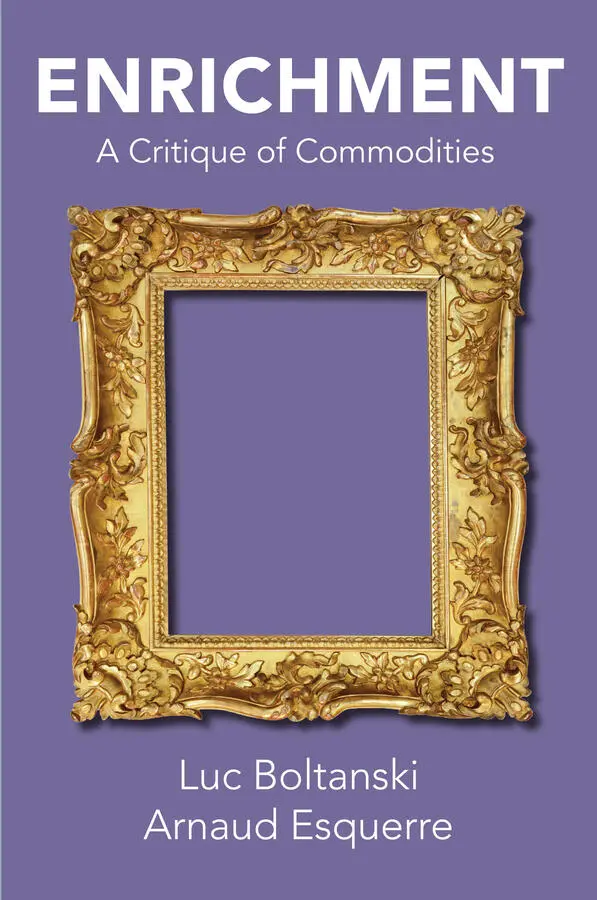
- Название:Enrichment
- Автор:
- Жанр:
- Год:неизвестен
- ISBN:нет данных
- Рейтинг книги:4 / 5. Голосов: 1
-
Избранное:Добавить в избранное
- Отзывы:
-
Ваша оценка:
Enrichment: краткое содержание, описание и аннотация
Предлагаем к чтению аннотацию, описание, краткое содержание или предисловие (зависит от того, что написал сам автор книги «Enrichment»). Если вы не нашли необходимую информацию о книге — напишите в комментариях, мы постараемся отыскать её.
Enrichment — читать онлайн ознакомительный отрывок
Ниже представлен текст книги, разбитый по страницам. Система сохранения места последней прочитанной страницы, позволяет с удобством читать онлайн бесплатно книгу «Enrichment», без необходимости каждый раз заново искать на чём Вы остановились. Поставьте закладку, и сможете в любой момент перейти на страницу, на которой закончили чтение.
Интервал:
Закладка:
More generally, the “production of local cultural singularities” has made it possible to constitute “monopoly revenues”; 32the process of localization around terroirs , which we have seen in relation to wines, has been imitated for a large number of other products of more or less local origins, such as truffles, certain mushrooms ( cèpes ), beef (from Aubrac), or fowl (capons or pullets from Bresse), but also for products that are made from imported raw materials (such as chocolate) but that supposedly benefit from a form of processing associated with a local tradition. The deep roots of tradition are called upon in particular in response to economic or moral critiques, as in the case of foie gras , viewed as a national emblem – a phenomenon that Michaela DeSoucey has called “gastronationalism.” 33This attribution of local roots to luxury food items, dispersed over a multiplicity of terroirs each of which is presumed to present special characteristics unlike any other, has accompanied a growing economic concentration in the sector of luxury foods, a sector partly absorbed by the broader French luxury industry. This is attested, for example, by the fusion of the Moët Hennessy group with the Louis Vuitton group (LVMH), or by François Pinault’s purchase of Château Latour in 1993 and Bernard Arnault’s acquisition (for LVMH) of Château d’Yquem in 1998 and then of Château Cheval Blanc in 1999. International groups with headquarters in other countries have acquired similarly prestigious properties; Garcia-Parpet highlights “an increasing share of large groups (banks, insurance companies, management and finance companies, and so on) for which investments in French luxury foods constitute a financial investment first and foremost.” 34The development of luxury foods is thus both a factor in the expansion of world capitalism and a “tool of territorial development,” because it supports local agricultural activity. It also plays a major role in showcasing two other domains that we shall now examine: tourism, increasingly focused on food, wine, and ecological concerns, 35and heritage creation, which profits from the historical enrichment of sites, terroirs , and cities associated with gastronomic traditions.
A key feature of the luxury industry is its reliance on brands. Brands can be purchased by groups as non-material agents for the prestige they carry, even in cases where their products do not bring in profits and have to be offset by other products from the same group, or, in cases where the brands belong to businesses that have ceased all activity, their names can be purchased and put back into circulation in association with a narrative about the past. The prestige of a brand name is enhanced by its identification with a country such as Italy or France, political entities that are themselves treated as brands; their worth depends in a circular fashion on the exceptional items they produce and on the “art of living” they purportedly exemplify. The idea of building the image of a country as one would do for a commercial brand is relatively recent, 36having developed in parallel with the enrichment economy. The national image may find support in any statement (or “stereotype”) that is generally associated positively with the country being promoted. In the case of France, the historical and heritage dimensions associated with its monuments, landscapes, arts, foods, and perfumes can all be foregrounded (for example Versailles, Camembert, Veuve Clicquot, Chanel no. 5, Saint Laurent). But this insistence on the past has to be associated with the idea of creation and thus with “surprise and life,” so it won’t be “perceived as conservative.” 37
This introjection of the past into the present – positing a sort of equivalence between a past considered from the vantage point of the present and a present considered from the vantage point of the future (that is, already viewed as past) – is the operation that traces the outline of “eternal France.” 38The promotion of the brand “France” presupposes close collaboration between “public authorities” and commercial brands – that is, between “the corporate competence of the State” and the businesses or groups that have an international base. This collaboration is manifested, for example, through operations such as “Christian Lacroix providing furnishings for TGV [high-speed train] lines” or “exporting the Louvre to Abu Dhabi,” in which the creation of the building was entrusted to the architect Jean Nouvel, who was charged with “updating our heritage.” As for the “targets,” they include above all “opinion leaders, business circles, experts in specific sectors, and journalists,” not to mention the “public at large” and especially (for “not all publics are equal”) “graduates of major institutions of higher education in the leading countries.” 39One of the principal aims of those who promote the “France” brand is to “influence the rankings” so as to maintain France’s place in “international comparisons,” in keeping with the requirements that stem from the generalization of benchmarking. 40
Heritage creation
In addition to interest in exceptional items, a second factor in the creation of wealth is currently growing in importance. This factor is linked to various processes that can be called processes of heritage creation . 41While they affect real estate in particular, they can also be extended to other types of goods. Examples can be found in apartments situated in the historical center of a large city, in residences located close to monuments or sites viewed as exceptional (“the loveliest villages in France”), or in housing near zones categorized as “parks” that have been subjected to “protective” measures after an administrative process of selection. Such measures typically require that they be maintained “as before” – often after the location in question has been subjected to an attempt to reconstitute a more or less fictional past. This process has a significant economic impact, since wherever it occurs it leads to major price increases in the associated lands and property, and it has important repercussions for tourism as well. For example, in the historic districts of major cities one now finds real-estate agencies advertising themselves as specialists in “collectable properties.”
A concomitant phenomenon is what might be called made-to-order heritage creation . The patrimonial effect is triggered in this case when new establishments such as museums or cultural centers are created in a given locale or when local events (festivals, commemorations, and so on) are inaugurated. In addition, there are many cases in which some part of the built environment previously deemed lacking in interest and destined to be razed – often a former site of industrial production – is rehabilitated in view of housing artistic or cultural activities that are apt to give rise to “events” or “happenings.” Heritage creation, whether made to order or not, can be achieved without regard to the venerability of the site or the building; indeed, these may have been entirely reconstructed, reconfigured, or even newly created, for heritage creation is based primarily on a narrative that inscribes a place within a genealogy.
One example of direct heritage creation, now classic and widely imitated, is that of Bilbao, an industrial city in decline whose luster has been restored by the addition of a Guggenheim museum designed by Frank Gehry. This operation was part of a broader project undertaken in the late 1980s at the initiative of the Guggenheim board in New York: its aim was to set up a “global museum” housed at various sites, chiefly in order to extend and diversify the existing exhibit spaces, which the acquisition of new collections had rendered inadequate. The plan included the establishment of a vast museum devoted to conceptual and minimalist art in North Adams, a small Massachusetts industrial town in decline. But that project ran up against the tension between the local authorities’ insistence on highlighting local identity and honoring the workers in the former factory and the Guggenheim’s wish to promote worldwide art. 42Many similar cases can be found in France: for example, the efforts made by the authorities in Nantes to enhance the image of the city by reorienting its activities toward art and culture. Among other measures, the former site of the LU cookie factory has been transformed into a national theater, the Lieu Unique (Unique Place); an “artistic itinerary” has been set up along the Loire estuary, including a series of “installations” created by well-known artists; “events” such as exhibits or festivals have proliferated; and the establishment of luxury shops has been encouraged. 43An example resembling that of Bilbao even more closely is the Luma Foundation in Arles, which called upon the same famous architect, Frank Gehry, to build a museum on the site of former train repair workshops (closed in 1984) for the purpose of developing increased tourism.
Читать дальшеИнтервал:
Закладка:
Похожие книги на «Enrichment»
Представляем Вашему вниманию похожие книги на «Enrichment» списком для выбора. Мы отобрали схожую по названию и смыслу литературу в надежде предоставить читателям больше вариантов отыскать новые, интересные, ещё непрочитанные произведения.











Обсуждение, отзывы о книге «Enrichment» и просто собственные мнения читателей. Оставьте ваши комментарии, напишите, что Вы думаете о произведении, его смысле или главных героях. Укажите что конкретно понравилось, а что нет, и почему Вы так считаете.