Luc Boltanski - Enrichment
Здесь есть возможность читать онлайн «Luc Boltanski - Enrichment» — ознакомительный отрывок электронной книги совершенно бесплатно, а после прочтения отрывка купить полную версию. В некоторых случаях можно слушать аудио, скачать через торрент в формате fb2 и присутствует краткое содержание. Жанр: unrecognised, на английском языке. Описание произведения, (предисловие) а так же отзывы посетителей доступны на портале библиотеки ЛибКат.
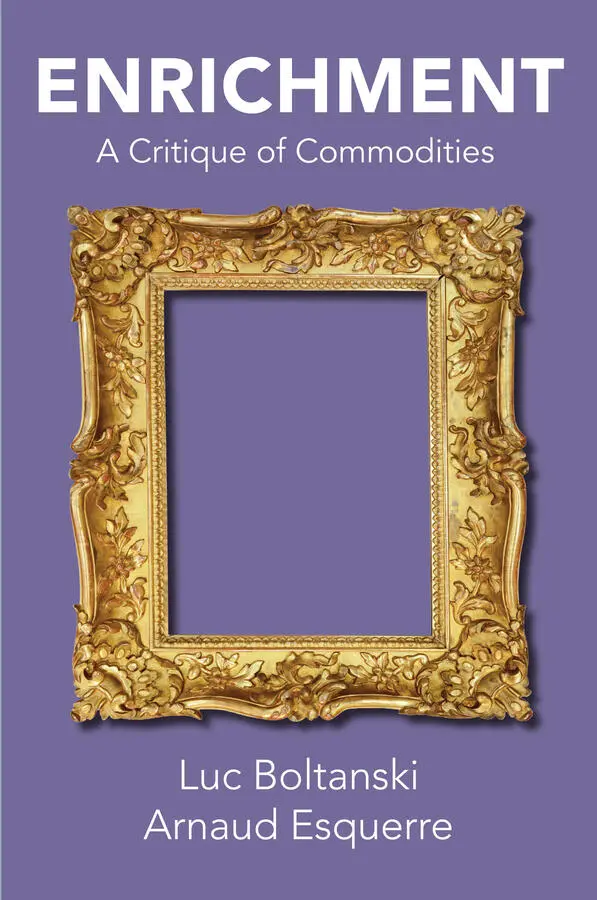
- Название:Enrichment
- Автор:
- Жанр:
- Год:неизвестен
- ISBN:нет данных
- Рейтинг книги:4 / 5. Голосов: 1
-
Избранное:Добавить в избранное
- Отзывы:
-
Ваша оценка:
Enrichment: краткое содержание, описание и аннотация
Предлагаем к чтению аннотацию, описание, краткое содержание или предисловие (зависит от того, что написал сам автор книги «Enrichment»). Если вы не нашли необходимую информацию о книге — напишите в комментариях, мы постараемся отыскать её.
Enrichment — читать онлайн ознакомительный отрывок
Ниже представлен текст книги, разбитый по страницам. Система сохранения места последней прочитанной страницы, позволяет с удобством читать онлайн бесплатно книгу «Enrichment», без необходимости каждый раз заново искать на чём Вы остановились. Поставьте закладку, и сможете в любой момент перейти на страницу, на которой закончили чтение.
Интервал:
Закладка:
In more general terms, heritage creation has become a technique of “territorial development,” with its experts in “local development strategies” who know how to “reveal” the “territorial agents” and to highlight their hidden “potential.” The instrument of choice is “relaunching,” which transforms a dormant legacy into an active heritage by stimulating the capacity of the actors to “appropriate history for themselves, even if that means transforming it.” The case of chestnuts in the Cévennes, once associated with poverty, is a good example: producers have taken steps to orient their product toward gastronomy and to protect the crop legally by a Protected Designation of Origin ( Appellation d’origine contrôlée ). These “heirs of history” use history with the goal of adding value to the goods and services they provide, so as to “specify” and to “differentiate products and services with respect to their competitors.” This systematic exploitation of the past via “relaunching” is what French experts call “patrimonial innovation.” 44This form of innovation often relies, as we have seen in the case of vineyards, on the reactivation of an ancestral figure whose ties with the site being highlighted may be more or less tenuous; the choice of a central figure and the way he or she is (re)invented play a major role in the success of the business, as Stéphane Gerson has shown in the case of Salon-de-Provence. This small city, a residential suburb of the industrial zone of Fos-sur-Mer, had little to attract tourists; owing to the decline of the petrochemical industry, it sought to give itself new luster, starting around 1975, by reactivating the only historical figure associated with its past: Nostradamus. The effort ultimately failed, quite probably because the local “great man” 45has never been the glorified subject – whether hero or villain – of a work of art or fiction that could have attracted interest – unlike Count Dracula, for example, whose presumed castle in the Carpathian Mountains draws visitors thanks to Bram Stoker’s novel and its numerous televised and film versions (such as Roman Polanski’s Dance of the Vampires ).
The processes of heritage creation have affected not only ancient cities and buildings deemed historical, moreover, but also rural areas, especially those in which the passage from an economy of agricultural production toward a residential economy has been most pronounced and most advanced. 46These processes have involved villages, sites, and even entire regions. In these cases, things from the past, often falling into ruin, are – on the same basis as collectable objects – selected, rehabilitated, and associated with historical narratives designed to orient their interpretation and enhance their value. In contrast, unlike mobile objects, these entities cannot be moved; thus associating them with other entities and inserting them in a series can be achieved only at a distance, by getting them added – often with the support of a public organization – to a list modeled on UNESCO’s repertory of worldwide heritage sites. 47By means of such lists, these entities can be represented as equivalent or in a hierarchical relation to one another (for example through attribution of Michelin-type stars). The listings, which are reversible, are generally associated with commitments – especially financial – on the part of the local authorities responsible for preserving the entities in question. This type of heritage creation has given new life to regions – in France, especially mountainous ones – threatened with depopulation beginning in the 1960s and 1970s, owing to the industrialization of European agriculture that had marked the postwar decades and the resultant decline in small family farms. Such rural regions were in a position to benefit from a sort of aesthetic heritage because their “traditional” character and their geographic specificities were already anchored in the minds of a broad public, having been highlighted by writers, landscape painters, and local scholars during the nineteenth century and the first half of the twentieth. 48It is in these regions in particular that the remaining farmers have been encouraged to take part in the “conversion of agricultural space to landscape,” a process in which the regional parks were a driving force. Under way since the mid-1980s, this trend benefited from the support of European institutions; justified above all by ecological considerations, it has been coordinated in France by a government agency devoted to “nature and landscape” under the auspices of the ministry responsible for environmental issues. It has also provided a way of facing up to the problem posed by European agricultural surpluses and, especially, a way of stimulating the attractiveness of rural areas, sought for their qualities as landscapes and increasingly for their value from a residential standpoint. The Landscape Law of 1993 extended to all such spaces a “landscape-oriented attention” that had previously been concentrated on exceptional sites. Animal breeders and farmers have thus found themselves involved in agro-environmental measures and encouraged to contribute to the “common good” by supplying an “environmental service” that turns them, sometimes against their will, into landscapers. 49
The development of tourism
A third factor in the creation of wealth is tourism, especially upscale tourism; unfortunately, the available statistical studies do not make it easy to circumscribe this sector in depth. 50Tourism has undergone considerable development over the last several decades. In 2012, international tourism (counted in terms of the number of arrivals) reached the figure of 1,035 million (compared to 25 million in 1950, 278 million in 1980, and 528 million in 1995), 51and it has more than doubled during the last twenty years. 52More than half the tourist flow is concentrated in Europe, and France remains the premier destination worldwide: 25 million foreign tourists arrived in 2015, 53and the yearly total is expected to reach 100 million between now and 2030. 54This amounts to approximately 1.3 billion nights (a night is the unit of measure for tourism). On average, tourists in France spent 80 euros a day in 2005; thus “tourist expenditure is equivalent to the income of 8 million average French citizens.” “Commercial net revenues from tourism came to some 90 billion euros in 2005 … roughly equivalent to the net revenues in the automobile and aeronautics industries.” 55Tourism represented 7.4 percent of France’s gross domestic product in 2013; 56it employed around 1.3 million people directly and generated a million supplementary jobs indirectly. 57The development of national and especially international tourism has been facilitated by a reduction in transportation costs, an increase in the absolute number of wealthy individuals, especially in the so-called emerging countries 58(associated with an increase in inequalities), and financing that associates European and local support with international enterprises, especially in the hotel and transportation sectors. 59
Tourism has stimulated the luxury industry, and specialists in tourism marketing in France emphasize the interactions between tourism and luxury, considering that “tourism creates an affinity for France, and more generally toward all of its products, everything that can be labeled ‘made in France,’” along with an affinity for “luxury,” “the great pillar of the image of our country in the world,” a pillar that underlies one of the principal motives for visits by foreign tourists: the French art de vivre , the “art of living” well. Tourism is thus viewed as a “lever for exportations that occur on French territory.” 60Most luxury products are identified with the country that is presumed to be the one in which they have been conceived and manufactured. Thus they are frequently purchased at tourist destination sites (as if that made them more “authentic”), or in airports, often as gifts, or, when they are bought in their countries of origin, in “exotic” shops frequented chiefly by tourists. Thus highlighting the national culture, promoting luxury products, and exploiting the tourist business go hand in hand; this is attested, for example, by the transformation of Saint-Germain-des-Prés. Fifty years ago, this district in the heart of Paris embodied an intellectual Bohemia; now it is a high point of international luxury that exploits the history of this Bohemia and the “existentialism” with which it has been associated.
Читать дальшеИнтервал:
Закладка:
Похожие книги на «Enrichment»
Представляем Вашему вниманию похожие книги на «Enrichment» списком для выбора. Мы отобрали схожую по названию и смыслу литературу в надежде предоставить читателям больше вариантов отыскать новые, интересные, ещё непрочитанные произведения.










Обсуждение, отзывы о книге «Enrichment» и просто собственные мнения читателей. Оставьте ваши комментарии, напишите, что Вы думаете о произведении, его смысле или главных героях. Укажите что конкретно понравилось, а что нет, и почему Вы так считаете.