Luc Boltanski - Enrichment
Здесь есть возможность читать онлайн «Luc Boltanski - Enrichment» — ознакомительный отрывок электронной книги совершенно бесплатно, а после прочтения отрывка купить полную версию. В некоторых случаях можно слушать аудио, скачать через торрент в формате fb2 и присутствует краткое содержание. Жанр: unrecognised, на английском языке. Описание произведения, (предисловие) а так же отзывы посетителей доступны на портале библиотеки ЛибКат.
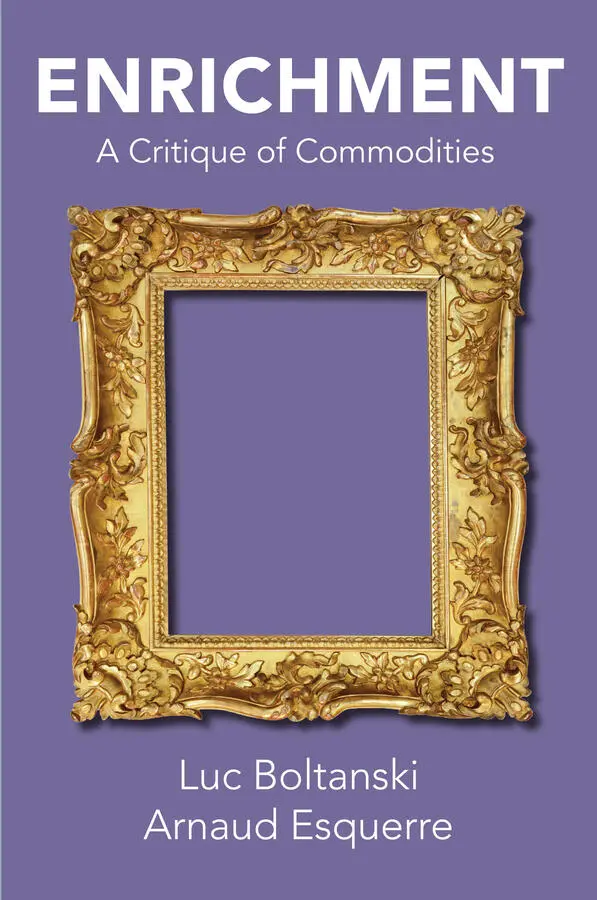
- Название:Enrichment
- Автор:
- Жанр:
- Год:неизвестен
- ISBN:нет данных
- Рейтинг книги:4 / 5. Голосов: 1
-
Избранное:Добавить в избранное
- Отзывы:
-
Ваша оценка:
Enrichment: краткое содержание, описание и аннотация
Предлагаем к чтению аннотацию, описание, краткое содержание или предисловие (зависит от того, что написал сам автор книги «Enrichment»). Если вы не нашли необходимую информацию о книге — напишите в комментариях, мы постараемся отыскать её.
Enrichment — читать онлайн ознакомительный отрывок
Ниже представлен текст книги, разбитый по страницам. Система сохранения места последней прочитанной страницы, позволяет с удобством читать онлайн бесплатно книгу «Enrichment», без необходимости каждый раз заново искать на чём Вы остановились. Поставьте закладку, и сможете в любой момент перейти на страницу, на которой закончили чтение.
Интервал:
Закладка:
In addition, the development of culture, unlike that of luxury and upscale goods, is not motivated primarily by export, because in most instances cultural commodities are not easily moved; they have to be consumed on site, as it were. This holds true of course for heritage sites, which cannot be moved, but also for a large number of activities – for example, the performing arts, art exhibits, and even literary activities – whose displacement is expensive in various respects, from transportation costs to the costs of insurance or translation. The most economical way to “export” such activities is therefore to import tourists.
The development of the various cultural domains has been driven by a significant increase in internal demand, a consequence of the considerable increase in the participants’ educational level over the last four decades. Between 1991 and 2011, the proportion of the workforce with degrees representing three years of post-baccalaureate study has doubled (to 20 percent). The proportion of household expenses devoted to cultural goods and services (not including the purchase of equipment such as computers) reached 2.5 percent of total household consumption in 2007, which corresponds to an increase of 23.3 percent over cultural spending in 2000; this is especially apparent in the area of theater and the other performing arts. 82Similarly, a study undertaken by Olivier Donnat on “French cultural practices” during the 1990s shows a slight but regular increase in attendance at shows and in visits to museums, historical monuments, and libraries, going from 4 percent for holders of a technical certificate (CAP) to 41 percent for holders of more advanced degrees. The proportion of individuals who had visited a heritage site during the past twelve months was 37 percent for people with higher education and 20 percent for those with a CAP. 83As Donnat suggests, the growth in cultural consumption is related to the increase in amateur practices, especially in theater, where these practices grew considerably during the 1990s among young people aged fifteen to nineteen, corresponding to the rise in the level of schooling.
The figures we have just mentioned, whether they concern the added value of cultural activities, the number of persons employed, or the level of consumption in the cultural realm, may appear relatively modest. But, beyond the fact that, as we have seen, they by no means include the entire set of domains that contribute to the formation of an enrichment economy, they also fail to take into account either the indirect and induced effects of these activities or their capacity to attract participants. The tendencies that these figures reveal may be more important than their absolute value. If we compare these data with the data characterizing the industrial revolution (a comparison that we shall develop more fully later on), it is useful to recall that, in the first half of the nineteenth century, a vast proportion of the lower classes consisted of farmers, craftsmen, and servants (according to the historian Peter Laslett, at the end of the Old Regime in France, some 40 percent of adolescents in Western societies underwent the experience of domestic service); 84workers in large-scale industries were still only a small minority. This fact shows, retrospectively, the prescience of Karl Marx, whose analyses could be judged utopian in his day, compared to those of Pierre-Joseph Proudhon, for example. The latter, as Pierre Ansart has shown, was in a sense the spokesman for the aspirations of craftsmen, who were still a driving force at the heart of the working class. 85
The art trade
There is probably no domain in which the commercial dimensions of cultural activities have given rise to more commentary since the beginning of the 2000s than that of contemporary art; trade in artworks has undergone changes that have attracted the attention of a growing number of art historians, critics, sociologists, and journalists. In this case, as in that of stars in the music business, in fashion, or in cinema, local cultural contributions to regional economies or to a region’s ability to attract residents has not seemed to interest the experts nearly as much as the global dimension of the phenomenon. This dimension entails what has been viewed as the formation of an art “market” unified from above, supported by a culture of celebrity on a worldwide scale – a market frequently described by journalists, 86art critics, and observers from the social sciences. 87The words used, especially in texts intended for a broad audience, evoke the vocabulary used to speak of “financial markets,” such as “trend,” “crisis,” “collapse,” “a killing” (as in the stock market), “boom” and “bust,” and “scene” 88(referring to a leading center of worldwide activity in the field). There is an emphasis on the “incredible” prices of certain works publicized by the media and, more generally, on the “colossal” sums that circulate in the upper spheres of the artistic world, as well as on the power in the hands of a small number of individuals on whom both the prices of the works and the reputation of their creators depend.
Three related phenomena, developed during the last few decades, play a pivotal role in these descriptions. First, the importance that has accrued to auctions of contemporary art conducted by the main art houses (such as Christie’s, Sotheby’s, Phillips, and, in France, Artcurial), and, more generally, the development of what is called the “secondary market” (to distinguish it from direct sales by galleries to collectors). 89Second, the multiplication of rankings: starting with the Kunstkompass , created in Germany in 1970, hierarchical listings of the principal artists worldwide (up to a hundred) are published regularly, awarding points to each artist according to varying criteria; these rankings are presumed to exercise considerable influence on collectors’ purchases (an assumption that is sometimes challenged). Other rankings have come along in the last ten years or so, claiming to classify “the most important players in the contemporary art world” on an international scale, “not in terms of fame, but in terms of influence and power”; alongside artists themselves, these lists feature critics, directors of public or private institutions and foundations, collectors, curators, journalists, and bloggers, the best known among the latter being Power 100 , published by ArtReview , followed by other publications – for example Le Monde , with its supplement featuring “fifteen who make fashion.” 90Finally, a third phenomenon, already noted above: the relationships established between the art world and the business world, especially businesses devoted to luxury goods. Ties between the arts and business are hardly new, of course: they are attested, for example, in the numerous biographies of collectors who, from the nineteenth century on, have stood out both through their financial successes and through their roles as discoverers and patrons of artists. By contrast, what does seem new is the fact that these ties, once considered private in nature and taken as evidence of taste, ostentation, and profligate spending on the part of supremely wealthy individuals, modern embodiments of the sumptuous practices of the princes of yesteryear, have now largely become public, 91and they serve to support the publicity with which luxury brands surround themselves in order to increase their sales. Thus these brands are likely to be associated not with the register of sumptuary expenditures, which formerly underlay their worth, but with that of commercial utility.
We must note that, while in most of the social science texts we have consulted the contribution of cultural activities to the development of regional economies and their power to attract new residents is generally presented in a more or less positive manner, almost as a social cause worthy of support, the processes associated with the emergence of an international art market are often called out, sometimes implicitly, when they play on the public’s fascination with the rich and the powerful (which can easily turn into indignation), and sometimes in an openly critical way. From the 1920s to the 1980s, roughly speaking, the tendency to denounce the domination exercised by money over art and culture was associated with critiques of industrial society (we shall come back to this point); art, as an expression of the uniqueness of individuals, was viewed as the chief rampart against all-out standardization. Over the last few decades, this tendency seems to have shifted toward new schemas based on the increased proximity between art and finance.
Читать дальшеИнтервал:
Закладка:
Похожие книги на «Enrichment»
Представляем Вашему вниманию похожие книги на «Enrichment» списком для выбора. Мы отобрали схожую по названию и смыслу литературу в надежде предоставить читателям больше вариантов отыскать новые, интересные, ещё непрочитанные произведения.











Обсуждение, отзывы о книге «Enrichment» и просто собственные мнения читателей. Оставьте ваши комментарии, напишите, что Вы думаете о произведении, его смысле или главных героях. Укажите что конкретно понравилось, а что нет, и почему Вы так считаете.