Luc Boltanski - Enrichment
Здесь есть возможность читать онлайн «Luc Boltanski - Enrichment» — ознакомительный отрывок электронной книги совершенно бесплатно, а после прочтения отрывка купить полную версию. В некоторых случаях можно слушать аудио, скачать через торрент в формате fb2 и присутствует краткое содержание. Жанр: unrecognised, на английском языке. Описание произведения, (предисловие) а так же отзывы посетителей доступны на портале библиотеки ЛибКат.
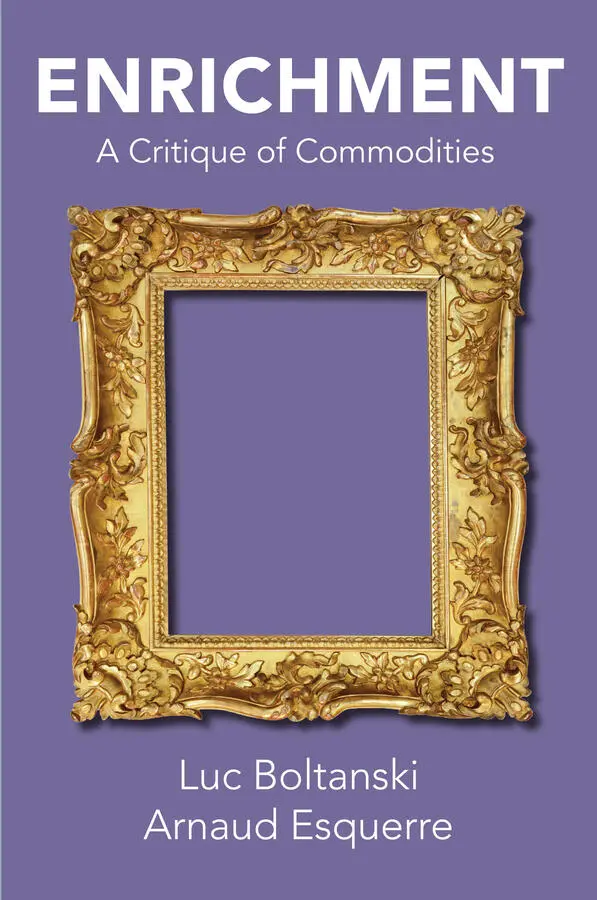
- Название:Enrichment
- Автор:
- Жанр:
- Год:неизвестен
- ISBN:нет данных
- Рейтинг книги:4 / 5. Голосов: 1
-
Избранное:Добавить в избранное
- Отзывы:
-
Ваша оценка:
Enrichment: краткое содержание, описание и аннотация
Предлагаем к чтению аннотацию, описание, краткое содержание или предисловие (зависит от того, что написал сам автор книги «Enrichment»). Если вы не нашли необходимую информацию о книге — напишите в комментариях, мы постараемся отыскать её.
Enrichment — читать онлайн ознакомительный отрывок
Ниже представлен текст книги, разбитый по страницам. Система сохранения места последней прочитанной страницы, позволяет с удобством читать онлайн бесплатно книгу «Enrichment», без необходимости каждый раз заново искать на чём Вы остановились. Поставьте закладку, и сможете в любой момент перейти на страницу, на которой закончили чтение.
Интервал:
Закладка:
Bullfighting has also played an important role in the city’s heritage creation, not only because of the associated festivals whose folkloric dimensions are intensified by their organizers but also in that it has attracted intellectuals and artists; this was especially true from the 1930s through the 1960s, when writers and painters saw this entertainment as a pinnacle of popular art, at once savage and ancestral. While the folkloric preoccupations of regional writers (for example, Charles Maurras, who won the Félibrige prize for an elegy dedicated to the Provençal poet Théodore Aubanel) and regionalist painters (Yves Brayer, for one) made Arles an attractive destination for people with right-wing tendencies (when he visited Arles in 1940, Marshal Pétain mingled with the gardians , local herdsmen who symbolized the return to the land and to traditions), the folkloric aspects of the arena, with its bulls and bullfighters evoking Spain (and the Spanish Civil War), made Arles attractive to left-leaning visitors as well. The fact that the Confédération générale du travail (CGT, a major labor union) and the Communist Party have deep roots in Arles, and the fact that the city’s residents have generally voted on the left, at least until the 1980s, helped to draw artists such as Jean Lurçat and Ossip Zadkine (the Réattu Museum had exhibits of both painters in 1953), and especially Picasso, an aficionado of the feria (he was photographed in 1959 in the arena alongside Jean Cocteau and the bullfighter Luis Miguel Dominguín). Like Cocteau, Picasso stayed at the Nord-Pinus Hotel, which helped ensure the fame of that establishment. The photographer Lucien Clergue was a major factor in the “artification” of Arles: he made it a center for photography – a “middlebrow” art whose aesthetic worth has been increasingly recognized during the last several decades – first by ensuring the opening of a photography section in the Réattu Museum as early as 1965, then by setting up an international summer photography festival in the 1970s; these gatherings, now known as the Rencontres d’Arles, increased significantly in scope starting in 1982.
The city has invested in cultural facilities such as the Mediathèque in the Espace Van Gogh and the Musée de l’Arles antique, a major archeological museum; it also sponsors cultural events – among others, a festival devoted to popular music (Les Suds), another featuring harpists (Journées de la harpe), and readings in the Saint-Trophime cloister; along with the Rencontres d’Arles, these events draw around 300,000 visitors each year. With the city’s support, numerous cultural associations have been created, and their widely varied activities range from the protection of Arles’s heritage to the plastic arts and theater. 94One objective of these cultural associations is obviously to attract establishments and enterprises that can stimulate the city’s economic activity and create jobs. The publishing house Actes Sud set up shop in Arles in 1978, and the music publisher and distributor Harmonia Mundi did the same in 1983. A school for advanced study in photography opened in Arles in 1982 in a sumptuous private residence that the city had purchased from its owners in 1978. Similar stories can be told about PRIDES (a regional association that promotes collaborative economic development), subsidiaries of book and music publishing houses, and other industries promoting culture and heritage. The publishing and audiovisual sectors, along with the arts (including the performing arts), account for some 1,000 jobs. But these new positions, while they attract white-collar workers and managers, have not sufficed to bring unemployment down to a level equivalent to the regional average. The loss of jobs in industry has not been compensated either by second homes, a sector where there has been a significant increase compared to 1990 (+44 percent) and which represents 1.8 percent of the residences in the commune, or by tourists passing through, even though this sector has developed considerably (with a bottom line of 63 million euros in 2004). The number of employees in the tourism industry in the commune came to 812 salaried workers in 2004; jobs connected to tourist accommodation (6,414 beds, including camping facilities and bed-and-breakfast operations) represented 1.4 percent of the total in January, twice that in the summer. 95However, these domestic and seasonal activities did not compensate for the loss of jobs in industry and agriculture.
It was in this context, problematic for the city’s residents and for its budget (employment by the city rose from 635 in 1980 to 1,289 in 2000), that Maja Hoffmann chose Arles as the site for the Foundation for Contemporary Art that she created in 2004; she called it Luma, after her two children, Lucas and Marina.
Maja Hoffmann, who studied cinema at the New School for Social Research in New York, is the daughter of Luc Hoffmann, a part-time resident in Arles from the 1940s on; Luc was a founder of and major contributor to the Fondation Vincent Van Gogh, which was officially established in 2010. This foundation, housed in the Hôtel Léautaud de Donines, a refurbished fifteenth-century mansion, displays works by Impressionist painters; it has ten Van Gogh paintings on loan from the Amsterdam Museum. Luc Hoffmann, an amateur ornithologist, had previously devoted much energy and a great deal of money to the ecological protection of the Camargue region. Father and daughter are among the heirs to the Swiss Hoffmann–La Roche laboratories. Some descendants of the Hoffmann family came together in 1948 in a stockholders’ pact to keep control of F. Hoffmann–La Roche SA, a pact that controls 45 percent of the company’s voting rights. In 2012, the family members’ fortune was estimated to be 16 to 17 billion in Swiss francs, 96which makes it one of the top fortunes in Switzerland. Maja Hoffmann, like her father and grandmother, has a lengthy track record as a collector and philanthropist in the realm of contemporary art. She actively supports the Palais de Tokyo in Paris, the Serpentine in London, and the Venice Biennale; she is president of the Zurich Kunsthalle and vice president of the Emanuel Hoffmann in Basel, a foundation created by her grandparents to hold their collection, which was later donated to Basel’s Museum of Contemporary Art. Like her father, Maja Hoffmann has for many years maintained a foothold in Arles, where she owns a home and a hotel; she also has a celebrated restaurant in the Camargue featuring organically produced ingredients.
The establishment of the Luma Foundation in Arles has been supported by the current mayor, Hervé Schiavetti, who is a member of the Communist Party. Drawn into regional administration after his studies in sociology at the University of Aix-en-Provence, he was elected mayor in 2001 and re-elected in both 2008 and 2014, despite the opposition of the Front de gauche, the anti-capitalist New Party, and Europe Écologie–Les Verts; these parties reproach him for being too close to the Socialists.
A first construction project initiated by Maja Hoffmann was rejected by the National Commission on Historical Monuments because it did not respect the perimeter of the heritage site. The current project, entrusted to the architect Frank Gehry – an aluminum tower 57 meters high – is under construction; the first stone was laid on 5 April 2015, and the museum, originally scheduled for completion in 2018, is now expected to open in 2020. The budget of 150 million euros is being financed entirely by Maja Hoffmann, in the largest private cultural investment in Europe. The tower is going up on the site of the old rail yards. Seven buildings from the complex (the former site of the Rencontres de la photographie) have been purchased by Hoffmann from the Provence–Alpes–Côte d’Azur region; they have been preserved and renovated. These old locomotive manufacturing and repair shops are located at the foot of the hill where the ancient city was established; the École supérieure Supinfocom, devoted to multimedia technologies, was opened in 2000, along with university residences, on about 27 acres of industrial wasteland partly owned by the city of Arles.
Читать дальшеИнтервал:
Закладка:
Похожие книги на «Enrichment»
Представляем Вашему вниманию похожие книги на «Enrichment» списком для выбора. Мы отобрали схожую по названию и смыслу литературу в надежде предоставить читателям больше вариантов отыскать новые, интересные, ещё непрочитанные произведения.








Обсуждение, отзывы о книге «Enrichment» и просто собственные мнения читателей. Оставьте ваши комментарии, напишите, что Вы думаете о произведении, его смысле или главных героях. Укажите что конкретно понравилось, а что нет, и почему Вы так считаете.