Luc Boltanski - Enrichment
Здесь есть возможность читать онлайн «Luc Boltanski - Enrichment» — ознакомительный отрывок электронной книги совершенно бесплатно, а после прочтения отрывка купить полную версию. В некоторых случаях можно слушать аудио, скачать через торрент в формате fb2 и присутствует краткое содержание. Жанр: unrecognised, на английском языке. Описание произведения, (предисловие) а так же отзывы посетителей доступны на портале библиотеки ЛибКат.
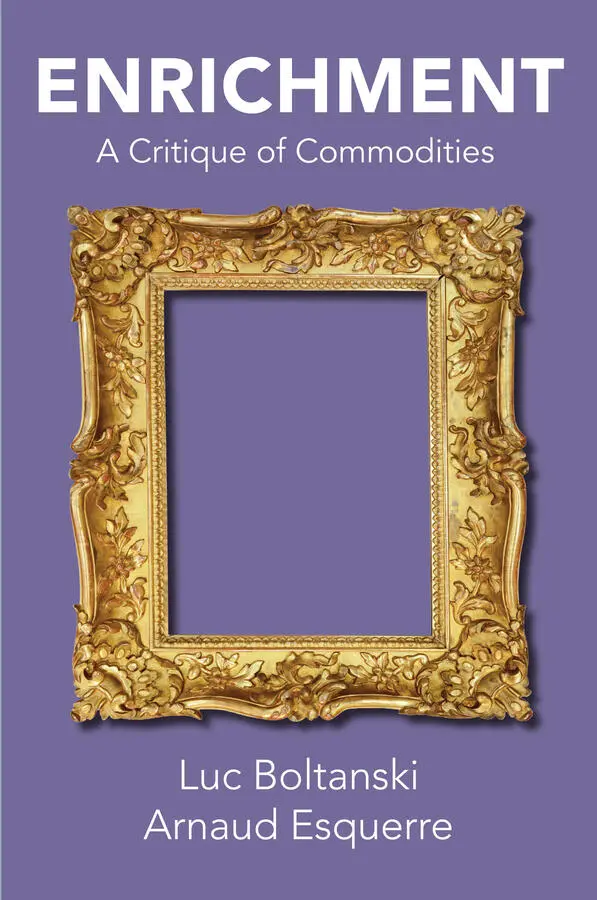
- Название:Enrichment
- Автор:
- Жанр:
- Год:неизвестен
- ISBN:нет данных
- Рейтинг книги:4 / 5. Голосов: 1
-
Избранное:Добавить в избранное
- Отзывы:
-
Ваша оценка:
Enrichment: краткое содержание, описание и аннотация
Предлагаем к чтению аннотацию, описание, краткое содержание или предисловие (зависит от того, что написал сам автор книги «Enrichment»). Если вы не нашли необходимую информацию о книге — напишите в комментариях, мы постараемся отыскать её.
Enrichment — читать онлайн ознакомительный отрывок
Ниже представлен текст книги, разбитый по страницам. Система сохранения места последней прочитанной страницы, позволяет с удобством читать онлайн бесплатно книгу «Enrichment», без необходимости каждый раз заново искать на чём Вы остановились. Поставьте закладку, и сможете в любой момент перейти на страницу, на которой закончили чтение.
Интервал:
Закладка:
37 37. Bonnal, “Comprendre et gérer.”
38 38. On the way traditions are invented, see the classic work by Eric Hobsbawm and Terence Ranger, eds, The Invention of Tradition (Cambridge: Cambridge University Press, 1983); see also Anne-Marie Thiesse, La création des identités nationales (Paris: Seuil, 1999).
39 39. Bonnal, “Comprendre et gérer.”
40 40. On the generalization of benchmarking, see especially Isabelle Bruno and Emmanuel Didier, Benchmarking: l’État sous pression statistique (Paris: Zone Books, 2013); see also Christian Laval, Francis Vergne, Pierre Clément, and Guy Dreux, La nouvelle école capitaliste (Paris: La Découverte, 2011).
41 41. The processes of heritage creation are currently receiving a great deal of attention, especially from historians and anthropologists but also from sociologists, geographers, and economists; the literature on the subject is increasing day by day. One of the most notable editorial projects in this area is a collection edited by Pierre Nora and published by Gallimard: Pierre Nora, ed., Rethinking France=Lieux de mémoire, trans. David Jordan, 4 vols (Chicago: University of Chicago Press, [1984–92] 2001). See also Xavier Greffe, La valeur économique du patrimoine (Paris: Anthropos, 1990); Alain Berger, Pascal Chevalier, Geneviève Cortes, and Marc Dedeire, eds, Patrimoines, héritages et développement rural en Europe (Paris: L’Harmattan, 2010). We should also mention the analysis by an anthropologist who studies the processes of heritage creation in Palma de Mallorca. The author shows that these are twofold processes. On one side, they put up barriers to the growth of gentrification; on the other, they promote the commodification of the zones surrounding sites of heritage creation. See Jaume Franquesa, “On Keeping and Selling: The Political Economy of Heritage Making in Contemporary Spain,” Current Anthropology, 54/3 (2013): 346–69.
42 42. See Sharon Zukin, The Culture of Cities (Oxford: Blackwell, 1995), pp. 79–108.
43 43. See, for example, the brochures “Nantes, le voyage,” and “Nantes, les adresses CHIK.”
44 44. See Berger et al., Patrimoines, pp. 5–10.
45 45. Stéphane Gerson, “Le patrimoine local impossible: Nostradamus à Salon-de-Provence (1890–1999),” Genèses, no. 92 (2013): 52–75.
46 46. In recent years most households that have changed residences in France have moved to a rural or peri-urban commune, and they justify that choice by their quest for “life in the country.” Between 1999 and 2006, rural communes have experienced a net population growth of 0.8 percent, whereas the population in urban centers has remained stable; see Jean Laganier and Dalila Vienne, “Recensement de la population en 2006: la croissance retrouvée des espaces ruraux et des grandes villes,” Insee première, no. 1218 (2009).
47 47. On policies of public heritage creation and their expression over the last forty years, see François Hartog, Regimes of Historicity: Presentism and Experiences of Time (New York: Columbia University Press, [2003] 2015), pp. 180–6. Thus, for example, whereas the Athens Charter for the Restoration of Historical Monuments focused on isolated single monuments, the Venice charter, thirty years later, included in the notion of historical monument “not only the single architectural work but also the urban or rural setting in which is found evidence of a particular civilization, a significant development or a historic event” (p. 183).
48 48. To take just one example, Vincent Biot analyzes the way the plateaus known as the Grands Causses, carved out between the gorges of the Tarn and Jonte rivers, have been highlighted. In the nineteenth century these regions still benefited from flourishing economic activities based on livestock farming, especially tanneries, millinery, and trading in wool and silk; during the first third of the twentieth century, these activities all declined, with the exception of glove-making in Millau. Learned local authors undertook to call attention to the aesthetic value of the landscape, following the nineteenth-century writers Charles Nodier, Louis de Malafosse, and especially, a little later, Édouard-Alfred Martel; these authors achieved what Vincent Biot calls the “territorial construction” of this region. See Vincent Biot, “Valorisation patrimoniale et développement touristique des Grands Causses: l’empreinte d’Édouard-Alfred Martel (1859–1938),” in Jean-Yves Andrieux and Patrick Harismendy, eds, Initiateurs et entrepreneurs culturels du tourisme (1850–1950) (Rennes: Presses Universitaires de Rennes, 2011), pp. 35–46.
49 49. See Jacqueline Candau and Ludovic Ginelli, “L’engagement des agriculteurs dans un service environnemental: l’exemple du paysage,” Revue française de sociologie, 52/4 (2011): 691–718. Candau and Ginelli carried out their investigation among farmers in the Morvan and the Saint-Nectaire regions.
50 50. The proportion of lodgings in hotels as compared to those in campgrounds and other recognized “tourist accommodations” (holiday cottages, temporary rentals, vacation villages, and so on) can serve as a rough indicator for a first estimate of the proportion of high-end tourism: it is about 45 percent in France, where so-called open-air hotels play an important role. See “Le tourisme en Europe en 2015,” Insee première, no. 1610 (2016).
51 51. Tourism is one of the elements that allow geographers to understand the connection between the phenomena of globalization and the processes of reinforcing collective identities: see Peter Burns, “Brief Encounters: Culture, Tourism, and the Local–Global Nexus,” in Salah Wahab and Chris Cooper, eds, Tourism in the Age of Globalization (Abingdon: Routledge, 2001), pp. 290–305.
52 52. International tourism represents a market of 1,200 billion dollars and contributes 9 percent to the world economy; see Frédéric Pierret, “Le tourisme est-il devenu un enjeu stratégique?” Annales des Mines – Réalités industrielles, no. 3 (2015): 9–13.
53 53. Veille info tourisme, Ministère de l’Artisanat, du Commerce et du Tourisme ( www.veilleinfotourisme.fr/).
54 54. According to the assistant director of tourism in the office of tourism, commerce, arts and crafts, and services, Direction Générale des Entreprises (DGE), Ministère de l’Économie, de l’Industrie et du Numérique (interviewed by the authors, February 18, 2016).
55 55. Davezies, La République et ses territoires, p. 38.
56 56. DGE, available at www.veilleinfotourisme.fr/.
57 57. Pierret, “Le tourisme.”
58 58. In the European Union, the leading clientele is from Asia (39 percent of overnight stays), closely followed by the North American contingent (37 percent). The United Kingdom is the primary Asian destination; it attracts tourists especially from English-speaking countries and the Commonwealth; France and Italy come next. France draws more tourists from China and Japan than the other European countries: the rapidly growing Chinese clientele overtook the Japanese in 2012. See “Le tourisme en France,” Insee première.
59 59. Saskia Cousin and Bertrand Réau, Sociologie du tourisme (Paris: La Découverte, 2009), pp. 59–67.
60 60. Georges Panayotis, “Le tourisme français: un secteur économique majeur au fort potentiel,” Annales des Mines – Réalités industrielles, no. 3 (2015): 15–19.
61 61. On “experience management,” see B. Joseph Pine II and James H. Gilmore, The Experience Economy: Work is Theatre & Every Business a Stage (Boston: Harvard Business School Press, 1999), esp. pp. 15–17.
62 62. The proportion of overnight stays by the sea in relation to the overall number of nights can serve as an indicator to distinguish, among the European countries that have the highest percentage of tourists (the proportion of overnight stays in relation to the resident population), those whose potential for tourism rests not only on their “cultural” assets but also on the prominence of their coastal regions and on favorable climates that allow for a longer tourist season. This is the case for Spain, which benefits both from cultural tourism and “sea-and-sun” tourism; the proportion of overnight stays on the coast (80 percent) is more than double the proportion in France (around 35 percent). Spain, where the number of nights increased by 3.3 percent between 2012 and 2015 (compared to 0.4 percent in France), attracts a large number of Northern Europeans, especially to its seaside resorts, and it has benefited from “reports detrimental to countries outside of Europe deemed ‘risky.’” More generally, the southern coasts attract most of the foreign tourists coming from Europe: see “Le tourisme en Europe,” Insee première.
Читать дальшеИнтервал:
Закладка:
Похожие книги на «Enrichment»
Представляем Вашему вниманию похожие книги на «Enrichment» списком для выбора. Мы отобрали схожую по названию и смыслу литературу в надежде предоставить читателям больше вариантов отыскать новые, интересные, ещё непрочитанные произведения.










Обсуждение, отзывы о книге «Enrichment» и просто собственные мнения читателей. Оставьте ваши комментарии, напишите, что Вы думаете о произведении, его смысле или главных героях. Укажите что конкретно понравилось, а что нет, и почему Вы так считаете.