Luc Boltanski - Enrichment
Здесь есть возможность читать онлайн «Luc Boltanski - Enrichment» — ознакомительный отрывок электронной книги совершенно бесплатно, а после прочтения отрывка купить полную версию. В некоторых случаях можно слушать аудио, скачать через торрент в формате fb2 и присутствует краткое содержание. Жанр: unrecognised, на английском языке. Описание произведения, (предисловие) а так же отзывы посетителей доступны на портале библиотеки ЛибКат.
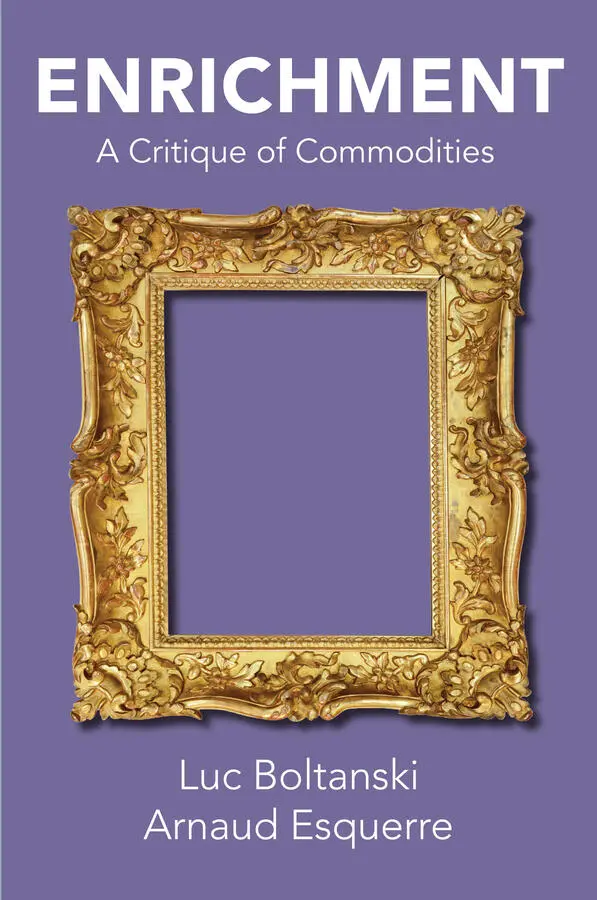
- Название:Enrichment
- Автор:
- Жанр:
- Год:неизвестен
- ISBN:нет данных
- Рейтинг книги:4 / 5. Голосов: 1
-
Избранное:Добавить в избранное
- Отзывы:
-
Ваша оценка:
Enrichment: краткое содержание, описание и аннотация
Предлагаем к чтению аннотацию, описание, краткое содержание или предисловие (зависит от того, что написал сам автор книги «Enrichment»). Если вы не нашли необходимую информацию о книге — напишите в комментариях, мы постараемся отыскать её.
Enrichment — читать онлайн ознакомительный отрывок
Ниже представлен текст книги, разбитый по страницам. Система сохранения места последней прочитанной страницы, позволяет с удобством читать онлайн бесплатно книгу «Enrichment», без необходимости каждый раз заново искать на чём Вы остановились. Поставьте закладку, и сможете в любой момент перейти на страницу, на которой закончили чтение.
Интервал:
Закладка:
10 10. Ibid., pp. 58–9.
11 11. In one-third of French households, the head of the household is retired. For a statistical analysis of the distribution of retirees, see Jean-François Léger, “La répartition géographique des retraités: les six France,” Population & Avenir, no. 716 (January–February 2014): 4–7. In France, the greatest proportion of retired workers or salaried employees with low incomes is found in the former industrial regions in the northeast. As for retired white-collar workers, found in particularly high numbers in the large urban centers, they are also increasingly numerous in the less urbanized territories in the coastal and southern regions owing to “very selective migratory and economic population flows (retirees with high incomes)”; see also Jean-Marc Zaninetti, “Les retraités en France: des migrations pas comme les autres,” Population & Avenir, no. 703 (May–June 2011): 4–20.
12 12. Gwendoline Volat, “L’habitat rural entre 1999 et 2009: des évolutions contrastées,” Le Point sur, Commissariat général au développement durable, no. 179 (December 2013).
13 13. Davezies, La République et ses territoires, p. 68.
14 14. This horizon of integral capitalism in which everyone is expected to become a merchant contrasts with that of merchants doing business abroad; see in the eighteenth century, as described by Francesca Trivellato in The Familiarity of Strangers: The Sephardic Diaspora, Livorno, and Cross-Cultural Trade in the Early Modern Period (New Haven, CT: Yale University Press, 2009). Trivellato depicts merchants as a distinct category (focusing here on Sephardic Jews from Livorno in Tuscany) and connects them with their merchandise (especially coral and diamonds). See also Fernand Braudel, Afterthoughts on Material Civilization and Capitalism (Baltimore: Johns Hopkins University Press, 1977).
15 15. For literature in French, see especially Nathalie Heinich, De la visibilité: excellence et singularité en régime médiatique (Paris: Gallimard, 2012).
16 16. See Alain Desrosières and Laurent Thévenot, Les catégories socio-professionnelles (Paris: La Découverte, 1988), and, for a recent update, Thomas Amossé, “La nomenclature socio-professionnelle: une histoire revisitée,” Annales: Histoire, Sciences Sociales, 68/4 (2013): 1039–75. The population that interests us can be sought here by relying on surveys by INSEE (the French National Institute of Statistics and Economic Studies). But, given the structure of the surveys and the nomenclatures they use, it is hard to come up with reliable figures, and the findings can always be challenged.
17 17. In L’esthétisation du monde: vivre à l’âge du capitalisme artiste (Paris: Gallimard, 2013), Gilles Lipovetsky and Jean Serroy propose to approach different things from the perspective of aestheticization as a “systematic incorporation of the creative and imaginary dimension in the sectors of commodity consumption.” Considered especially in terms of its current development, the “aestheticization of the world triggered by capitalism was to appear,” according to the authors, “starting in the second half of the nineteenth century” (p. 39). The idea of “aesthetic capitalism” is also defended by Gernot Böhme, Ästhetischer Kapitalismus (Berlin: Suhrkamp, 2016).
18 18. The Comité Colbert, created in 1954, brings together representatives from the luxury industry and French cultural institutions. See Christian Blanckaert, Les 100 mots du luxe (Paris: Presses Universitaires de France, 2010). (Blanckaert has served as director of Hermès international and as presiding delegate of the Colbert Committee.)
19 19. Romain Sautard, Valérie Duchateau, and Jeannot Rasolofoarison, “Les biens haut de gamme, un avantage comparatif européen,” Trésor Éco, no. 118 (September 2013). Of 270 prestigious brands surveyed in the world, 130 are French (Benjamin Leperchey, “Le Comité stratégique de filière (CSF) des industries de la mode et du luxe,” Annales des Mines –Réalités industrielles, no. 4 (2013): 14–19.
20 20. According to the Ministry of Economy, the “luxury industries” (including fashion, the culinary arts, and outstanding food products, especially wines and spirits, but excluding tourism) employ 170,000 people in France, for a bottom line of 43 billion euros.
21 21. Sautard et al., “Les biens haut de gamme.”
22 22. In France, the thirty leading brands in the fashion sector have cumulative sales amounting to 15 billion euros, of which 85 percent come from exports; see Leperchey, “Le Comité stratégique.”
23 23. Kenzo and Givenchy moved part of their operations to Poland, Vuitton to Romania; Hermès relied on Nigerian or Madagascan subcontractors. Italian brands did similar things: Prada moved part of its leather goods production to Turkey; Dolce & Gabbana outsourced some of its ready-to-wear apparel to Egypt; and so on. When the product is assembled in the brand’s home country, the components subcontracted to a country with low wages are those requiring the most hours of work – for example, in the case of a handbag, the handle. See Maxime Koromyslov, “Le ‘Made in France’ en question: pratiques et opinions des professionnels français du luxe,” Revue française de gestion, nos. 218–19 (2011): 107–22.
24 24. There is no universal legal framework requiring that a product’s country of origin be identified. Unlike the American context, for example, the European context is permissive. “The choice in branding at the point of importation and commercialization on national territory is left to the discretion of the manufacturer and thus remains optional” (ibid., p. 111).
25 25. Ibid., p. 120.
26 26. See chapter 8, pp. 206–7.
27 27. Roxana Azimi, “L’élite prend l’art,” M le magazine du Monde (April 5, 2014).
28 28. Vincent Marcilhac, Le luxe alimentaire: une singularité française (Rennes: Presses Universitaires de Rennes, 2012), p. 27.
29 29. See Alessandro Stanziani, Histoire de la qualité alimentaire, XIXe–XXe siècle (Paris: Seuil, 2005).
30 30. On the importance of authenticity in gastronomy, see Josée Johnston and Shyon Baumann, “Democracy versus Distinction: A Study of Omnivorousness in Gourmet Food Writing,” American Journal of Sociology, 113/1 (2007): 165–204.
31 31. Marie-France Garcia-Parpet, Le marché de l’excellence: les grands crus à l’épreuve de la mondialisation (Paris: Seuil, 2009).
32 32. Marcilhac, Le luxe alimentaire, p. 34; and on the growing ascendancy of the big multinational groups over the prestigious vineyards, see Garcia-Parpet, Marché de l’excellence, pp. 140–5.
33 33. Michaela DeSoucey, “Food Traditions and Authenticity Politics in the European Union,” American Sociological Review, 75/3 (2010): 432–55.
34 34. Garcia-Parpet, Marché de l’excellence, pp. 172–3.
35 35. Thus, for instance, the association “Bienvenue à la ferme,” supported by the Chamber of Agriculture of the Loiret (a region with a significant architectural heritage), describes itself as the “first French network for direct sales and for welcoming [visitors] to farms”; in its annual brochure, local winemakers and producers offer recipes to a cosmopolitan audience, but they nevertheless specify the use of traditional local products: “sauerkraut with fish from the Loire in a baking dish, sauce with butter from Nantes,” is presented by two Loire fishermen, a “lamb tagine” is described by locals who raise sheep, and a “stew with ancient vegetables” is proposed by fruit and vegetable growers.
36 36. Françoise Bonnal traces the notion of “nation branding” back to the publication of Philip Kotler’s book, Marketing Places: Attracting Investment, Industry and Tourism to Cities, States, and Nations (New York: Free Press, 1993); the notion was first put to work in marketing tourism. See Françoise Bonnal, “Comprendre et gérer la marque France: mode d’emploi pour les acteurs de la marque France,” Revue française de gestion, nos. 218–19 (2001): 27–43. Currently, many agencies, mostly based in London, specialize in the construction and diffusion of markers of identity and national narratives designed to highlight nations, regions, and cities, associating them with products in order to promote their commercialization; see Melissa Aronczyk, Branding the Nation: The Global Business of National Identity (Oxford: Oxford University Press, 2013).
Читать дальшеИнтервал:
Закладка:
Похожие книги на «Enrichment»
Представляем Вашему вниманию похожие книги на «Enrichment» списком для выбора. Мы отобрали схожую по названию и смыслу литературу в надежде предоставить читателям больше вариантов отыскать новые, интересные, ещё непрочитанные произведения.












Обсуждение, отзывы о книге «Enrichment» и просто собственные мнения читателей. Оставьте ваши комментарии, напишите, что Вы думаете о произведении, его смысле или главных героях. Укажите что конкретно понравилось, а что нет, и почему Вы так считаете.