Luc Boltanski - Enrichment
Здесь есть возможность читать онлайн «Luc Boltanski - Enrichment» — ознакомительный отрывок электронной книги совершенно бесплатно, а после прочтения отрывка купить полную версию. В некоторых случаях можно слушать аудио, скачать через торрент в формате fb2 и присутствует краткое содержание. Жанр: unrecognised, на английском языке. Описание произведения, (предисловие) а так же отзывы посетителей доступны на портале библиотеки ЛибКат.
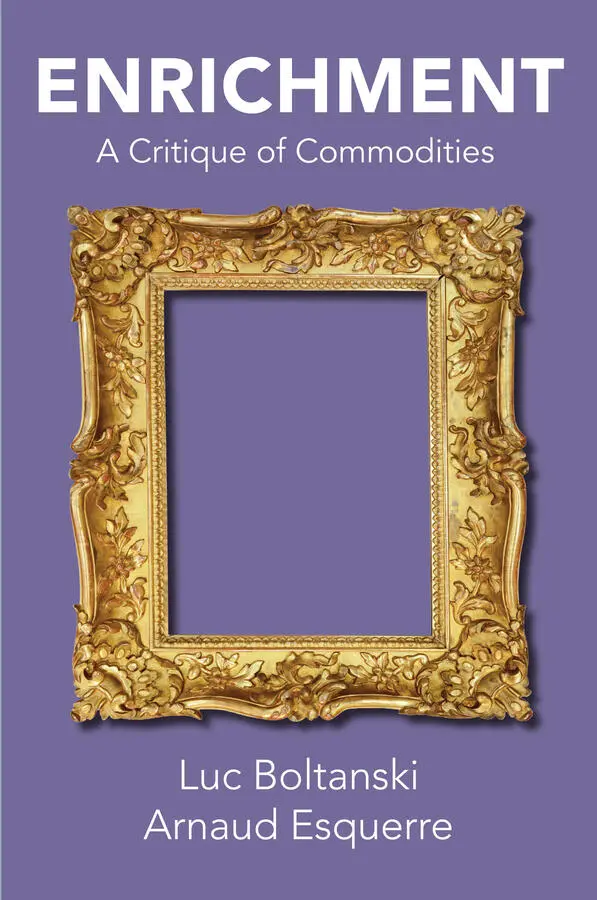
- Название:Enrichment
- Автор:
- Жанр:
- Год:неизвестен
- ISBN:нет данных
- Рейтинг книги:4 / 5. Голосов: 1
-
Избранное:Добавить в избранное
- Отзывы:
-
Ваша оценка:
Enrichment: краткое содержание, описание и аннотация
Предлагаем к чтению аннотацию, описание, краткое содержание или предисловие (зависит от того, что написал сам автор книги «Enrichment»). Если вы не нашли необходимую информацию о книге — напишите в комментариях, мы постараемся отыскать её.
Enrichment — читать онлайн ознакомительный отрывок
Ниже представлен текст книги, разбитый по страницам. Система сохранения места последней прочитанной страницы, позволяет с удобством читать онлайн бесплатно книгу «Enrichment», без необходимости каждый раз заново искать на чём Вы остановились. Поставьте закладку, и сможете в любой момент перейти на страницу, на которой закончили чтение.
Интервал:
Закладка:
63 63. Saskia Cousin, “L’Unesco et la doctrine du tourisme culturel: généalogie d’un ‘bon’ tourisme,” Civilisations, no. 57 (2008): 41–56.
64 64. For examples of the use of “the symbolics of travel” – an area in which writers such as Nicolas Bouvier and Bruce Chatwin are the current heroes – as instruments for critiquing the “tourism industry,” see among others Rodolphe Christin, L’usure du monde: critique de la déraison touristique (Montreuil: L’Échappée, 2014).
65 65. Cousin, “L’Unesco,” pp. 47–8.
66 66. The Malaga Chamber of Commerce, Le tourisme culturel en Méditerranée: quelques opportunités pour l’Espagne, la France, le Maroc, la Tunisie, in Invest in Med (Marseille: Etinet, Euromediterranean Tourist Network, 2011): 11.
67 67. See www.entrepriseetdecouverte.fr/.
68 68. Jonathan Friedman has analyzed the role played by tourism in the processes of identity affirmation that accompany globalization. For example, in the case of the Ainu people in northern Japan, the rearrangement of living spaces to make them conform better to the expectations of tourists seeking exoticism and the increased production of “traditional” objects for sale to tourists constitute “conscious strategies of identity reconstruction,” strategies that accompany calls for autonomy stressing ethnic specificity: see Jonathan Friedman, Cultural Identities and Global Process (London: Sage, 1994), pp. 109–13.
69 69. See Nelson Graburn, ed., Ethnic and Tourist Arts (Oakland: University of California Press, 1979); Paul van der Grijp, Art and Exoticism: An Anthropology of the Yearning for Authenticity (London: Transaction, 2009); and on authenticity as an argument for tourism, see Dennison Nash, Anthropology of Tourism (Oxford: Pergamon Press, 1996).
70 70. More generally, for countries that draw a significant portion of their revenues from tourism, the demand for security plays a central role; it lies at the heart of professional preoccupations, as we have seen for example in countries such as Egypt and Tunisia, where heritage sites and museums have been targeted in particular.
71 71. See Gérôme Truc, Shellshocked: The Social Response to Terrorist Attacks, trans. Andrew Brown (Cambridge: Polity, 2017).
72 72. On the filming of television dramas in castles, see Sabine Chalvon-Demersay, “La saison des châteaux: une ethnographie des tournages en ‘décors réels’ pour la télévision,” Réseaux, no. 172 (2012): 175–213.
73 73. As is very often the case in this type of quantitative study, the figures obtained are approximate and thus debatable, in the sense that they depend on the nomenclatures used and the methods adopted – for example, in this case, the decision to include “indirect activities” in the count.
74 74. Serge Kancel, Jérôme Itty, Morgane Weill, and Bruno Durieux, L’apport de la culture à l’économie de la France (Paris: Inspection générale des finances, 2013).
75 75. Yves Jauneau and Xavier Niel, “Le poids économique direct de la culture en 2013,” Culture Chiffres, no. 5 (2014): 1–18.
76 76. By “audiovisual” we refer here to radio, cinema, television, video, and CDs.
77 77. Kancel et al., L’apport de la culture.
78 78. A commune is a French administrative unit corresponding to a village, city, or incorporated township.
79 79. The number of museums and monuments open to the public in France, inventoried in a guide published by the Éditions du Cherche-Midi, increased from 7,000 in the 1992 edition to 10,000 in 2001: see Josquin Barré, “L’impact de la variable prix dans le tourisme culturel,” in Jean-Michel Tobelem, ed., La culture mise à prix (Paris: L’Harmattan, 2005), pp. 105–26.
80 80. See Jean-Cédric Delvainquière, François Tugores, Nicolas Laroche, and Benoît Jourdan, “Les dépenses culturelles des collectivités territoriales en 2010: 7,6 milliards d’euros pour la culture,” Culture Chiffres, no. 3 (2014):1–32.
81 81. Marie Gouyon and Frédérique Patureau, “Vingt ans d’évolution de l’emploi dans les professions culturelles,” Culture Chiffres, no. 6 (2014): 1–24.
82 82. Chantal Lacroix, “Les dépenses de consommation des ménages en biens et services culturels et télécommunications,” Culture Chiffres, no. 2 (2009): 1–7.
83 83. Olivier Donnat, Les pratiques culturelles des Français: enquête 1997 (Paris: La Documentation française, 1998), pp. 221, 279, 291.
84 84. Peter Laslett, Finnish Life and Illicit Love in Earlier Generations (Cambridge: Cambridge University Press, 1977), p. 43.
85 85. Pierre Ansart, Marx et l’anarchisme (Paris: Presses Universitaires de France, 1969).
86 86. See for example Harry Bellet, Le marché de l’art s’écroule demain à 18 h 30 (Paris: Nil, 2001); Daniel Granet and Catherine Lamour, Grands et petits secrets du monde de l’art (Paris: Fayard, 2010); and Don Thompson, The $12 Million Stuffed Shark: The Curious Economics of Contemporary Art (New York: Palgrave Macmillan, 2008).
87 87. See especially Isabelle Graw, High Price: Art between the Market and Celebrity Culture (Berlin: Sternberg, 2009); Sarah Thornton, Seven Days in the Art World (New York: W. W. Norton, 2008); Pierre-Michel Menger, The Economics of Creativity: Art and Achievement under Uncertainty, trans. Stephen Rendell et al. (Cambridge, MA: Harvard University Press, [2009] 2014); Nathalie Heinich, Le paradigme de l’art contemporain: structures d’une révolution artistique (Paris: Gallimard, 2014).
88 88. See Daniel Aaron Silver and Terry Nichols Clark, Scenescapes: How Qualities Shape Social Life (Chicago: University of Chicago Press, 2016).
89 89. See Olaf Velthuis, Talking Prices: Symbolic Meanings of Prices on the Market for Contemporary Art (Princeton, NJ: Princeton University Press, 2005).
90 90. See Alain Quemin, Les stars de l’art contemporain: notoriété et consécration artistique dans les arts visuels (Paris: CNRS, 2013); on rankings of personalities, see especially pp. 205–76.
91 91. Art collectors themselves are ranked, particularly in terms of their notoriety and their visibility, on the site Larry’s List ( www.larryslist.com).
92 92. According to the highly successful model presented by Robert H. Frank and Philip J. Cook, The Winner-Take-All Society: Why the Few at the Top Get So Much More than the Rest of Us (New York: Free Press, 1995).
93 93. Jean-Jacques Arrighi and Marjorie Martin, “Grand Arles: des difficultés à surmonter, des atouts à exploiter,” Insee études, no. 31 (2013).
94 94. See Jean-Maurice Rouquette, ed., Arles: histoire, territoires et cultures (Paris: Imprimerie nationale, 2008).
95 95. The statistics in this section come from Rouquette, Arles, and Arrighi and Martin, “Grand Arles.”
96 96. According to the magazine Bilan (November 30, 2012).
97 97. See the reports of the Boston Consulting Group ( www.bcg.com) and Gabriel Zucman, The Hidden Wealth of Nations: The Scourge of Tax Havens, trans. Teresa Lavender Fagan (Chicago: University of Chicago Press, [2013] 2015), pp. 29–30.
98 98. On the problems that this two-track consumption poses to the mass distribution sector, see Philippe Moati, L’avenir de la grande distribution (Paris: Odile Jacob, 2001) and La nouvelle révolution commerciale (Paris: Odile Jacob, 2011).
2 Toward Enrichment
The characteristics of an enrichment economy
The domains covered by an enrichment economy are not simply appended to the sectors of an industrial economy as add-ons that contribute, each in its own way, to a global bottom line. The enrichment economy is characterized by special features that have wide-reaching economic and social consequences. It is based on mechanisms that are in many respects quite different from those of an industrial economy. To prepare for the detailed analyses that follow, let us begin with an overview and several examples.
Читать дальшеИнтервал:
Закладка:
Похожие книги на «Enrichment»
Представляем Вашему вниманию похожие книги на «Enrichment» списком для выбора. Мы отобрали схожую по названию и смыслу литературу в надежде предоставить читателям больше вариантов отыскать новые, интересные, ещё непрочитанные произведения.










Обсуждение, отзывы о книге «Enrichment» и просто собственные мнения читателей. Оставьте ваши комментарии, напишите, что Вы думаете о произведении, его смысле или главных героях. Укажите что конкретно понравилось, а что нет, и почему Вы так считаете.