Francis Rouessac - Chemical Analysis
Здесь есть возможность читать онлайн «Francis Rouessac - Chemical Analysis» — ознакомительный отрывок электронной книги совершенно бесплатно, а после прочтения отрывка купить полную версию. В некоторых случаях можно слушать аудио, скачать через торрент в формате fb2 и присутствует краткое содержание. Жанр: unrecognised, на английском языке. Описание произведения, (предисловие) а так же отзывы посетителей доступны на портале библиотеки ЛибКат.
- Название:Chemical Analysis
- Автор:
- Жанр:
- Год:неизвестен
- ISBN:нет данных
- Рейтинг книги:3 / 5. Голосов: 1
-
Избранное:Добавить в избранное
- Отзывы:
-
Ваша оценка:
Chemical Analysis: краткое содержание, описание и аннотация
Предлагаем к чтению аннотацию, описание, краткое содержание или предисловие (зависит от того, что написал сам автор книги «Chemical Analysis»). Если вы не нашли необходимую информацию о книге — напишите в комментариях, мы постараемся отыскать её.
provides an up-to-date overview of the common methods used for qualitative, quantitative, and structural chemical analysis. Assuming no background knowledge in the subject, this student-friendly textbook covers the fundamental principles and practical aspects of more than 20 separation and spectroscopic methods, as well as other important techniques such as elemental analysis, electrochemistry and isotopic labelling methods.
Avoiding technical complexity and theoretical depth, clear and accessible chapters explain the basic concepts of each method and its corresponding instrumental techniques—supported by explanatory diagrams, illustrations, and photographs of commercial instruments. The new edition includes revised coverage of recent developments in supercritical fluid chromatography, capillary electrophoresis, miniaturized sensors, automatic analyzers, digitization and computing power, and more. Offering a well-balanced introduction to a wide range of analytical and instrumentation techniques, this textbook:
Provides a detailed overview of analysis methods used in the chemical and agri-food industries, medical analysis laboratories, and environmental sciences Covers various separation methods including chromatography, electrophoresis and electrochromatography Describes UV and infrared spectroscopy, fluorimetry and chemiluminescence, x-ray fluorescence, nuclear magnetic resonance and other common spectrometric methods such atomic or flame emission, atomic absorption and mass spectrometry Includes concise overview chapters on the general aspects of chromatography, sample preparation strategies, and basic statistical parameters Features examples, end-of-chapter problems with solutions, and a companion website featuring PowerPoint slides for instructors
, is the perfect textbook for undergraduates taking introductory courses in instrumental analytical chemistry, students in chemistry, pharmacy, biochemistry, and environmental science programs looking for information on the techniques and instruments available, and industry technicians working with problems of chemical analysis.
Review of Second Edition “An essential introduction to a wide range of analytical and instrumentation techniques that have been developed and improved in recent years.”
–
Chemical Analysis — читать онлайн ознакомительный отрывок
Ниже представлен текст книги, разбитый по страницам. Система сохранения места последней прочитанной страницы, позволяет с удобством читать онлайн бесплатно книгу «Chemical Analysis», без необходимости каждый раз заново искать на чём Вы остановились. Поставьте закладку, и сможете в любой момент перейти на страницу, на которой закончили чтение.
Интервал:
Закладка:
For a long time in gas chromatography, an adjustment value called the effective plate height H effwas calculated using the true efficiency, instead of the theoretical efficiency.
The calculation of H efffrom the real efficiency uses Eq. (1.20):
(1.20) 
Reduced plate height
In liquid chromatography, when the column is filled with spherical particles, a parameter known as the reduced plate height h is often encountered. This parameter takes into account the mean diameter d mof the particles. This eliminates the effect of the particle size for better comparison of columns with different mean diameter values. Columns with the same reduced plate height h will yield similar performance.
(1.21) 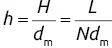
1.7 RETENTION PARAMETERS
1.7.1 Retention Times
The definition of retention times has been given previously ( Section 1.2).
1.7.2 Retention Volume (or Elution Volume) V R
The retention volume V Rof an analyte represents the volume of mobile phase necessary to enable its migration from one end of the column to the other. To estimate this volume, different methods (direct or indirect) that depend of the physical state of the mobile phase may be used. On the chromatogram, it corresponds to the volume of mobile phase that flows through between the time of injection and the time when the peak reaches its maximum point. If the flow rate F is constant, then:
(1.22) 
The volume of a peak V peakcorresponds to that volume of the mobile phase in which 95% of the solute is diluted when leaving the column. It is defined by:
(1.23) 
1.7.3 Hold‐up Volume (or Dead Volume) V M
The volume of the mobile phase in the column (known as the dead volume), V M, corresponds to the accessible interstitial volume. It can be calculated from a chromatogram, provided a solute not retained by the stationary phase is present. The dead volume is deduced from t Mand the flow rate F :
(1.24) 
1.7.4 Stationary Phase Volume
This volume designated by V sis not directly accessible from the chromatogram. In simple cases, we calculate it by subtracting the volume of the mobile phase from the total internal volume of the empty column. A column, whatever its design, may always be characterized by its phase ratio β defined as:
(1.25) 
1.7.5 Retention (or Capacity) Factor k
When a compound of total mass m Tis introduced onto the column, it separates into two quantities: m M, the mass in the mobile phase, and m S, the mass in the stationary phase. During the solute’s migration down the column, these two quantities remain constant. Their ratio, called the retention factor k , is constant and independent of m T:
(1.26) 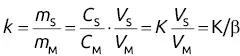
The retention factor k , also known as the capacity factor , is a very important parameter in chromatography for defining column performance. Though it does not vary with the flow rate or the column length, k is not a constant, as it depends upon the experimental conditions. k is dependent via K (Nernst distribution law) on the intensity of solute–stationary phase interactions, and via β on the column’s design. For this reason, it is sometimes designated by k ′ rather than by k alone.
This parameter takes into account the ability, great or small, of the column to retain each compound ( capacity ). When separations are being developed, k should not exceed 10. Ideally, k should be around five, otherwise the time of analysis is unduly long.
The expression capacity factorpresents a possible confusion with the capacityof a column, which is the maximum solute mass the column may retain without being saturated. This factor is given by manufacturers when describing a column.
An experimental approach to the retention factor k
On the basis of Craig’s model, each molecule is considered as passing alternatively from the mobile phase (in which it progresses down the column) to the stationary phase (in which it is immobilized). The average speed of the progression down the column is slowed if the time periods spent in the stationary phase are long. Extrapolate now to a case that supposes n molecules of this same compound (a sample of mass m T). If we accept that, at each instant, the ratio of the n Smolecules fixed upon the stationary phase (mass m S) and of the n Mmolecules present in the mobile phase (mass m M) is the same as that of the times ( t Sand t M) spent in each phase for a single molecule, the three ratios will therefore have the same value:
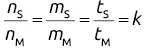
Take the case of a molecule that spends 75% of its time in the stationary phase. Its average speed will be four times slower than if it stayed permanently in the mobile phase. As a consequence, if 4 μg of such a compound has been introduced onto the column, there will be an average of 1 μg at all times in the mobile phase and 3 μg in the stationary phase.
Since the retention time of a compound t Ris such that t R= t M+ t S, the value of k is therefore accessible from the chromatogram  ( Figure 1.7):
(1.27) 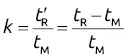
This important relation can also be written:
(1.28) 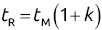
In light of Eqs. (1.16)and ( 1.18), the retention volume V Rof a solute can be written:
(1.29) 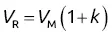
or
(1.30) 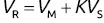
This last expression linking the experimental parameters to the thermodynamic coefficient of distribution K is valid for ideal chromatography.
Читать дальшеИнтервал:
Закладка:
Похожие книги на «Chemical Analysis»
Представляем Вашему вниманию похожие книги на «Chemical Analysis» списком для выбора. Мы отобрали схожую по названию и смыслу литературу в надежде предоставить читателям больше вариантов отыскать новые, интересные, ещё непрочитанные произведения.


![Евгений Матерёв - Музеи… или вдохновляющая музыка The Chemical Brothers [litres самиздат]](/books/437288/evgenij-materev-muzei-ili-vdohnovlyayuchaya-muzyka-th-thumb.webp)





Обсуждение, отзывы о книге «Chemical Analysis» и просто собственные мнения читателей. Оставьте ваши комментарии, напишите, что Вы думаете о произведении, его смысле или главных героях. Укажите что конкретно понравилось, а что нет, и почему Вы так считаете.