J. Ledgard - Giraffe
Здесь есть возможность читать онлайн «J. Ledgard - Giraffe» весь текст электронной книги совершенно бесплатно (целиком полную версию без сокращений). В некоторых случаях можно слушать аудио, скачать через торрент в формате fb2 и присутствует краткое содержание. Год выпуска: 2007, Издательство: Penguin Group, Жанр: Современная проза, на английском языке. Описание произведения, (предисловие) а так же отзывы посетителей доступны на портале библиотеки ЛибКат.
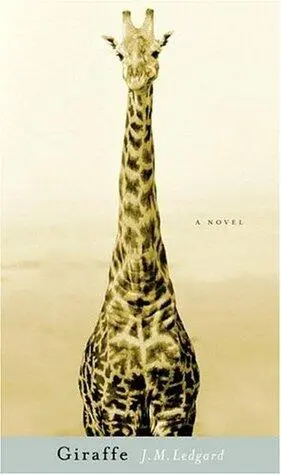
- Название:Giraffe
- Автор:
- Издательство:Penguin Group
- Жанр:
- Год:2007
- ISBN:нет данных
- Рейтинг книги:3 / 5. Голосов: 1
-
Избранное:Добавить в избранное
- Отзывы:
-
Ваша оценка:
Giraffe: краткое содержание, описание и аннотация
Предлагаем к чтению аннотацию, описание, краткое содержание или предисловие (зависит от того, что написал сам автор книги «Giraffe»). Если вы не нашли необходимую информацию о книге — напишите в комментариях, мы постараемся отыскать её.
In 1975, on the eve of May Day, secret police dressed in chemical warfare suits sealed off a zoo in a small Czechoslovakian town and ordered the destruction of the largest captive herd of giraffes in the world. This apparently senseless massacre lies at the heart of J. M. Ledgard's haunting first novel, which recounts the story of the giraffes from their capture in Africa to their deaths far away behind the Iron Curtain. At once vivid and unearthly, Giraffe is an unforgettable story about strangeness, about creatures that are alien and silent, about captivity, and finally about Czechoslovakia, a middling totalitarian state and its population of sleepwalkers.
It is also a story that might never have been told. Ledgard, a foreign correspondent for the
since 1995, unearthed the long-buried truth behind the deaths of these giraffes while researching his book, spending years following leads throughout the Czech Republic. In prose reminiscent of Italo Calvino and W. G. Sebald, he imbues the story with both a gripping sense of specificity and a profound resonance, limning the ways the giraffes enter the lives of the people around them, the secrecy and fear that permeate 1970s Czechoslovakia, and the quiet ways in which ordinary people become complicit in the crimes committed in their midst.
Giraffe — читать онлайн бесплатно полную книгу (весь текст) целиком
Ниже представлен текст книги, разбитый по страницам. Система сохранения места последней прочитанной страницы, позволяет с удобством читать онлайн бесплатно книгу «Giraffe», без необходимости каждый раз заново искать на чём Вы остановились. Поставьте закладку, и сможете в любой момент перейти на страницу, на которой закончили чтение.
Интервал:
Закладка:
I CANNOT SLEEP. I lie on this upper bunk in a cabin on the ship. A voyage has ended in which I have played no part. There are signs of departure, in sheets crumpled on the floor, cigarette butts, and reams of DDR newspapers. There are things that have been spoken of in this cabin far from land which cannot be repeated now. The regime, which appeared indistinct in the doldrums, comical even has drawn back into focus. I stare at a photograph pinned to the side of the greasy plywood bunk, forgotten in the rush to disembark. I take it down. It is a black-and-white photo of a woman striding down a concrete pier. She wears a bikini. Over her shoulder is a packed beach. The Cyrillic lettering above the ice-cream stand identifies the beach as Bulgarian. The woman is moving fast by the camera. The lens is turning to meet her. It is a fleeting image, such as I might frame with my eye. It is impossible to say whether the woman is irritated or simply impatient to be gone into the air at the end of the pier and down into the Black Sea. She is no mermaid returning to its element. She is large: Her breasts are barely contained in their flowered cups. Her skin is downy and smooth. There is a scar below her navel, punctured along its edges where the stitches have been recently drawn. She has no tail of a harbor porpoise, no flukes containing wonder nets. Her legs instead end in cheap COMECON plastic sandals.
I pin her back into the plywood. I switch on the transistor radio I have brought with me. I am no longer downhearted: I feel a slight buoyancy of the Eisfeld on the harbor waters. This is my first night in West Germany, in the new chain of flowers. I tune the dial. I listen. The songs belong to the West German moment, which is recognizably now the opposite of the Communist moment, in which time is marked out by clocks, loudspeaker announcements, and revolutionary parades no one comprehends; but there is no now and it is possible to live without remembering the year, and to have no sense of time passing, save in the changing colors of the seasons. Some of the songs playing are in English. A line in one of them pierces me.
The waters of Hamburg harbor are under this ship and gulls are turning somewhere above. There is a northern sky brightening out there. I cannot see it from in here. There is no porthole in this cabin, no ring of light. I am sunk below the waterline.
Emil
JUNE 20, 1973
IUNDERSTAND THE RIVER ELBE, or Labe. I have words to describe its course and to detail the life upon and within it. It runs twelve hundred kilometers from the Krkonoše Mountains in Czechoslovakia to the North Sea. It is a river. It wants to show us the sea. If the engines on the barge were cut now, it would carry us on its back through the port and city of Hamburg, by the scarlet poppy fields of Schleswig-Holstein, to its estuarine mouth fourteen kilometers wide in embrace of the world, and with plunging flow might beach us on the island of Scharhörn or Neuwerk, where we might settle, we few Czechoslovakians, with our state-owned giraffes, to breed a new subspecies under a domed and ever-changing sky, with feed brought from Cuxhaven. Or perhaps the Labe, with the last of its strength, would push us out beyond the two islands altogether, and we should be tossed on this barge across the Heligoland Bight, deep into the North Sea, and wash up at last, bleary and bruised, on the salt marshes I can only suppose lie black and tan along the shores of England, perhaps the same marsh over which Magwitch stumbled in leg irons before being captured and transported to Australia, there to provide Pip with his great expectations. We might pull ourselves free from those marshes after some days and drift on into the harbor of an English seaport, where, under the rule of Oliver Cromwell, the cubs of dancing and fighting bears must have been gagged and hidden on small vessels from Puritans who had orders to shoot them, and voyaged from that seaport to any land where the bear cubs could grow and move from town to town.
Ships pass around us in the port. Some of them sound their horns on sighting the giraffes, who shimmer in the hot morning light like the granary towers in the port. There is no drift back to the sea. The engines on the barge are not cut. They thump us out into the Labe, away from Schmauch, waving his cap on his ship’s bridge, just as I see the outline of my grandfather waving to his propeller planes. We pass under a bridge. It is thick with early morning traffic. Sunshine catches on the mirrors and windows of the cars now. I frame a hippie with long hair sitting in the lotus position on the bridge before the broken-down engine of his van.
The Labe is poisoned. There are no salmon alive in it. No polar bear could be led out to fish its portion from these waters. Swimmers emerge with a mustard scum on their skin and a sweet taste in their mouth. Only eels pass upstream with us. They pulse in from the ocean, tapered, like ghostly parts of an atom, working in through smaller and smaller rivers of DDR and ČSSR, until settling at the turn of a stream, or in the stillness of a millpond. I cannot say whether their migration is of their own will or is an act of remembrance, just as some liken flowing water to the subconscious and take the passing through it to be a passing through memory.
Because there is no bunk for me on the barge, I volunteer to sleep out on the deck, among the giraffes. I make a place for myself now at the prow. I sweep the area and lay down a sleeping bag. I tie the tarpaulin to the crate holding Sněhurka. We shall part the Labe together. She is wet with spray coming up off the river and has nostrils that open and clamp like those of a seal or mermaid. But she is not a watery creature. She has never wallowed, but instead cools herself under the shade of acacia trees and is camouflaged there by the markings on her hide, which also serve as open windows dissipating heat, just as the frontoparietal hollows atop her skull cool her brain to a lower temperature than her body.
I sit under the tarpaulin and am lit here by Sněhurka’s underbelly. I open my notebook. Inside is a clipping from a Polish art magazine of Burning Giraffes and Telephones, a painting by Salvador Dali. I unfold it. Three giraffes walk calmly across the horizon, untroubled by the flames bursting from their backs and necks, while in the foreground a massive eye borne on the muscular legs of a Nubian, with the torso of a boiler or a bank safe, attacks or makes love to a faceless woman whose arms are stretched up somnambulistically. I study the painting as I study passages from Great Expectations, or carotid arteries.
Watery meadows appear on either side of us. This is the end of Hamburg. I move up and down the barge now, making notes and sketches of the giraffes for my scientific paper. I am less concerned now with rumination, with the four divisions of the stomach, the Olympic-length intestines, the maneuverability of the tongue, the prehensile and undivided upper lip, the vocal cords that hardly pluck a sound, or even with the laryngeal nerve running from brain to heart and back again, than I am with the viscosity of giraffe blood, five times thicker than water, with a multiplication of crimson stars, in better distribution of oxygen, with the jugular veins several centimeters in diameter, stoppered with one-way valves, in such a way as to regulate flow from the head when it is lifted from the ground. There are thirty-two giraffes here, each with a wonder net hidden from view. When a giraffe splays its legs and sets down its head to drink, the pressure on its cranial vasculature triples. The giraffe’s cerebral blood vessels are too thin-walled to constrict against it. But for the wonder net, the giraffe would collapse, as cosmonauts do when certain g-force is applied. It is the wonder net that keeps the living form of giraffes pushed up, even to resemble creatures from a world of lesser gravity. When the head goes down, its endless shunts and meanders spread elastically across the base of the cranium, absorbing the flow that rushes in through the carotid artery.
Читать дальшеИнтервал:
Закладка:
Похожие книги на «Giraffe»
Представляем Вашему вниманию похожие книги на «Giraffe» списком для выбора. Мы отобрали схожую по названию и смыслу литературу в надежде предоставить читателям больше вариантов отыскать новые, интересные, ещё непрочитанные произведения.




Обсуждение, отзывы о книге «Giraffe» и просто собственные мнения читателей. Оставьте ваши комментарии, напишите, что Вы думаете о произведении, его смысле или главных героях. Укажите что конкретно понравилось, а что нет, и почему Вы так считаете.