J. Ledgard - Giraffe
Здесь есть возможность читать онлайн «J. Ledgard - Giraffe» весь текст электронной книги совершенно бесплатно (целиком полную версию без сокращений). В некоторых случаях можно слушать аудио, скачать через торрент в формате fb2 и присутствует краткое содержание. Год выпуска: 2007, Издательство: Penguin Group, Жанр: Современная проза, на английском языке. Описание произведения, (предисловие) а так же отзывы посетителей доступны на портале библиотеки ЛибКат.
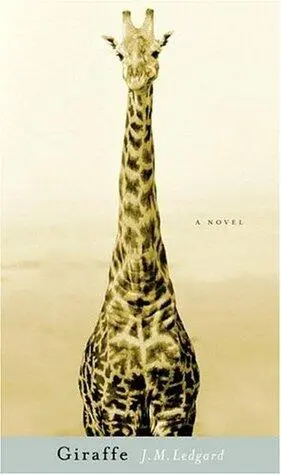
- Название:Giraffe
- Автор:
- Издательство:Penguin Group
- Жанр:
- Год:2007
- ISBN:нет данных
- Рейтинг книги:3 / 5. Голосов: 1
-
Избранное:Добавить в избранное
- Отзывы:
-
Ваша оценка:
Giraffe: краткое содержание, описание и аннотация
Предлагаем к чтению аннотацию, описание, краткое содержание или предисловие (зависит от того, что написал сам автор книги «Giraffe»). Если вы не нашли необходимую информацию о книге — напишите в комментариях, мы постараемся отыскать её.
In 1975, on the eve of May Day, secret police dressed in chemical warfare suits sealed off a zoo in a small Czechoslovakian town and ordered the destruction of the largest captive herd of giraffes in the world. This apparently senseless massacre lies at the heart of J. M. Ledgard's haunting first novel, which recounts the story of the giraffes from their capture in Africa to their deaths far away behind the Iron Curtain. At once vivid and unearthly, Giraffe is an unforgettable story about strangeness, about creatures that are alien and silent, about captivity, and finally about Czechoslovakia, a middling totalitarian state and its population of sleepwalkers.
It is also a story that might never have been told. Ledgard, a foreign correspondent for the
since 1995, unearthed the long-buried truth behind the deaths of these giraffes while researching his book, spending years following leads throughout the Czech Republic. In prose reminiscent of Italo Calvino and W. G. Sebald, he imbues the story with both a gripping sense of specificity and a profound resonance, limning the ways the giraffes enter the lives of the people around them, the secrecy and fear that permeate 1970s Czechoslovakia, and the quiet ways in which ordinary people become complicit in the crimes committed in their midst.
Giraffe — читать онлайн бесплатно полную книгу (весь текст) целиком
Ниже представлен текст книги, разбитый по страницам. Система сохранения места последней прочитанной страницы, позволяет с удобством читать онлайн бесплатно книгу «Giraffe», без необходимости каждый раз заново искать на чём Вы остановились. Поставьте закладку, и сможете в любой момент перейти на страницу, на которой закончили чтение.
Интервал:
Закладка:
The engineer takes another swig of vodka.
“My grandmother witnessed all those events,” he goes on, “and told me there was no need to feel pity for the mermaid since it was subhuman. I should do better, she said, to contemplate the suffering of a single herring on my breakfast plate. If I must pity anyone, she went on, it should be Brauhard, who remained an upstanding citizen of Hiddensee despite the actions of his neighbors, although he never remarried and left his money to the widows of drowned sailors, some of whom, by our island tradition, were said to have awakened when their bodies settled on the seafloor and taken mermaids as brides until the day of judgment, when the drowned are supposed to rise up from each body of water.”
“Did Brauhard give any explanation of how he came to love a mermaid?” I ask. “Was he himself drowned and wakened?”
The engineer pauses. I frame him now; I keep this moment.
“I cannot say that,” he says. “Brauhard said only that the mermaids reminded him of angels he had seen painted on the walls of the whitewashed churches of our Hiddensee.”
I HAVE CLIMBED down a rope ladder from the Eisfeld. I stand below, on the barge. The leaving party is over. The wind rushes in off the fresh waters, filling my lungs with the fast-coming smell of Danish peat bogs. The wind beats against me and causes my hair to unfurl, as a flag should unfurl.
It is the giraffe called Sněhurka who towers over me at the front of the barge. I recognize her underbelly. I reach inside her crate and place a hand on her. The zoo historian has told me that Egyptians used a hieroglyph of a giraffe to indicate prophecy or foreknowledge. And I wonder why Sněhurka does not kick out at her crate. Can she not see that this Czechoslovakian barge is no ark of Noah, but is instead a vessel charged with delivering her into captivity?
I look up at her. I want her to meet my gaze, just as the ship’s mate said. She does not. She stares, unblinking, out toward Hamburg, with eyes large, entire as the Heligoland Bight. She might be sleeping, for giraffes are sleepless beasts, who sleep for only a few minutes each day with their eyes open, unblinking, and move as sleepwalkers in that short sleep, like the African somnambulist the Slovak spoke of, who fell to the dust and rose again still with her arms stretched up. I feel Sněhurka’s vein pulsing against my fingertips. I translate the pulse into numbers. I cannot help myself. I am a doubler: I am an agent of the shipping company and of hemodynamics also.
There is a sound. I see Schmauch in the air between his ship and the barge. He lands. He strides down the barge to me, hat in hand.
“I want to see the giraffes one more time,” he says.
“I thought they made you uneasy.”
“I must take my leave of them all the same. It has been a long voyage,” he says. “There have been moments, comrade.”
“A mermaid?”
He smiles.
“No, not this time. I was thinking of a day I spent fishing off Zanzibar. A blue day, blue as a flame. The engine of the ship had given out and we anchored there for several days, on a dazzling sea, waiting for the repairs to be made. A Persian motored out from Zanzibar in a dinghy to witness the giraffes. He offered to take me fishing. So I went fishing with that man: He was one of those regal men who devote their lives to hunting one living thing or another. We attached his dinghy to my ship by a long rope, as cosmonauts tether themselves to a space capsule. Or perhaps,” Schmauch says, reconsidering, “it was my crew who tied the rope, to prevent me drifting away to Zanzibar, just as a falconer tethers his hawk. In any case, we rowed out as far as the rope would allow and found ourselves sitting upon a dark bloom in the waters, which were sardines come north from the cold southern belt. We took turns casting into the bloom. We were not after the sardines, but the tuna and swordfish we could see parting the bloom. It did not matter to me that landing such a large fish on our small dinghy was unlikely. I was happy watching the sardines swelling and hollowing under us, like bees, or a flock of starlings billowing black at dusk over woods by the seashore. The Persian took it more seriously. He was a fine fisherman. You had only to watch the arc of the line over his shoulder as he cast to understand that. He hooked a swordfish and fought it hard until the line broke and then, without pausing, he tied on a new hook, baited it, and cast into the bloom. ‘Watch this, captain,’ he said. Sure enough, another swordfish ran straight at the bait and was alarmingly hooked through the top of its mouth. The Persian landed that swordfish in the dinghy. There was hardly enough room for it. It thrashed in the salt water at our feet and gashed my leg here, below the knee. It was only when the swordfish stilled, died, that the Persian pointed out that it was the same creature he had grappled with first, still with that hook in its mouth. The Persian held it up by its sword. ‘A swordfish lives by instinct,’ he said. ‘It has three seconds of memory. No more.’ He set down the fish and drew a circle in the air with his hands. ‘Here is the moment,’ he said. ‘It loops, like so, completes, and is gone. That is the mind of a swordfish,’ he said. It was a common occurrence to release a swordfish only to have it run straight back at the hook, without remembrance.”
Schmauch puts his hand out also and touches Sněhurka.
“I have thought often of that swordfish in the last weeks,” he says, “how it has no past and no future, but only the present parting of water before its blade, just as I stand on my ship’s bridge parting oceans, without past or future.”
SCHMAUCH HAS CLIMBED BACK UP to his ship and I am left alone now among the giraffes and their rising blood. The wind is still blowing hard over the plowed fields about Hamburg, allowing the Communist moment no purchase on this Czechoslovakian barge, and blowing such spirits as linger here away from me. I could speak to the sailors of ghosts, as they spoke to me of mermaids. I see outlines of the dead in ČSSR. Not just my grandfather waving to his planes. I see others also. There is no obvious hemodynamic explanation for my condition: It is more than clinical nostalgia. It is not that the dead step living into this 1973, or that I step into the past; I am not so fanciful. The explanation is more likely meteorological. I say only that it is natural for ghosts to linger in a windless country, where there is not even the faintest zephyr to part the dead from the living, that, in the absence of wind, they leave an outline on ČSSR I am sometimes able to frame and keep.
I glimpse another Czechoslovakia, which I sometimes call Tonakia because the men I see there wear trilbies or bowlers manufactured by the Tonak company. I see in Prague the capital of Tonakia also, which is the Prague of 1933 or some close year. I see quicklime outlines of a vendor hawking ties from a suitcase on Haštalská Street, and an aristocrat running down the center of Národní Street in top hat and tails. I see laundrywomen washing spectral clothes in the rapids of the Vltava before Josef Šejnost’s atelier on the Smetana Embankment, and horses stabled in their hundreds under the hill on which the Bohumil Kafka’s equestrian statue of the Hussite commander Žižka now stands totalitarian. I see students in heavy overcoats chalking a political manifesto on the steps of a convent on Vyšehradská Street, a tinker singing a Moravian folk song while pushing a cart down Belgická Street, and a blind busker winding his music box outside the Hotel Europa on Wenceslas Square. Coal smoke of the Communist moment mingles with coal smoke of Tonakia and drifts ginger and lime together over the outline of long-dead lovers kissing in the shadows of St. Jakub’s church on Malá Štupartská Street and settles in material and immaterial soot on the unfurled spectral wings of geese and swans, nailed like severed angels to the ghostly wooden boards of a butcher’s shop that no longer exists.
Читать дальшеИнтервал:
Закладка:
Похожие книги на «Giraffe»
Представляем Вашему вниманию похожие книги на «Giraffe» списком для выбора. Мы отобрали схожую по названию и смыслу литературу в надежде предоставить читателям больше вариантов отыскать новые, интересные, ещё непрочитанные произведения.



Обсуждение, отзывы о книге «Giraffe» и просто собственные мнения читателей. Оставьте ваши комментарии, напишите, что Вы думаете о произведении, его смысле или главных героях. Укажите что конкретно понравилось, а что нет, и почему Вы так считаете.