J. Ledgard - Giraffe
Здесь есть возможность читать онлайн «J. Ledgard - Giraffe» весь текст электронной книги совершенно бесплатно (целиком полную версию без сокращений). В некоторых случаях можно слушать аудио, скачать через торрент в формате fb2 и присутствует краткое содержание. Год выпуска: 2007, Издательство: Penguin Group, Жанр: Современная проза, на английском языке. Описание произведения, (предисловие) а так же отзывы посетителей доступны на портале библиотеки ЛибКат.
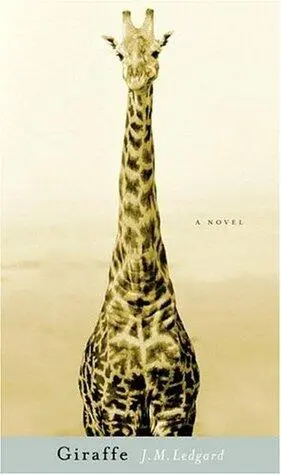
- Название:Giraffe
- Автор:
- Издательство:Penguin Group
- Жанр:
- Год:2007
- ISBN:нет данных
- Рейтинг книги:3 / 5. Голосов: 1
-
Избранное:Добавить в избранное
- Отзывы:
-
Ваша оценка:
Giraffe: краткое содержание, описание и аннотация
Предлагаем к чтению аннотацию, описание, краткое содержание или предисловие (зависит от того, что написал сам автор книги «Giraffe»). Если вы не нашли необходимую информацию о книге — напишите в комментариях, мы постараемся отыскать её.
In 1975, on the eve of May Day, secret police dressed in chemical warfare suits sealed off a zoo in a small Czechoslovakian town and ordered the destruction of the largest captive herd of giraffes in the world. This apparently senseless massacre lies at the heart of J. M. Ledgard's haunting first novel, which recounts the story of the giraffes from their capture in Africa to their deaths far away behind the Iron Curtain. At once vivid and unearthly, Giraffe is an unforgettable story about strangeness, about creatures that are alien and silent, about captivity, and finally about Czechoslovakia, a middling totalitarian state and its population of sleepwalkers.
It is also a story that might never have been told. Ledgard, a foreign correspondent for the
since 1995, unearthed the long-buried truth behind the deaths of these giraffes while researching his book, spending years following leads throughout the Czech Republic. In prose reminiscent of Italo Calvino and W. G. Sebald, he imbues the story with both a gripping sense of specificity and a profound resonance, limning the ways the giraffes enter the lives of the people around them, the secrecy and fear that permeate 1970s Czechoslovakia, and the quiet ways in which ordinary people become complicit in the crimes committed in their midst.
Giraffe — читать онлайн бесплатно полную книгу (весь текст) целиком
Ниже представлен текст книги, разбитый по страницам. Система сохранения места последней прочитанной страницы, позволяет с удобством читать онлайн бесплатно книгу «Giraffe», без необходимости каждый раз заново искать на чём Вы остановились. Поставьте закладку, и сможете в любой момент перейти на страницу, на которой закончили чтение.
Интервал:
Закладка:
“Oh, yes, epochs old. They’re volcanoes. You could journey down through them to the center of the earth.”
We can see only a few of the hills now. I frame one. It is seductive from this distance, a mound of soft earth and sweet grass with a nipple thicket of beech trees.
She is going as far as the town of Ústí nad Labem. She has a part in a production of Dvořák’s opera Rusalka that is playing there.
“Just a small part,” she says shyly, “of a nymph rising to the surface of a stream.”
“Still,” I say.
“Where are you going?” she asks.
I unfold a map for her, which includes parts of West Germany. I put a finger to Hamburg.
“I’m going here,” I say.
My eye is drawn to the sea beyond Hamburg. I point also to the town of Cuxhaven.
“Here also.”
I draw my finger around the islands of Scharhörn and Neuwerk, which I imagine as two black dots — gull’s eyes staring up from a yet-vague swell. “Also here, to these two islands.”
I indicate with a sweep the Heligoland Bight beyond Scharhörn and Neuwerk. “I’d also like to sail here.”
“You must have seen the sea many times,” she says.
I blush. I cannot lie so directly.
“No,” I say. “I have only ever read stories of the sea.”
I WAKE NOW in Deutsche Demokratische Republik, or DDR. The compartment is empty. That is Saxony out there, so flat and untroubled; those are Trabant 601’s, little plastic wonder cars of DDR, putt-putting along moonlit country lanes overhung with elms and goat willows.
East Berlin’s train station comes in an electric sign whose lettering, OSTBAHNHOF, brings with it an immediate sense of fictional Emil waiting at a street corner for a signal, and of me somewhere unborn in the Charlottenburg district, in West Berlin, flashing him that signal with a mirror from the window of an apartment. But my stop in divided Berlin is short. There is no thief for me to pursue: My wallet is untouched. I walk from this platform to another and board the night train to Hamburg. I arrange myself by the window. The train pulls out of the station, out past the columns of the great Pergamon Museum, within which I know are the winged bulls of Persepolis. Soldiers come into the compartment. They lower the blinds and secure the window against the dead of night with a padlock, so that I pass through the Iron Curtain unseeing and unseen, with only the stamping of documents to mark my release.
Emil
JUNE 19, 1973
IHAVE ARRIVED in Hamburg. It is just before dawn. The sky is orange and red. I was blind, but now can see — isn’t that what they sing in America? It is a little like that. There is no one watching me. There is no one at my back. I am the watcher now. I take a taxi to the port of Hamburg, where there might be a shore and wind and spume on the wind. I roll down the windows. I let the brightness of the northern dawntide pass in through the veins woven across my wrists. West Germany comes at me in different-shaped buildings and signs, in extraordinary cars and buses and in kiosks and flower stalls streaming with color. All this new information is painful to me. There is too much here to frame and stop.
The taxi drops me off by the gates of the port. The East German freighter is pointed out to me. It is a narrow ax in the far distance. I walk toward it now in disappointment. The port is not as I hoped it to be. I want to be made aware of how far I have come, I want to walk down to a gravel beach. I want to frame a buoy and a lighthouse. I wish to teeter on a shore, over seaweed, and be overcome with a different kind of vertigo, that is not restricted flow through my vertebral artery, but a vertiginous sense of possibility. But there is no sea here: The sea is far away. The port is urban. The ships do not ride at anchor as Soviet battleships do, but bristle against one another in a hive. They bob on metal-colored water in narrow channels marked off by granary towers and bounded with toxic mud, where I see rats scattering now from one clump of weed and rope to another.
I come under the rusting hull of my freighter. It is called the Eisfeld.
“Who goes there?” a disembodied voice calls down from the deck in German.
“Comrade Freymann,” I call in German. “Representing the Czechoslovakian Shipping Company.”
“Come aboard then,” the voice says.
I throw my bag on my shoulder and step up the gangway. It gives and sways under me. I go up slowly now in the knowledge that this ascent will be my only margin and I shall see no shore, no Cuxhaven, no islands of Scharhörn and Neuwerk. I shall not sail across the Heligoland Bight. I look down between the hull and the quay. I feel nothing: It is not nearly dizzying enough.
I STEP ABOARD. I see the giraffes and am dumbfounded. I stop. I stare up. I have worked with one living giraffe, but an old giraffe, a zoo animal, weary, blind, hunched somehow under those electric lights. I have seen nothing like this. There are so many of them, and wild, not of a zoo, and impossibly stretched. There is no such animal! They scrape this cirrus as towers of the Qasr al-Qadim. Tarpaulins have been drawn across the crates, so that only their necks and shoulders are visible, and this makes them more unthinkable. I run my eye up and down their necks. They are too tall for me to frame. I try not to think of blood pressing up inside them, but instead to consider their muscle and bone. I dwell on their necks, of the same seven vertebrae that push up my skull, but each one as thick as a chair leg and grooved, as by a carpentry machine, the better to hold the slabs of muscle needed to keep the neck upright. These necks are the greatest natural selection. The tallest giraffes survived. All others perished — or disappeared into the jungle. I cannot say how I missed these towers while walking toward the Eisfeld, or why I have not thought of them on my journey, but have instead given myself over to a chain of flowers and imaginings of a lighthouse set by a cool green sea. I take a step closer. I place my bag down on the deck. The smell of the giraffes is pungent, like racehorses sweating in a paddock after the Pardubice steeplechase. I count thirty-two animals, reticulated and Rothschild both. They make no sound. When they move, they cease to be towers or minarets, but are instead something flowing underwater, or perhaps a slender tree swaying. There is no urgency in them: They do not in any way resemble the orangutan I passed one winter afternoon in the Prague Zoo, which beat on the Perspex window of its cage to attract the attention of every passerby, as though from the inside of an airless cockpit.
A sailor takes up a bucket of grain and brings it to me — it is his voice I heard from below.
“Hold your hands out — cup them,” he says.
I do so. He pours grain into them.
“Now hold them up to a giraffe. That one there. The Czechoslovakians call her Sněhurka.”
I see why: Her underbelly is a blizzard.
“I’m Czechoslovakian,” I say, still in German. “ Sněhurka means ‘Snow White’ in Czech.”
The sailor nods and looks up.
Sněhurka slides her tongue out to me. It is the length of my arm, dark as a blood blister. She takes the grain. I feel her lips and teeth against my palm.
The same sailor guides me inside now. He swings open a heavy metal door. I dip my head. The lightbulbs are caged in wire. I breathe in spaceship air, stale, smelling of fuels. We slide down ladders, from one deck to another. The sailor opens and closes steel hatches. There are slogans on the doors. There are hammers and sickles. There are red stars. We pass a galley in which I see pans firing and spitting on a gas cooker. The sailor shows me into a saloon, where the ship’s officers are taking breakfast. I recognize the captain of the Eisfeld from a picture in the ring binder given me by the shipping director. I introduce myself. I stand here with my hands in my pockets, rocking on my heels.
Читать дальшеИнтервал:
Закладка:
Похожие книги на «Giraffe»
Представляем Вашему вниманию похожие книги на «Giraffe» списком для выбора. Мы отобрали схожую по названию и смыслу литературу в надежде предоставить читателям больше вариантов отыскать новые, интересные, ещё непрочитанные произведения.



Обсуждение, отзывы о книге «Giraffe» и просто собственные мнения читателей. Оставьте ваши комментарии, напишите, что Вы думаете о произведении, его смысле или главных героях. Укажите что конкретно понравилось, а что нет, и почему Вы так считаете.