Leopoldo Marechal - Adam Buenosayres
Здесь есть возможность читать онлайн «Leopoldo Marechal - Adam Buenosayres» весь текст электронной книги совершенно бесплатно (целиком полную версию без сокращений). В некоторых случаях можно слушать аудио, скачать через торрент в формате fb2 и присутствует краткое содержание. Год выпуска: 2015, Издательство: McGill-Queen's University Press, Жанр: Классическая проза, на английском языке. Описание произведения, (предисловие) а так же отзывы посетителей доступны на портале библиотеки ЛибКат.
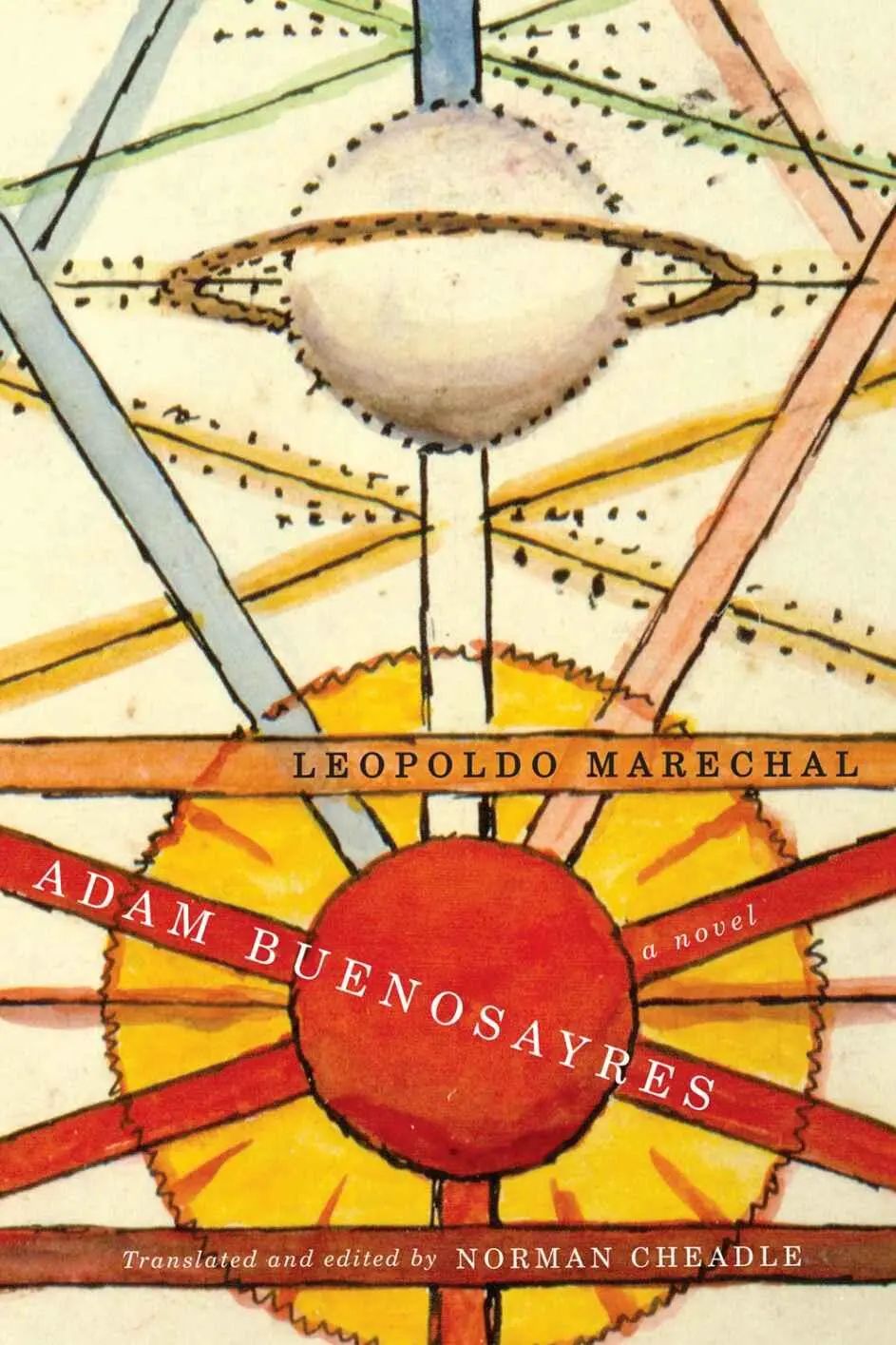
- Название:Adam Buenosayres
- Автор:
- Издательство:McGill-Queen's University Press
- Жанр:
- Год:2015
- ISBN:нет данных
- Рейтинг книги:5 / 5. Голосов: 1
-
Избранное:Добавить в избранное
- Отзывы:
-
Ваша оценка:
Adam Buenosayres: краткое содержание, описание и аннотация
Предлагаем к чтению аннотацию, описание, краткое содержание или предисловие (зависит от того, что написал сам автор книги «Adam Buenosayres»). Если вы не нашли необходимую информацию о книге — напишите в комментариях, мы постараемся отыскать её.
Adam Buenosayres — читать онлайн бесплатно полную книгу (весь текст) целиком
Ниже представлен текст книги, разбитый по страницам. Система сохранения места последней прочитанной страницы, позволяет с удобством читать онлайн бесплатно книгу «Adam Buenosayres», без необходимости каждый раз заново искать на чём Вы остановились. Поставьте закладку, и сможете в любой момент перейти на страницу, на которой закончили чтение.
Интервал:
Закладка:
Del Solar, on tenterhooks, tried to calm him down.
— Don’t pay any attention to them, he said. They’re completely shitfaced.
— This ain’t no speakeasy, insisted Flores. They’ve got me pissed off with all their laughing.
The pesado Rivera piped up in turn.
— Shhh! he ordered the mockers. You’re at a funeral wake!
At that point something outrageous happened. Franky Amundsen, obviously the ringleader of the dissident faction in the kitchen, turned to the pesado Rivera, held out his hand imperiously, and, eyes a-glint, slurred a thick-tongued order:
— Pash ’e bottle, pard’!
Utterly flummoxed by the sheer audacity of it, the pesado mechanically handed him the bottle and came to his senses only when Franky handed it back to him, after having generously refreshed his friends’ glasses. In a sublime gesture, the pesado filled his own glass and sent it down the hatch, perhaps wishing to drown the speck of rage already fermenting in his kidneys. That was arguably the moment when Rivera began to incubate in his mind the brilliant manoeuvre with the shoe, an act that was subsequently to put an end to the hostilities.
With the storm rumbling on the horizon, it’s time we took a look at the heterodox group in the kitchen, if only to get a faint idea as to what those inebriated intellectuals were getting up to, drunk as they were on something more than glory. What was the reason for the laughter? Could they, as innocent victims of the illustrious bottle, have been forgetting the norms of intellectual decorum? No, they were not the sort of men who hang their virtue in a noose from the sarmentous tree of Dionysus! On the contrary, in that sector there were a few men whose intelligence reached its zenith only after they’d achieved a goodly blood-alcohol coefficient. Such, for example, was Franky Amundsen, descendant of those Vikings who in bygone times used to drink themselves blotto with absolute dignity under the northern lights. So, too, Samuel Tesler, scion in a direct blood line of the wine grower Noah. And thus as well Adam Buenosayres, whose genealogical tree could well have been a grapevine, bearing in mind the crew of insatiable drinkers on both sides of his family who had preceded him in the sublime art of raising a glass. No less scholarly than their counterparts, these heresiarchs likewise observed, sorted out, and analyzed the stuff of life that chance put in their path. However, the observations they made about the storytelling taita Juan José Robles and the pesado Rivera were characterized by a scientific rigour and a philosophical universality that it would have been pointless to expect from the romantic emotion of the three criollista scholars.
The case of Juan José Robles, it may safely be affirmed, was not at all difficult. This individual displayed the most salient traits of the vegetative soul; hence, following a motion by the academician Buenosayres, Juan Robles was placed ipso facto in the Vegetable Realm. The taita Flores would have been similarly classified, had the opinion of Amundsen prevailed. Fortunately, however, other fellows of the Academy had seen the taita manifest certain characteristics of the sensitive soul: to wit, the senses of sight, hearing, smell, and taste, as well as anger; these signs having been duly noted, Flores was catalogued forthwith under the Animal Realm. True, Amundsen did not give in easily; he stubbornly attributed to the taita a sort of inferior animality, going so far as to suspect he was equipped with a scaley dermis and a vestigial air bladder. The Academy received this argument with a formidable guffaw, and poor Amundsen held his tongue for the time being.
The debate about the pesado Rivera, though, was of quite a different order. The researchers coincided, with rare unanimity, in granting him the fullness of the sensitive soul, crowning him with the status of animaldom, and declaring him to be essentially brutum . Nevertheless, this bare-bones classification was considered insufficient, and further precision was deemed necessary. Accordingly, a list of pertinent questions was drawn up. Could Rivera distinguish the range of sensations between intense heat and intense cold? Was he able to differentiate among the colours, or was he totally colour blind? Were his eyes multifaceted like those of the fly, or simple like those of the opossum? Did he emit phosphorescence at night? Did he have a full olfactory range? Did he usually find his way back to his lair using his sense of smell? Did he piss against walls with one leg raised? How subtle was his sense of hearing? Did he register any other tastes besides those of booze, mate , and tobacco? Was his body covered in fur, feathers, or a carapace? Did he shed his skin annually? Then, upon recalling that memory, instinct, and imagination all formed part of animal nature, the academicians formulated the following questions. Did Rivera remember the place where he ate and slept? Did his memory retain insults, pleasures, and punishments? Was he in rut at a certain time of the year? Did he bark at the moon in the night? Did he have premonitions of death, risk, and storms? Did he have erotic dreams and dreams of the hunt?
Such questions were posed and dealt with on the spot, and the intellectual pleasure produced by this analytical exercise was quite often expressed in the form of noisy hilarity. But the astrologer Schultz’s silence had been weighing heavily on the Academy and finally he manifested his disdain for the individual under discussion. After heaping abuse upon the paleo-taitas present among them, he mysteriously announced the reign of the Neotaita in the near future. Pressed by the academician Amundsen to declare whether the Neotaita could be distinguished in any way from the Neocriollo, Schultz responded by saying that the Neotaita would be an aspect of the Neocriollo. The former would be characterized by his enormously developed kidneys, the organ of Mars, for purposes of war. Unfortunately, this attempt to orient the debate in a metaphysical direction didn’t get very far. The Academy fell back on the terrain of pure biology when Franky Amundsen solemnly proposed a study be carried out on the pesado Rivera. Franky’s research plan was vast; it included longitudinal and transversal cross-sections of the pesado , urine and blood analyses, Wassermann reaction, measurements of dilational coefficient, material tensile strength and specific gravity, as well as X-rays and an autopsy.
Wildly enthusiastic, the academician Buenosayres not only supported the Amundsen project, but also proposed, in a sudden flash of insight, that Rivera be studied as if he were a country . This new perspective infinitely widened the scope of the investigation. They would need to submit the pesado Rivera to mensurations and triangulations, geological and meteorological studies, dams, marine surveys, frontier demarcations, explorations of his forests and mountain ranges. Then the academician Tesler, carried away by the utilitarianism characteristic of his race, suggested the advisability of adding to their study of the pesado a series of diagrams and statistical tables, with particular reference to his annual production of fingernails, body hair, and dandruff; the voltage of his motor energy; his normal output of guano, textiles, and crude oils; the extent of his petroleum deposits; his hotsprings, coral reefs, and fish stocks, etcetera etcetera. For the academician Tesler recognized that such data were indispensable for any rational industrialization of the pesado Rivera. It was at this point in the discussion that the academics let fly the universal guffaw that had set everyone’s nerves on edge over on the other side of the kitchen.
Читать дальшеИнтервал:
Закладка:
Похожие книги на «Adam Buenosayres»
Представляем Вашему вниманию похожие книги на «Adam Buenosayres» списком для выбора. Мы отобрали схожую по названию и смыслу литературу в надежде предоставить читателям больше вариантов отыскать новые, интересные, ещё непрочитанные произведения.






Обсуждение, отзывы о книге «Adam Buenosayres» и просто собственные мнения читателей. Оставьте ваши комментарии, напишите, что Вы думаете о произведении, его смысле или главных героях. Укажите что конкретно понравилось, а что нет, и почему Вы так считаете.