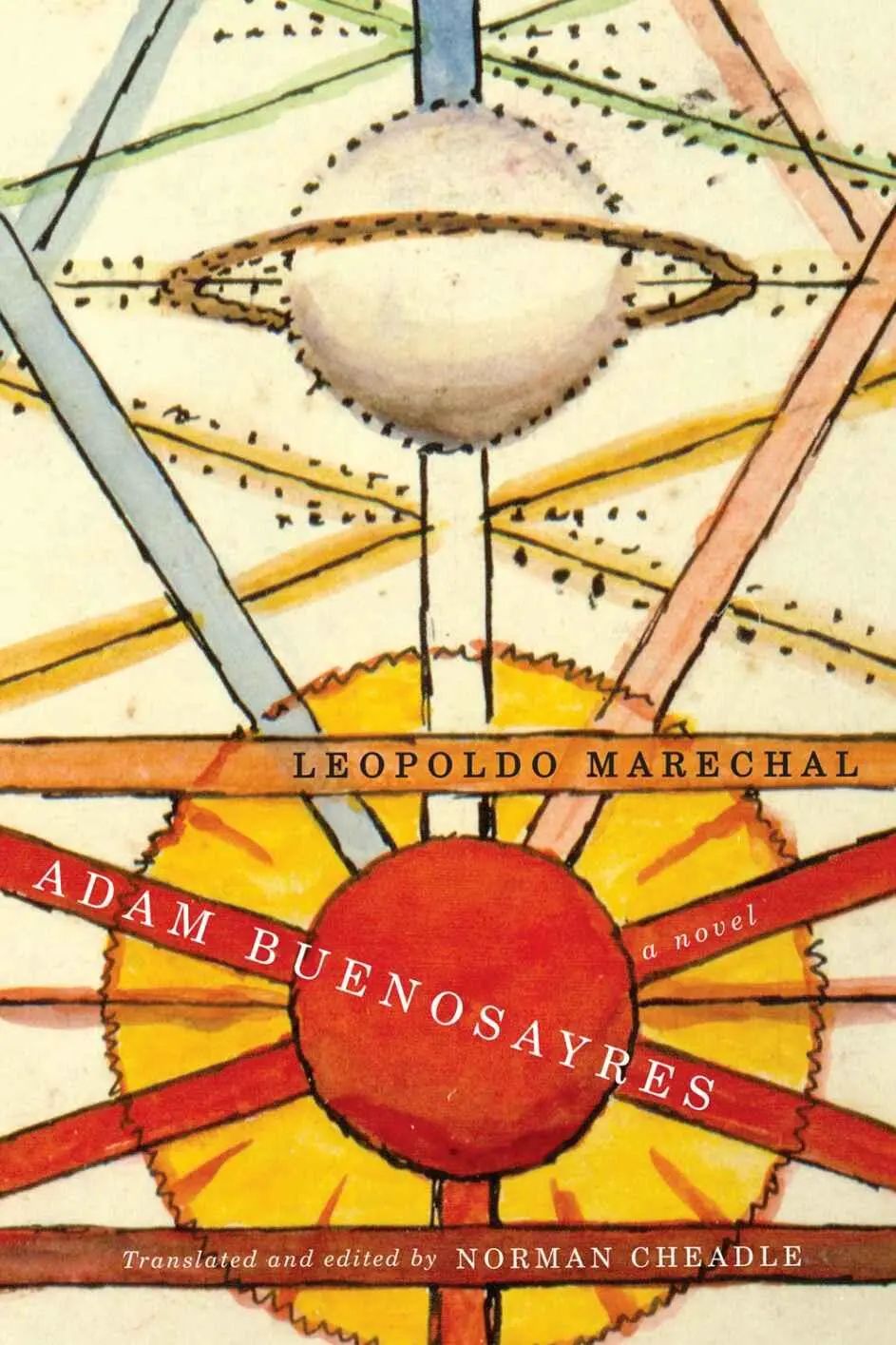
Leopoldo Marechal - Adam Buenosayres
Здесь есть возможность читать онлайн «Leopoldo Marechal - Adam Buenosayres» весь текст электронной книги совершенно бесплатно (целиком полную версию без сокращений). В некоторых случаях можно слушать аудио, скачать через торрент в формате fb2 и присутствует краткое содержание. Год выпуска: 2015, Издательство: McGill-Queen's University Press, Жанр: Классическая проза, на английском языке. Описание произведения, (предисловие) а так же отзывы посетителей доступны на портале библиотеки ЛибКат.
- Название:Adam Buenosayres
- Автор:
- Издательство:McGill-Queen's University Press
- Жанр:
- Год:2015
- ISBN:нет данных
- Рейтинг книги:5 / 5. Голосов: 1
-
Избранное:Добавить в избранное
- Отзывы:
-
Ваша оценка:
Adam Buenosayres: краткое содержание, описание и аннотация
Предлагаем к чтению аннотацию, описание, краткое содержание или предисловие (зависит от того, что написал сам автор книги «Adam Buenosayres»). Если вы не нашли необходимую информацию о книге — напишите в комментариях, мы постараемся отыскать её.
Adam Buenosayres — читать онлайн бесплатно полную книгу (весь текст) целиком
Ниже представлен текст книги, разбитый по страницам. Система сохранения места последней прочитанной страницы, позволяет с удобством читать онлайн бесплатно книгу «Adam Buenosayres», без необходимости каждый раз заново искать на чём Вы остановились. Поставьте закладку, и сможете в любой момент перейти на страницу, на которой закончили чтение.
Интервал:
Закладка:
Reynoso passed him a mate .
— Good old earth, he echoed sententiously.
The three men fell silent, perhaps following their internal train of thought. With admirable discretion, the Young Neighbour had got to his feet to have a look at the row of geraniums that just happened to end at the door to the street. He was moving further and further away, one geranium at a time, studying the details of flowers and leaves with a highly suspect intensity of interest. Leaning against his dad’s chair, Pancho was nodding between wakefulness and sleep. Zanetti had blown off steam now, and Don José showed no sign of breaking his silence. Reynoso, however, was in the grip of ancient and venerable memories; he kept on sighing and looking over at the chapel. There was something he wanted to say, but didn’t, vacillating between reserve and an emotion welling up inside him.
— Were you very good friends? Don José finally asked him with extraordinary delicacy.
— Almost brothers, answered Reynoso. We were buddies as young bucks. I was best man at his wedding, and I’m godfather to Márgara. Think of it!
— Yes, yes, Don José encouraged him.
— And look at him now, poor guy! concluded the old man with a sigh.
— Everybody’s gotta go some time, Don José said sententiously. Sooner or later…
— That’s right, said Reynoso. But there’s certain things… Aw, what the hell!
The old man passed a hand across his brow, as if wanting to erase some strange notion. But he could see the question forming in Don José’s affable eyes and he took the plunge:
— Have you seen the deceased?
— Yes, answered Don José. You’d think he was asleep.
— Did you see the suit they dressed him in? insisted Reynoso in a low voice.
Don José looked at him a bit anxiously.
— Yes, he said. A dark suit. What about it?
— It’s the suit he got married in, Reynoso declared. Thirty-two years ago, on a night like this, I helped him into it myself, before we left for the church. The very same suit!
— Hmm! agreed Don José. Now I get it. Well, if you stop to think what a man’s life is…
— Life! Zanetti growled bitterly.
— Bah, life’s a dream, Don José concluded.
Adrift on the gentle current of memory, Reynoso smiled, more at his reminiscences, however, than at his pensive partners in conversation.
— I can still see him! he said. Out on the patio, people calling for him: “The groom, the groom!” And me, trying to get that goddam stiff collar to fit him! Old Juan, he could hardly move in those trousers, he was so used to his baggy gaucho pants.
— Good man on a horse, murmured Don José pensively.
— Who, Juan? Reynoso considered. He was every inch a horseman.
He stroked his mustache with a sunbaked hand.
— Yep, he said. A night just like tonight, must be thirty-two years gone by…
Ah, what a night it was! Guitar, violin, and flute… To the inner rhythmn of a lost mazurka, now recovered in memory, old man Reynoso is replaying the scene: the grand patio with its carpet and tent, and the wedding procession opulent as an Independence Day celebration on the Twenty-Fifth of May, no expenses spared. The two coupés arrive from the church, amid a swarm of kids shrieking “Godfather! Penniless godfather!” He, Reynoso, responds to the ritual challenge by throwing handfuls of pennies; sprays of tinkling metal hit the cobblestones, and the kids swarm after them, snatching coins from beneath the horses’ hooves. Later, the dance begins — guitar, violin, and flute — “Square dance! Choose your partners!” The groom takes the bride, the best man and future godfather takes the godmother, and the young people pair up laughing, hand in hand, eyes looking into eyes. Bravo! The old folks look on from the sidelines and raise glasses filled to the brim. The kids buzz avidly around the tray loaded with a tall tower of sugar, as well as two figurines of barley sugar, a bride and a groom. The musicians are playing like demons — guitar, violin, and flute. Midnight strikes! Yes, the bride must be spirited away! Discreetly. Who by? Reynoso! While Juan waits outside on the street, standing beside a rented horse-and-buggy, Reynoso gives the signal to the musicians, and they play “Waltz Over the Waves”:
Waves that break and die
plaintive at my feet… 8
Watch! Reynoso whirls, his guiding arm around the bride’s waist. He makes his way among the spinning couples, crosses the entire patio, and sneaks her into the vestibule. Nobody has seen the subterfuge. Reynoso returns triumphant: “The newlyweds have left!” he shouts. “Oh, no!” protest the dancers. “You sly old fox, Reynoso.” Guitar, violin, and flute! Old man Reynoso, carried away, wants to cling to the hallucinatory images. But Zanetti’s voice breaks the spell, and old man Reynoso awakens with a start to find himself once more beside the rectangle of light projected onto the tiled patio from Juan’s funeral chapel.
— Death, Zanetti has said. Same thing for everyone. It’s the only justice there is in this world!
A single tear rolls down Reynoso’s cheek.
— That’s right, he agrees. No way around it.
Don José hands him the empty mate . Reynoso goes to refill it, but there’s no water left.
— Son of a beehive! exclaims the old man. We drank the kettle dry.
— Yep, Don José adds. Just like out on the range.
— I’m going to see if there’s more in the kitchen, says Reynoso.
Kettle in hand, he slowly ambles away.
— Lovely old guy, murmurs Don José turning toward the collector, who is lost in thought.
Zanetti says nothing, so Don José for a long while caresses the head of his little Pancho, the boy now wandering the outskirts of dreamland. From the geraniums over to the street door, there’s not a soul in sight. The Young Neighbour has flown the coop.
Reynoso could have gone in and out of the illustrious kitchen a hundred times, and the denizens of that Olympus would scarcely have noticed his venerable humanity. It was a narrow space built of wood and zinc, equipped with a two-burner, cast-iron stove. Lying in harmonious arrangement on a pine table covered by a red oilcloth were a heel of sausage still impaled on a fork, one bottle of caña quemada and another of anisette, a grimy coffee pot, and few squalid cups.
Though the mise-en-scène was humble, the actors were of magnificent stature. The whole criollo Parnassus was gathered there. (Eminent figures one and all, they were waiting patiently in the wings, in unjust anonymity, for the Homer who might plunge them into the delicious scandal of glory.) Juan José Robles, scratching the ears of the puppy dog called Balín, headed up the group of criollista divinities. On his left, the taita Flores, majestically seated upon an empty kerosene box, was the centre of attention; his audience was coaxing a story, episode by episode, out of the taita ’s unfathomable modesty. To the right of Juan José was the melancholy effigy of the pesado Rivera, the heavy who served both as Flores’s bodyguard and as occasional cup-bearer at this feast; his generous hand flew to the bottle at the slighest indication that any of the heroes was going dry. Facing the three eminent figures just named, sat three engrossed souls: those of the pipsqueak Bernini, Del Solar, and Pereda. Reverentially hanging on the taita ’s every word, the audience of three never took their eyes off him, except to exchange a look of appreciation each time Flores revealed a new facet of his intricate personality. The research project those scholars had been working on was no small beer. It’s well known that criollo bravery, once personified in the sublime gaucho Martín Fierro, had evolved into the semi-rural heroism of a Juan Moreira, 9to conclude in the urban bellicosity of the glorious lineage of malevos who flourished in Buenos Aires in the years just before and after the turn of the twentieth century. Now, according to Del Solar and his scholarly buddies, the taita Flores was the last in the line of classical malevos , a living document generously offering itself to be read hic et nunc . No wonder, then, that the criollista bards plied the taita with questions as if he were the Delphic Apollo in rope-soled sandals. No doubt about it, a subtle sense of smell would have picked up an aroma of legend wafting in the kitchen, over and above the one emanating from the garlic sausage.
Читать дальшеИнтервал:
Закладка:
Похожие книги на «Adam Buenosayres»
Представляем Вашему вниманию похожие книги на «Adam Buenosayres» списком для выбора. Мы отобрали схожую по названию и смыслу литературу в надежде предоставить читателям больше вариантов отыскать новые, интересные, ещё непрочитанные произведения.







Обсуждение, отзывы о книге «Adam Buenosayres» и просто собственные мнения читателей. Оставьте ваши комментарии, напишите, что Вы думаете о произведении, его смысле или главных героях. Укажите что конкретно понравилось, а что нет, и почему Вы так считаете.