Luc Boltanski - Enrichment
Здесь есть возможность читать онлайн «Luc Boltanski - Enrichment» — ознакомительный отрывок электронной книги совершенно бесплатно, а после прочтения отрывка купить полную версию. В некоторых случаях можно слушать аудио, скачать через торрент в формате fb2 и присутствует краткое содержание. Жанр: unrecognised, на английском языке. Описание произведения, (предисловие) а так же отзывы посетителей доступны на портале библиотеки ЛибКат.
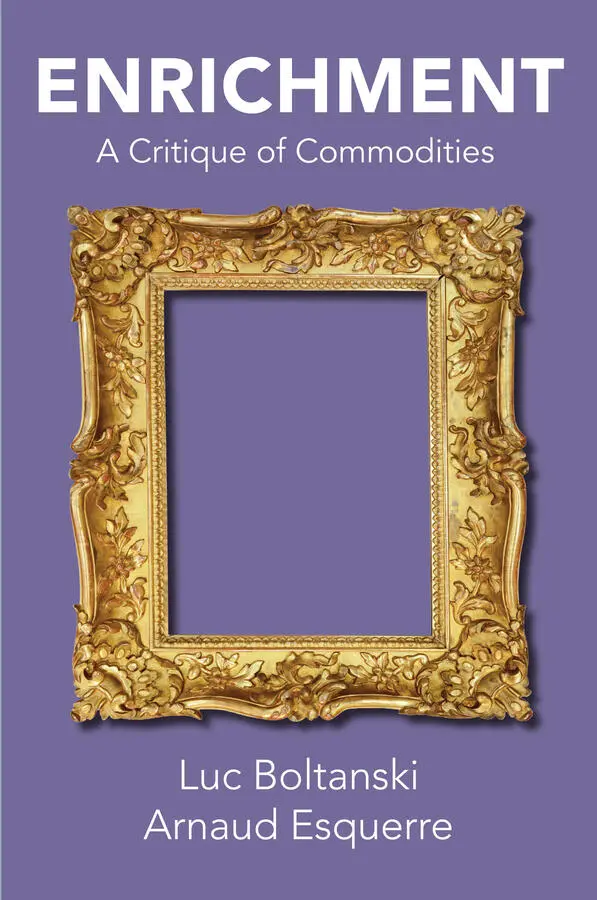
- Название:Enrichment
- Автор:
- Жанр:
- Год:неизвестен
- ISBN:нет данных
- Рейтинг книги:4 / 5. Голосов: 1
-
Избранное:Добавить в избранное
- Отзывы:
-
Ваша оценка:
Enrichment: краткое содержание, описание и аннотация
Предлагаем к чтению аннотацию, описание, краткое содержание или предисловие (зависит от того, что написал сам автор книги «Enrichment»). Если вы не нашли необходимую информацию о книге — напишите в комментариях, мы постараемся отыскать её.
Enrichment — читать онлайн ознакомительный отрывок
Ниже представлен текст книги, разбитый по страницам. Система сохранения места последней прочитанной страницы, позволяет с удобством читать онлайн бесплатно книгу «Enrichment», без необходимости каждый раз заново искать на чём Вы остановились. Поставьте закладку, и сможете в любой момент перейти на страницу, на которой закончили чтение.
Интервал:
Закладка:
From ornamental patrimony to heritage creation
The case of chateaux belonging to the aristocracy is particularly relevant to our attempt to show how measures to highlight regions undertaken by the public sector have converged with the interests of the patrimonial elites. In her work devoted to the sociology of nobility, Monique de Saint Martin’s discussion of chateaux helps us to sketch a sort of phenomenology of the way the enrichment economy was gradually established and the way measures initiated by the central government – especially concerning taxation – met the expectations and economic interests of the old elites. 55
Let us recall that, in France, private parties own nearly half (49.57 percent in 2014) of the protected heritage sites, some 22,000 monuments. 56In addition to funds for maintenance and restoration that come directly from the state, these property owners benefit from a favorable tax status. One criterion for attribution of this tax break – guaranteed public access to the building – was called into question in the 2010s, according to a Senate report, for it did not correspond any longer “to contemporary touristic practices.” In fact, “a well-managed cottage or a bed and breakfast arranged in a way respectful of the building’s history can attract a broader public and generate more public revenue than opening the site a few weeks a year.” The notion of “economic and regional valorization of the building” as a substitute for opening it to the public is justified in this report by invoking Viollet-le-Duc, for whom “the best way to preserve a structure was to find a use for it.” 57
A heritage site par excellence, a chateau more than any other object embodies the sense of belonging to the nobility, because it anchors the relation between a name, a title, and a history. A nobleman is constructed as such inasmuch as he remembers that he has a history, that he is History, and that, if this historical memory is to be maintained and transmitted, it needs, like all memories, to be inscribed not only in bodies but also in things and in situations designed to promote contact with those things. In the case of the French nobility, chateaux are concrete emblems of the difference or gap without which the sentiment of nobility cannot be maintained, inasmuch as their transmission is inscribed in the succession of generations that make up family lines. In Monique de Saint Martin’s analysis, the relation between owners and chateaux, at least as it had been maintained more or less until the 1970s, was separate from the building’s properly economic components, and even from its aesthetic aspect. On the one hand, a person who inherits a chateau may boast of being merely its “custodian.” On the other hand, a family chateau may be sought doggedly after it has been lost, even though a person who has inherited the name, has succeeded in buying the chateau back, and has restored it to the family line may actually find it “very ugly.” 58Chateaux that “quite often are no longer of great economic value and make no money, or very little, are often said by their owners to be a source of expenditures and ‘charges’ or ‘debts.’” 59
The same remarks apply as well to the chateau’s furnishings:
What owners appreciate are not so much the aesthetic properties, the style of the objects, furniture, or paintings, as their history, their origin: it is not so much a Louis XV chest of drawers or a Louis-Philippe armchair that is admired in a small drawing room as the commode that belonged to great-grandmother C or the armchair on which the Duchess of R from the chateau of X used to sit. The commercial value of such objects may even be unknown; the familiar objects simply sit there, their owners pretending not to notice them. Most often it is not a masterpiece by some more or less famous painter that occupies the place of honor but a portrait of the Marshal of X or the Duke of R, preferably an ancestor with whose historic exploits all family members, young and old alike, are expected to be familiar; the story of the adventures and vicissitudes of the painting itself is often better known than the artistic qualities of the painting or the history of the painter. 60
One of the interesting aspects of Saint Martin’s work is that she depicts the nobility and its relation to objects at a time when its members’ efforts to maintain their status require new strategies that intersect with the formation of an enrichment economy. At this point in time, the past – history, and thus the narratives that accompany the objects in question and mark their value – is no longer valued exclusively with reference to a family lineage – that is, to a private subset of interested parties, closed off in its difference; the past has taken on an additional dimension that is at once economic and public. Seen from this perspective, the enrichment economy, and the processes of heritage creation in particular, can be viewed as extensions of the relation of the aristocracy to the world of objects, at the price of a radical transformation that shifts the referential orientation of these objects from the private toward the public, from the family toward the territory (regional or national), and at the same time connects them with the evolution of capitalism. Families whose fortunes rested on economic capital of the industrial variety and/or with the development of conversion strategies, on jobs requiring advanced university studies and benefiting from high salaries, could consider their “ancestral” homes as costs, “burdens,” or, at best, an enjoyable legacy favoring the maintenance of familial and social relations. With the transformations of capitalism, the patrimony associated with the quest for distinction has gradually been transformed into capital capable of generating a profit through commercial exchange, and also through tourism.
The practice of opening chateaux to visitors developed in France starting in the 1970s and 1980s, and it was given favorable treatment by tax legislation adopted on 23 December 1964 and 5 January 1988. The first law “allows owners to deduct from their taxable revenue the entirety of expenses incurred in restoration and maintenance if the ‘private historical monument,’ officially registered as such, is open to the public at least forty to fifty days a year.” The second allows “private historical monuments open to the public at least 80 to 100 days a year, according to the circumstances, to be transmitted from one generation to the next tax-free.” The theme of “chateaux for everyone” or “chateaux open to all” developed rapidly among owners as a manifestation of their good will “as citizens” “in the service of the public good.” “One of the new duties of descendants of the nobility [is] to preserve in their families the chateau or home they have inherited and, to this end, to be able to allow visitors access within carefully defined limits, and perhaps to serve as guides, commenting with telling anecdotes and historical information.” More and more often, spaces in chateaux can be rented for receptions and weddings, and bedrooms are transformed into “(paying) guest rooms.” 61Certain grand chateaux (such as that of the Marquis de Breteuil) have been converted into veritable businesses, embracing “visitors’ activities, seminars, professional colloquia, parties organized by company boards, concerts, weddings, restaurants, and so on.” 62
The transmutation of private homes into heritage objects, essential elements for enrichment basins, has come about in France in conjunction with the development of a politics of patrimony, showcased for example with Jack Lang’s 1984 creation of “Journées portes ouvertes dans les monuments historiques” (open house days for historical monuments). Coordinated at the national level by an office in charge of heritage sites, these events were initially centered on visits to buildings usually closed to the public, especially places from which government authorities exercised power; it was later extended to properties managed by regional entities, and also to a number of private properties, especially “historic” homes whose owners have thus been recognized as “partners” in the politics of heritage creation. 63The insertion of private owners into this apparatus increased both the reputation of the goods they possessed and the value of those goods as capital. Such public–private partnerships rely on owners’ associations set up to “protect the patrimony.” The oldest of these associations, “La Demeure historique” (Historic Homes), includes almost nothing but chateaux of the aristocracy (2,000 in 1989) and “Vieilles Maisons françaises,” whose much more numerous members (18,000) do not always hold titles. 64
Читать дальшеИнтервал:
Закладка:
Похожие книги на «Enrichment»
Представляем Вашему вниманию похожие книги на «Enrichment» списком для выбора. Мы отобрали схожую по названию и смыслу литературу в надежде предоставить читателям больше вариантов отыскать новые, интересные, ещё непрочитанные произведения.









Обсуждение, отзывы о книге «Enrichment» и просто собственные мнения читателей. Оставьте ваши комментарии, напишите, что Вы думаете о произведении, его смысле или главных героях. Укажите что конкретно понравилось, а что нет, и почему Вы так считаете.