Luc Boltanski - Enrichment
Здесь есть возможность читать онлайн «Luc Boltanski - Enrichment» — ознакомительный отрывок электронной книги совершенно бесплатно, а после прочтения отрывка купить полную версию. В некоторых случаях можно слушать аудио, скачать через торрент в формате fb2 и присутствует краткое содержание. Жанр: unrecognised, на английском языке. Описание произведения, (предисловие) а так же отзывы посетителей доступны на портале библиотеки ЛибКат.
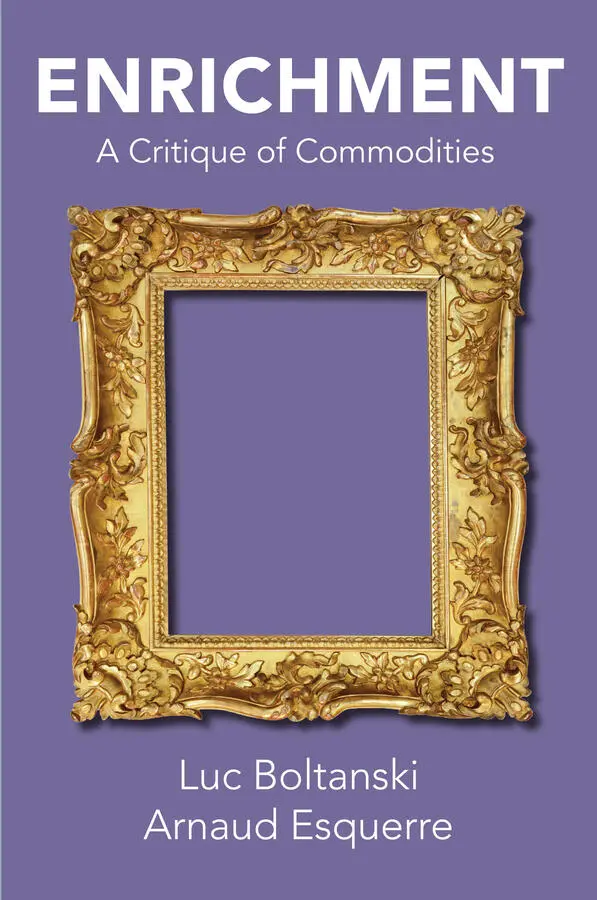
- Название:Enrichment
- Автор:
- Жанр:
- Год:неизвестен
- ISBN:нет данных
- Рейтинг книги:4 / 5. Голосов: 1
-
Избранное:Добавить в избранное
- Отзывы:
-
Ваша оценка:
Enrichment: краткое содержание, описание и аннотация
Предлагаем к чтению аннотацию, описание, краткое содержание или предисловие (зависит от того, что написал сам автор книги «Enrichment»). Если вы не нашли необходимую информацию о книге — напишите в комментариях, мы постараемся отыскать её.
Enrichment — читать онлайн ознакомительный отрывок
Ниже представлен текст книги, разбитый по страницам. Система сохранения места последней прочитанной страницы, позволяет с удобством читать онлайн бесплатно книгу «Enrichment», без необходимости каждый раз заново искать на чём Вы остановились. Поставьте закладку, и сможете в любой момент перейти на страницу, на которой закончили чтение.
Интервал:
Закладка:
A new perspective in economic analysis
Jack Lang’s directives, which he implemented when the left came to power in France in 1981, accompanied and sometimes preceded a turn that was taking place among economists, especially among those who had been influenced by Marxism or by the economic outlook of the radical American left. A number of the latter thinkers had worked in French research organizations, especially INSEE. Their work accompanied the planning that took place in the 1960s and, as the 1960s gave way to the 1970s, their models sought to integrate the effects of international competition on an economy that had been conceived, after the Second World War, primarily within national frameworks. 39In the 1980s, these economists shared a serious concern about competitiveness, but they also agreed that the economic models centered on the major industrial firms were being exhausted, although they did not give up on the project of a public framing structure for the economy. That project led them to resist the economic trend that was fast becoming dominant, the trend toward placing particular stress on demand and on the dynamics of international commerce. The work of these economists is relevant to the genealogy of the enrichment economy that we are trying to depict in broad strokes, because, even though they still concentrated on production rather than on the exchange and circulation of things, they sought to multiply the directions that competition and growth could take by tracing paths that deviated from that of the mass industrial economy. This orientation gave them common ground with economists who were attentive to sociology and, more generally, to the social and political sciences that were developing a new orientation in the second half of the 1980s: the economics of conventions. 40
As one example of this new approach, we can look at a work by Michael Piore and Charles Sabel, The Second Industrial Divide , published in the United States in 1984 and in 1989 in French translation as Les chemins de la prospérité: de la production de masse à la spécialisation souple (The paths of prosperity: from mass production to supple specialization). The book was highly influential in Europe, especially in France and Italy, among scholars who focused on small, networked, sometimes family-run businesses, on the dynamics of proximity, and on local development policies centered in regional agencies and industrial districts. 41In the preface to the French edition, Piore and Sabel undertook to show that the opposition on which their book was based, between “two antagonistic modes of technological progress” (assembly-line production on the one hand, an artisanal economy on the other), is particularly valid for France. While “nineteenth-century France appeared as a country with an artisanal economy par excellence,” unlike “its rivals in industrial competition” Great Britain and the United States, France transformed itself after the Second World War, by a deliberate political choice on the part of its leaders, into a prototypical mass production economy rivaled only by that of the United States. 42
The economic model that Piore and Sabel sought to promote in the mid-1980s was supposed to be valid for any type of production. But companies that had turned toward a luxury economy served as their primary models, and it was chiefly with respect to the manufacture of exceptional products that the turn advocated by the authors proved to be realistic. A case in point can be found in the textile district of Prato, in Tuscany. Faced with competition from less expensive textiles made in Japan and Eastern Europe, Prato became a paradigmatic example of local development based on networked small businesses. It succeeded owing to two factors: “a long-term shift from standard to fashionable fabrics, and a corresponding reorganization of production from large integrated mills to technologically sophisticated shops specializing in various phases of production.” 43Lyon offers a counter-example: it had stopped producing artisanal silk in the late nineteenth century in favor of industrial spinning mills, and it saw its textile industry disappear in the late 1950s. In the context of the “industrial districts” of “the third Italy,” middle-sized factories benefited from the activation of familial and political solidarities in an environment shaped by dynamic regional entities; this explains the success of clothing companies such as Benetton or, later, Diesel, both of which attained the status of worldwide groups. 44
As a second example, we can consider a book published in 1993 by Robert Salais and Michael Storper, Les mondes de production: enquête sur l’identité économique en France . 45This work is particularly relevant to our effort to grasp the moment at which the orientation toward exceptional goods with a strongly cultural tenor was beginning to be considered as a way to compensate for the decline in mass production that was affecting the industrial regions in France. By relying on the notion of “possible worlds,” borrowed from the economy of conventions, the authors distinguished between an industrial world in which price-based competition is driven by “economies of scale and costs” and a world in which competition relies on an “economy of variety (scope)” that includes both high-tech objects and objects of superior quality or objects that are exceptional in some other way. As it happens, one of the pitfalls of the French economy at the time was that it was too polarized toward industry, where it was not succeeding very well, to the detriment of an “economy of variety-scope,” 46which was particularly successful in the United States, in the area of high-tech products, and in Italy, in the area of luxury goods. It follows that “the future [belonged] to products that are not strictly ‘industrial’” 47and that rely on conventions of quality. Since the publication of Salais and Storper’s book, France has in fact seen growth in sales of products in areas that the authors deemed promising, such as wine, perfume, jewelry, and fashion.
A shift to different scales
In France, the orientation toward an economy centered on localities, on exceptional goods produced by artisans, on the luxury economy, and on the development of culture as an economic asset and a means of combating unemployment was first initiated by the central government through public policies whose inspiration went against the grain of those adopted at the end of the Second World War. At the outset, then, the initiative did not come from the business world, and certainly not from the large industrial firms, which were oriented instead toward delocalization, transformation into multinationals, and finance. The new public policies opened the door to active interventions at the local level. As it happened, actions of this sort, stimulated by regionalization, decentralization, and the growing autonomy allowed to local collectivities in the management of their budgets, encouraged the formation of an enrichment economy, but from below , as it were. The key factors were the new local cultural policies and a focus on the associative sphere, where new initiatives were encouraged and subsidized.
The public cultural policies introduced by the Ministry of Culture and Communication were characterized by “a massive use of contractual arrangements – contracts, conventions, and other protocols for agreements established by public or private organizations committed to financing and/or implementing action plans within a pre-established time period.” This led to a “generalized contractualization” in 1982–8, largely under the impetus of Michel Rocard; it took the form of intercommunal development charters and neighborhood social development operations that blended urban, social, educational, cultural, and environmental concerns. 48Thus cultural action was integrated into regional planning, which was inseparable from public action wholly based on a regional political logic ; in other words, “cultural action” was approached not “as a sector for action” but in its global dimension, inscribed in a politics of regional development. Key factors in the program’s success were “strong involvement by elected officials,” “a dialogue with associations and communes,” and “intense coordination among the services: culture, regional planning, tourism.” 49In short, the implementation of this policy was based on processes of “concertation,” “dialogue,” “joint elaboration,” and “shared responsibilities,” during which cultural actors – actors in theater and film, dancers, painters, sculptors, writers, librarians, and so on – found themselves led, and in some cases compelled, to keep on working, making contacts with mayors, local officials, managers, and so on. These processes could be seen as exemplifying the “encounters” on which Jack Lang counted for an intensification of creativity at all levels.
Читать дальшеИнтервал:
Закладка:
Похожие книги на «Enrichment»
Представляем Вашему вниманию похожие книги на «Enrichment» списком для выбора. Мы отобрали схожую по названию и смыслу литературу в надежде предоставить читателям больше вариантов отыскать новые, интересные, ещё непрочитанные произведения.












Обсуждение, отзывы о книге «Enrichment» и просто собственные мнения читателей. Оставьте ваши комментарии, напишите, что Вы думаете о произведении, его смысле или главных героях. Укажите что конкретно понравилось, а что нет, и почему Вы так считаете.