Luc Boltanski - Enrichment
Здесь есть возможность читать онлайн «Luc Boltanski - Enrichment» — ознакомительный отрывок электронной книги совершенно бесплатно, а после прочтения отрывка купить полную версию. В некоторых случаях можно слушать аудио, скачать через торрент в формате fb2 и присутствует краткое содержание. Жанр: unrecognised, на английском языке. Описание произведения, (предисловие) а так же отзывы посетителей доступны на портале библиотеки ЛибКат.
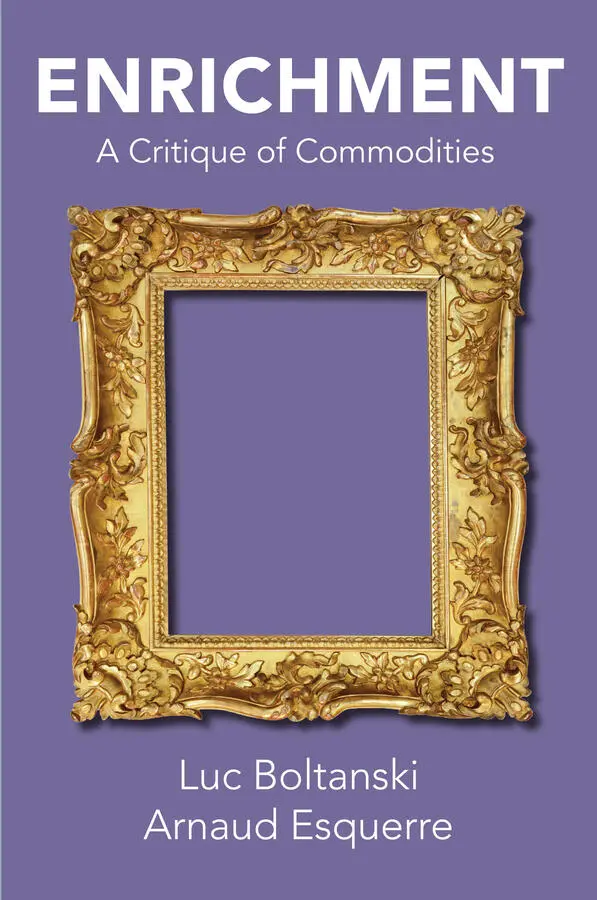
- Название:Enrichment
- Автор:
- Жанр:
- Год:неизвестен
- ISBN:нет данных
- Рейтинг книги:4 / 5. Голосов: 1
-
Избранное:Добавить в избранное
- Отзывы:
-
Ваша оценка:
Enrichment: краткое содержание, описание и аннотация
Предлагаем к чтению аннотацию, описание, краткое содержание или предисловие (зависит от того, что написал сам автор книги «Enrichment»). Если вы не нашли необходимую информацию о книге — напишите в комментариях, мы постараемся отыскать её.
Enrichment — читать онлайн ознакомительный отрывок
Ниже представлен текст книги, разбитый по страницам. Система сохранения места последней прочитанной страницы, позволяет с удобством читать онлайн бесплатно книгу «Enrichment», без необходимости каждый раз заново искать на чём Вы остановились. Поставьте закладку, и сможете в любой момент перейти на страницу, на которой закончили чтение.
Интервал:
Закладка:
Jack Lang, who served as minister of culture during François Mitterrand’s presidency, became the principal interpreter of this transformation, displacing the conception of culture – thematized by André Malraux but also by communist intellectuals – that had predominated during the preceding period, when the state had assumed significant legal and financial responsibility for cultural activities. The progressives who had been active in the Resistance during the war considered culture in terms of a pair of oppositions that, in their eyes, justified its “democratization” – its transmission to workers. The first was the opposition between culture and the economy, mirroring the opposition between the soul and the body. Workers, who are the foundation of the economy, and especially those workers whose labor makes heavy demands on the body, must have access to culture because they (too) have souls. Culture is in some sense their due: the economy is necessary, of course, but subordinate. Culture, to play its role, must be removed from the economic sphere. The second opposition is between high or elite culture, supported by “noble” institutions (museums, universities, and so on), and low or mass culture (industrial culture, cultural commodities, or culture at the service of the commodity cosmos); the latter was viewed with loathing by elitists and reactionaries, but it was also regarded with repulsion by certain thinkers on the left inspired in particular by the Frankfurt School. 29Seen in this spirit, cultural democratization was aimed at extracting the masses from the grip of low culture and raising them up toward high culture.
These are the oppositions that Jack Lang took it upon himself to deconstruct in a public way, beginning with a speech in Mexico City in 1982 that drew a lot of attention. On the one hand (the first opposition), he asserted that the ties between culture and the economy were not scandalous sources of corruption but normal and even indispensable. The economy does not pervert culture; culture requires the economy. Without an economy, there is no culture. Conversely, he predicted that it would be through cultural inventiveness that the economies of the world would be revitalized, and that “conquering unemployment is a cultural change that comes about through a change in cultural policy.” 30Culture is and must be at the service of the economy (above all thanks to tourism). On the other hand (the second opposition), Lang opened up the definitions of the term “culture” (following the lead of anthropology and sociology in this respect) in such a way as to break down the border between high and low culture. The concept of culture would henceforth include the so-called industrial arts, such as fashion and design, and also the popular arts, for example songs, comic books, and street art. Similarly, a nation’s heritage would include, on equal footing, long-standing historical monuments recognized as such and industrial complexes showcased by the eco-museums under development at the time 31(Lang had fought the destruction of the Baltard pavilions, which he had wanted to transform into a cultural center). Now anything could become culture, and every individual could become a creator if he or she were recognized as such. Lang proposed to replace the “democratization of culture” by “cultural democracy,” which would privilege the processes – very numerous, as it turned out – known as “artification.” 32Thus the power to bestow recognition on works of art that had long belonged to agencies such as museums, academic institutions, and critics had to be transferred to public financing agencies, whether these depended on the central government or on local authorities.
This new line was not just a matter of words. Lang’s argument was accompanied by concrete measures such as the creation of regional foundations for contemporary art (FRACs), which escaped the control of museum conservators, 33or the National Association for the Development of the Arts of Fashion (in 1989). These measures provoked outrage among the defenders of culture “in the noble sense”; beginning in the 1980s, the authorities implementing the new measures were accused of “relativism,” an anathema that was to resurface in force later on, when “values” became a central issue in political disputes. 34The FRACs were different from museums in the sense that their mission was to constitute collections and to organize itinerant exhibits. These innovations disrupted the hierarchy of intermediaries in the plastic arts – a hierarchy dominated up to that point by museum officials – while giving important roles to actors who had not been certified by any official title and who enjoyed a certain degree of autonomy with respect to institutions. 35They accompanied a proliferation of exhibit organizers (“curators”), who worked on “projects” without answering to any hierarchical body; this often went hand in hand with considerable economic insecurity and an increased dependence on major collectors and galleries.
This redefinition of culture and the measures that accompanied it were undergirded by a philosophy that has been expressed in part by Félix Guattari, 36in a theory that associates the processes of creation and the constitution of value with the expression of differences of any order, whether the object in question is new (for example, an industrial wasteland whose beauty can suddenly be revealed) or old (for example, a Romanesque church), differences that can modify the perception of the world shared by the people to whom they are pointed out. “What can be done to ensure that music, dance, creation, all forms of sensibility, belong by rights to the entire set of social components?,” Guattari asks. 37The response lies in the conception according to which all human beings are creators whenever they realize their humanity by paying attention to differences in which they recognize themselves, and when they manifest a desire to share with others both the recognition of those differences and the recognition of their humanity inasmuch as their humanity is expressed in the attention paid to the differences. Thus everyone turns out to be oriented toward a goal, which is to interest other people, to arouse their curiosity , and this process is at the root of the formation of communities constituted around encounters among distinct beings, each of whom intends to share with the others the differences that constitute his or her singularity. From this perspective (which Philippe Urfalino judiciously characterizes as vitalist), 38the mission of cultural agencies – above all, the agencies that distribute the funding that cultural activities need – is to put people into circulation and bring them into contact, to organize encounters in order to promote the exchange of identities and differences.
Money is the energy that allows such encounters to take place, through the financing of travel, performances, colloquia, festivals, and so on. But these encounters produce an energy that generates money in its turn, so that the economy – the libidinal economy, as it were – of exchanges of energy among actors, who are all animated by the same desire to awaken the curiosity of others by deploying their own differences while awakening themselves through contact with the differences manifested by others, rejoins the economy as understood by economists. In order to function, this generalized economy thus presupposes, on the one hand, that the participants will limit or delay the selection process, for one cannot know a priori what will arouse the curiosity and the creativity of others – that is, where the liberation of energy will come from – and, on the other hand, that participants will not fear excess, profusion, loss, or expenditures, for, in the absence of these, no energy can be produced. A conception to which disconsolate souls, unable to think in terms other than those of management control, object that money spent on culture – input – can easily be accounted for, and that it often leads to losses, and that the energy that culture is supposed to generate not only eludes accountability but also resists any other form of objectivization. This is the case up to the point when the importance of what geographers call the residential economy is recognized, and when mayors in urban agglomerations realize that cultural investment in the broad sense constitutes a solid asset for attracting qualified workers, tourists, foreign residents, or wealthy retirees to their cities – and also, increasingly, businesses specialized in exploiting the type of resources on which an enrichment economy is based.
Читать дальшеИнтервал:
Закладка:
Похожие книги на «Enrichment»
Представляем Вашему вниманию похожие книги на «Enrichment» списком для выбора. Мы отобрали схожую по названию и смыслу литературу в надежде предоставить читателям больше вариантов отыскать новые, интересные, ещё непрочитанные произведения.









Обсуждение, отзывы о книге «Enrichment» и просто собственные мнения читателей. Оставьте ваши комментарии, напишите, что Вы думаете о произведении, его смысле или главных героях. Укажите что конкретно понравилось, а что нет, и почему Вы так считаете.