Luc Boltanski - Enrichment
Здесь есть возможность читать онлайн «Luc Boltanski - Enrichment» — ознакомительный отрывок электронной книги совершенно бесплатно, а после прочтения отрывка купить полную версию. В некоторых случаях можно слушать аудио, скачать через торрент в формате fb2 и присутствует краткое содержание. Жанр: unrecognised, на английском языке. Описание произведения, (предисловие) а так же отзывы посетителей доступны на портале библиотеки ЛибКат.
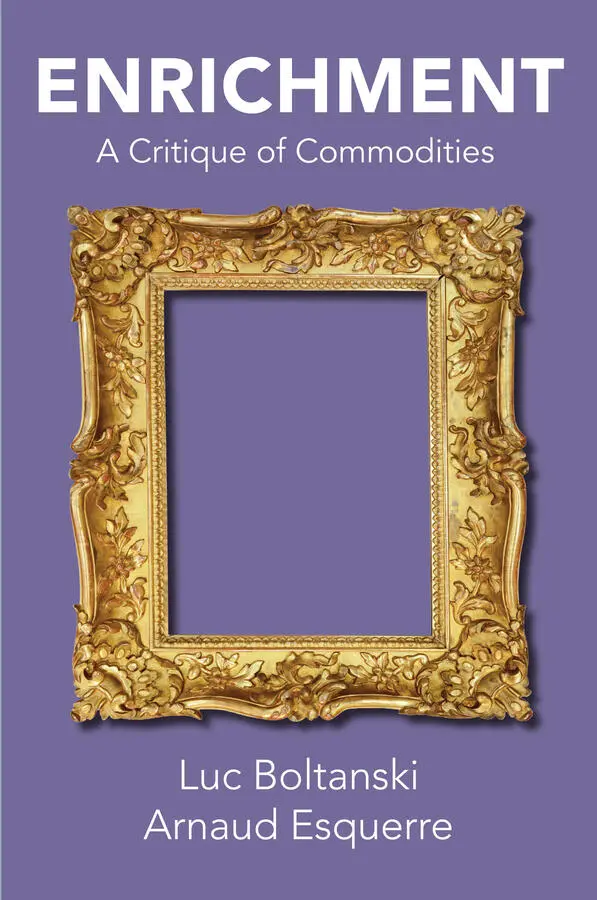
- Название:Enrichment
- Автор:
- Жанр:
- Год:неизвестен
- ISBN:нет данных
- Рейтинг книги:4 / 5. Голосов: 1
-
Избранное:Добавить в избранное
- Отзывы:
-
Ваша оценка:
Enrichment: краткое содержание, описание и аннотация
Предлагаем к чтению аннотацию, описание, краткое содержание или предисловие (зависит от того, что написал сам автор книги «Enrichment»). Если вы не нашли необходимую информацию о книге — напишите в комментариях, мы постараемся отыскать её.
Enrichment — читать онлайн ознакомительный отрывок
Ниже представлен текст книги, разбитый по страницам. Система сохранения места последней прочитанной страницы, позволяет с удобством читать онлайн бесплатно книгу «Enrichment», без необходимости каждый раз заново искать на чём Вы остановились. Поставьте закладку, и сможете в любой момент перейти на страницу, на которой закончили чтение.
Интервал:
Закладка:
The increase in the number of people employed in the performing arts is often attributed in part, or even wholly, to the adoption of special legislation providing a degree of financial security for intermittent workers. However, this explanation does not apply to other workers in the cultural sector, and it underestimates the role played in this augmentation by regional planning since the 1980s. The policy introduced by Lang, based on contracts involving both public authorities and private interests, encouraged the development of associations, especially in the performing arts, and it also supported development in the non-profit sector. (With the exception of “social work,” the arts, theater, and other cultural activities were the only domain in which salaried employees working for organizations belonging to the non-profit sector – around 100,000 – were nearly equivalent in number to those employed outside of that sector.) The combined budgets of non-profit associations in the economy of culture, which amounted to 8.3 billion euros in 2011, add up to roughly 10 percent of the combined budgets of all non-profit associations in France. 50But the Lang policy has led to income precarity for a significant number of workers in the cultural domain. The salaried workers employed by cultural associations in 2011, estimated at around 170,000, were working more frequently on short-term contracts even though their educational levels were higher than those of workers in other sectors. 51Contractualization thus had features in common with the “project” culture that characterized the change in management methods implemented in businesses from the mid-1980s on and that may have served as a model.
As for festivals, they are especially plentiful in France. They are typically devoted to literature, comic books, theater, and above all music (1,972 musical events were produced in France in 2013). The creation and development of festivals during the second half of the 1970s and in the 1980s was first envisaged by actors on the ground, most often public figures serving as instruments of local development in interactions with government agencies; their projects benefited from the government’s decentralization measures. The budgetary equilibrium of such festivals, which depends – in proportions that vary on a case-by-case basis – on public subsidies, ticket sales, and private funds, is nevertheless fragile: when a festival is cancelled – sometimes owing to movements connected with the renegotiation of the status of intermittent workers – or even disappears altogether – most often owing to a reduction in public financing – the repercussions affect not only the culture workers involved but the entire set of local services and businesses.
Onto this development of the enrichment economy from below , which has benefited from governmental initiatives and subsidies that are often justified as measures intended to curtail unemployment, an expansion from above has gradually been grafted, as the prospect of profit has led to growth in investments in luxury goods, heritage sites, tourism, art, culture, and so on; the profitability of private capital has seemed all the less risky in these domains in that they have been supported or encouraged by public authorities. Investments oriented toward an enrichment economy are even more difficult to quantify and summarize than jobs, given the absence of transparency and the lack of an adequate accounting framework. But various indices, such as the development of luxury firms, suggest that these investments are significant and that they increase regularly, as do the profits generated.
Intensification of relationships between public cultural action and private enterprise was deemed necessary early on, in order to give substance to the idea that culture could make a significant contribution to economic growth. This intensification has taken the form of symbolic and material support on the part of public authorities for what can be designated as “culture industries,” thus making it clear that such industries are fully entitled to state support, with a primary emphasis on sectors judged prestigious on the international level – for example, haute couture, cinema, and of course the national heritage. The tourism sector, placed under the authority of the Ministry of Foreign Affairs in 2010, is another exemplary case, since public efforts in favor of tourism, a real national “cause,” cannot be effective without support from private interests in the areas of transportation, the hotel and restaurant industries, and upscale commerce, all of which are highly concentrated around a few major companies. As evidence, we can consider the demand, approved by law in 2015 after lengthy debates, that stores in designated tourist zones in Paris be allowed to stay open on Sundays and in the evenings. But the concern for stimulating investor interest is also taken into account on a more local level, with the promotion of heritage sites and regional attractions. The tourism secretariat thus includes among its “poles of excellence” a “wine tourism pole” that aims to “bring together the various actors in viticulture and tourism,” most notably by organizing “winery visits.” An “ecotourism pole” focuses on tourism by boat, on foot, by bicycle, or on horseback; this form of tourism is expected to benefit the development of rural regions by increasing the commodity value of the landscapes and increasing familiarity with local gastronomic products. 52This is why, among the personalities that make up the Tourism Promotion Council, alongside diplomats, local elected officials, and journalists, we find a representative of the National Group of Independents, a CEO of a high-quality food processing company, and the president of the Federation of Wines and Spirits.
The emphasis on tourism and, more generally, the highlighting of regions and areas offering important heritage sites that attract well-to-do residents (for example, chateaux, abbeys, exceptionally well-preserved villages, outstanding wine-growing regions, and “traditional arts and crafts”) are profitable above all for those who own property in the area, whether or not they themselves actually live there. These developments have thus helped increase the revenues drawn from heritage sites as compared with those drawn from work; this shift has been among the defining traits of the changes that have affected the bourgeoisie in France over the past thirty years. 53
Let us look, for example, at the Forum d’Avignon, created in 2007 with the support of the Ministry of Culture and Communication; it is presented on its website as “a laboratory of ideas and a space for international encounters at the service of culture and its dialogue with the economic and digital worlds.” 54Its mission is “to recall that culture is an investment – and not a cost – that is at once individual, collective, and financial, and that its triple nature – artistic, economic, and social – shares actively in the development of the economy and of the territories.” It brings together “artists,” “creators,” “entrepreneurs,” and officials from public agencies, as represented by the twenty or so personalities on its board of directors; the board addresses problems such as tax issues affecting creators, intellectual property rights and authorial rights, “cultural entrepreneurship,” or the contribution of culture to the development of regional “powers of attraction.” The Forum is increasingly interested in the impact of digital developments on the financing of the cultural sector. The existence of such an organization is emblematic of an enrichment economy, for it seeks to make three dimensions of the enrichment economy compatible: first, promotion of the nation itself as a brand in international competition (the brand “France”); second, development of the various regions, so as to maintain activity in them and, if possible, increase their powers of attraction; and, third, exploitation of those resources.
Читать дальшеИнтервал:
Закладка:
Похожие книги на «Enrichment»
Представляем Вашему вниманию похожие книги на «Enrichment» списком для выбора. Мы отобрали схожую по названию и смыслу литературу в надежде предоставить читателям больше вариантов отыскать новые, интересные, ещё непрочитанные произведения.










Обсуждение, отзывы о книге «Enrichment» и просто собственные мнения читателей. Оставьте ваши комментарии, напишите, что Вы думаете о произведении, его смысле или главных героях. Укажите что конкретно понравилось, а что нет, и почему Вы так считаете.