Luc Boltanski - Enrichment
Здесь есть возможность читать онлайн «Luc Boltanski - Enrichment» — ознакомительный отрывок электронной книги совершенно бесплатно, а после прочтения отрывка купить полную версию. В некоторых случаях можно слушать аудио, скачать через торрент в формате fb2 и присутствует краткое содержание. Жанр: unrecognised, на английском языке. Описание произведения, (предисловие) а так же отзывы посетителей доступны на портале библиотеки ЛибКат.
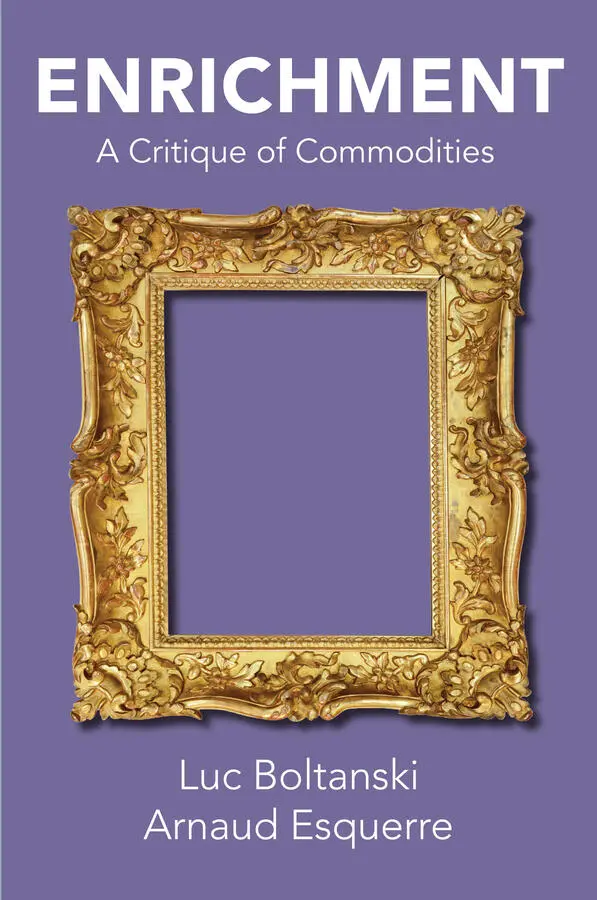
- Название:Enrichment
- Автор:
- Жанр:
- Год:неизвестен
- ISBN:нет данных
- Рейтинг книги:4 / 5. Голосов: 1
-
Избранное:Добавить в избранное
- Отзывы:
-
Ваша оценка:
Enrichment: краткое содержание, описание и аннотация
Предлагаем к чтению аннотацию, описание, краткое содержание или предисловие (зависит от того, что написал сам автор книги «Enrichment»). Если вы не нашли необходимую информацию о книге — напишите в комментариях, мы постараемся отыскать её.
Enrichment — читать онлайн ознакомительный отрывок
Ниже представлен текст книги, разбитый по страницам. Система сохранения места последней прочитанной страницы, позволяет с удобством читать онлайн бесплатно книгу «Enrichment», без необходимости каждый раз заново искать на чём Вы остановились. Поставьте закладку, и сможете в любой момент перейти на страницу, на которой закончили чтение.
Интервал:
Закладка:
Notes
1 1. Michael Thompson, Rubbish Theory: The Creation and Destruction of Value (Oxford: Oxford University Press, 1979).
2 2. See Michel Melot, Mirabilia: essai sur l’inventaire général du patrimoine culturel (Paris: Gallimard, 2012), and, for an ethnography of the selection processes, Nathalie Heinich, La fabrique du patrimoine (Paris: Éditions de la MSH, 2009).
3 3. Thorstein Veblen, The Theory of the Leisure Class (New York: Penguin Books, [1899] 1979).
4 4. See Marie-France Garcia-Parpet, Le marché de l’excellence: les grands crus à l’épreuve de la mondialisation (Paris: Seuil, 2009).
5 5. Jean-Pierre Cometti ignores this problem when he addresses the question: see Jean-Pierre Cometti, Conserver/restaurer: l’oeuvre d’art à l’époque de sa préservation technique (Paris: Gallimard, 2016).
6 6. This theme has been developed in American sociology; see especially Paul DiMaggio, “Classification in Art,” American Sociological Review, 52/4 (1987): 440–55; Sharon Zukin, The Culture of Cities (Oxford: Blackwell, 1995), pp. 79–108; on the notion of “symbolic goods,” see Michèle Lamont and Marcel Fournier, Cultivating Differences: Symbolic Boundaries and the Making of Inequality (Chicago: University of Chicago Press, 1992).
7 7. Pierre Bourdieu, “Le marché des biens symboliques,” L’Année sociologique 22 (1971): 49–126.
8 8. Jean Baudrillard, The System of Objects, trans. James Benedict (London: Verso, [1968] 1996).
9 9. Here we follow Cornelius Castoriadis in The Imaginary Institution of Society, trans. Kathleen Blamey (Cambridge, MA: MIT Press, [1975] 1987): “Everything that is presented to us in the social–historical world is inextricably tied to the symbolic. … the innumerable material products without which no society could live even an instant, are not (not always, not directly) symbols. All of these, however, would be impossible outside of a symbolic network” (p. 117). According to Castoriadis, the “symbolic” can neither be treated (as it often is) as a mere neutral cloak nor as stemming from a “logic” properly speaking that would be superimposed on another kind of order known as “rational” (pp. 117–27).
10 10. Howard S. Becker, Art Worlds (Berkeley: University of California Press, 1982), p. 34.
11 11. A nineteenth-century elevated railroad track converted in the early twenty-first century to a space for strolling enhanced by contemporary art works, the High Line is in a former industrial district that has become a center for art galleries and luxury shops. See David Halle and Elisabeth Tiso, New York’s New Edge: Contemporary Art, the High Line, and Urban Megaprojects on the Far West Side (Chicago: University of Chicago Press, 2014).
12 12. See Edward Anthony Wrigley, Continuity, Chance & Change: The Character of the Industrial Revolution in England (Cambridge: Cambridge University Press, 1990), and Energy and the English Industrial Revolution (Cambridge: Cambridge University Press, 2010).
13 13. See Dominique Poulot, Une histoire des musées en France (Paris: La Découverte, 2008).
14 14. On the constitution of the French national patrimony, see Alexandra Kowalski, “The Nation, Rescaled: Theorizing the Decentralization of Memory in Contemporary France,” Comparative Studies in Society and History, 54/2 (2012): 308–31; and “State Power as Field Work: Culture and Practice in the French Survey of Historic Landmarks,” in Richard Sennett and Craig Calhoun, eds, Practicing Culture (London: Routledge, 2007), pp. 82–104.
15 15. Bénédicte Savoy, Patrimoine annexé: les biens culturels saisis par la France en Allemagne autour de 1800, 2 vols (Paris: Éditions de la MSH, 2003).
16 16 Guido Guerzoni, Apollo and Vulcan: The Art Markets in Italy, 1400–1700, trans. Amanda George (East Lansing: Michigan State University Press, [2006] 2011).
17 17. Cissie Fairchilds, “The Production and Marketing of Populuxe Goods in Eighteenth-Century Paris,” in John Brewer and Roy Porter, eds, Consumption and the World of Goods (New York: Routledge, 1993), pp. 228–48.
18 18. Louis Bergeron, Les industries du luxe en France (Paris: Odile Jacob, 1998).
19 19. See Eric Zuelow, ed., Touring Beyond the Nation: A Transnational Approach to European Tourism History (Burlington, VT: Ashgate, 2011).
20 20. Alain Croix, ed., Initiateurs et entrepreneurs culturels du tourisme (1850–1950), Actes du colloque de Saint-Brieuc, June 2–4, 2010 (Rennes: Presses Universitaires de Rennes, 2011).
21 21. See Pierre Bourdieu and Luc Boltanski, La production de l’idéologie dominante (Paris: Demopolis, [1976] 2008).
22 22. A good indicator is the work Le partage des bénéfices, published under the collective name of Darras, which brings together the contributions to a colloquium organized by Pierre Bourdieu in 1965 by sociologists and anthropologists (P. Bourdieu, J.-C. Chamboredon, C. Durand, R. Sainsaulieu, J. Lautman, J. Cuisenier), economists (J.-P. Pagé, C. Gruson, M. Praderie), and statisticians from INSEE (A. Darbel, C. Seibel, J.-P. Ruault). Prefaced by Claude Gruson, a Keynesian economist influenced by social Christianity, then director of INSEE, the work dealt with the fact that “expansion” had not managed to reduce inequality envisaged on several levels: employment, agriculture, schooling, and so on. The papers tended to stress the need for “social mobility.” See Darras, Le partage des bénéfices, expansion et inégalités en France (Paris: Minuit, 1966).
23 23. After the first report of the Club of Rome, in 1972, titled “The Limits to Growth.” See Peter Wagner, Modernity: Understanding the Present (Cambridge: Polity, 2012), pp. 49–52.
24 24. See for example La Gueule ouverte, a successful periodical similar to Charlie Hebdo, published by Pierre Fournier with contributions by Cavanna, Wolinski, Reiser, and Cabu; and also Alain Hervé’s Le Sauvage, similar to Le Nouvel Observateur, where André Gorz was a journalist.
25 25. The number of students grew sixfold between the early 1960s and the first decade of the twenty-first century, from 215,000 to 1.3 million. In 1982, among French people between the ages of twenty-five and fifty-four who were working or actively seeking employment, 2.1 million – that is, 13 percent of this age group – had degrees attesting to post-secondary education. In 2010, the number with similar degrees reached 8 million, or four times as many, and they represented more than a third (36 percent) of people in the workforce between the ages of twenty-five and fifty-four. See Jean-François Léger, “Plus de diplômés, plus d’inégalités territoriales?” Population & Avenir, no. 718 (2014): 4.
26 26. For a detailed description of the reorganization of companies and changes in working conditions, see Luc Boltanski and Ève Chiapello, The New Spirit of Capitalism, trans. Gregory Elliott (London: Verso, [1999] 2005).
27 27. This devaluation of diplomas, which began in the 1980s, became particularly significant starting in the 1990s, and it has only been accentuated since then. In 1982, as we have seen, 2.1 million members of the workforce had higher degrees, while there were 1.6 million workers at the managerial level (cadres); thus there were thirteen members of the workforce with higher degrees for every ten cadres. In 2010, 8 million members of the workforce held higher degrees, while there were 3.6 million cadres, or twenty-two members of the workforce with higher degrees for every ten cadres. In 1990, 45 percent of people with higher degrees were cadres. Twenty years later, the proportion had fallen to 37 percent. At the same time, the territorial distribution of opportunities to get a position as a cadre became more and more unequal: cadres with higher degrees were concentrated in the Paris region and to a lesser extent in the major regional metropolitan centers such as Lyon, Marseille, and Toulouse. See Léger, “Plus de diplômés,” pp. 4–7.
Читать дальшеИнтервал:
Закладка:
Похожие книги на «Enrichment»
Представляем Вашему вниманию похожие книги на «Enrichment» списком для выбора. Мы отобрали схожую по названию и смыслу литературу в надежде предоставить читателям больше вариантов отыскать новые, интересные, ещё непрочитанные произведения.












Обсуждение, отзывы о книге «Enrichment» и просто собственные мнения читателей. Оставьте ваши комментарии, напишите, что Вы думаете о произведении, его смысле или главных героях. Укажите что конкретно понравилось, а что нет, и почему Вы так считаете.