Mohammad Asadzadeh - An Introduction to the Finite Element Method for Differential Equations
Здесь есть возможность читать онлайн «Mohammad Asadzadeh - An Introduction to the Finite Element Method for Differential Equations» — ознакомительный отрывок электронной книги совершенно бесплатно, а после прочтения отрывка купить полную версию. В некоторых случаях можно слушать аудио, скачать через торрент в формате fb2 и присутствует краткое содержание. Жанр: unrecognised, на английском языке. Описание произведения, (предисловие) а так же отзывы посетителей доступны на портале библиотеки ЛибКат.
- Название:An Introduction to the Finite Element Method for Differential Equations
- Автор:
- Жанр:
- Год:неизвестен
- ISBN:нет данных
- Рейтинг книги:3 / 5. Голосов: 1
-
Избранное:Добавить в избранное
- Отзывы:
-
Ваша оценка:
An Introduction to the Finite Element Method for Differential Equations: краткое содержание, описание и аннотация
Предлагаем к чтению аннотацию, описание, краткое содержание или предисловие (зависит от того, что написал сам автор книги «An Introduction to the Finite Element Method for Differential Equations»). Если вы не нашли необходимую информацию о книге — напишите в комментариях, мы постараемся отыскать её.
An Introduction to the Finite Element Method (FEM) for Differential Equations
An Introduction to the Finite Element Method
An Introduction to the Finite Element Method for Differential Equations — читать онлайн ознакомительный отрывок
Ниже представлен текст книги, разбитый по страницам. Система сохранения места последней прочитанной страницы, позволяет с удобством читать онлайн бесплатно книгу «An Introduction to the Finite Element Method for Differential Equations», без необходимости каждый раз заново искать на чём Вы остановились. Поставьте закладку, и сможете в любой момент перейти на страницу, на которой закончили чтение.
Интервал:
Закладка:

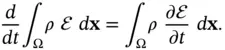
and the time rate (time derivative) of change of thermal energy in  is:
is:
Let  denote the heat flux vector and
  denote the outward unit normal to the boundary
  , at the point
  . Then
  represents the flow of heat per unit cross‐sectional area per unit time crossing a surface element. Thus,

is the amount of heat per unit time flowing into  across the boundary
  . Here,
  represents the element of surface area. The minus sign reflects the fact that if more heat flows out of the domain
  than in, the energy in
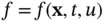
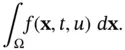
  decreases. Finally, in general, the heat production is determined by external sources that are independent of the temperature. In some cases, (such as an air conditioner controlled by a thermostat), it depends on temperature itself, but not on its derivatives. Hence, in the presence of a source (or sink), we denote the corresponding rate at which heat is produced per unit volume by
  so that the source term becomes
Now, the law of conservation of energy takes the form
(1.5.8) 
Applying the Gauss divergence theorem to the integral over  , we get
(1.5.9) 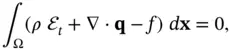
where  denotes the divergence operator. In the sequel, we shall use the following simple result:
Lemma 1.1
Let  be a continuous function satisfying
 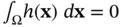 for every domain
  . Then
  .
.
Proof:
Let us assume to the contrary that there exists a point  where
where  . Assume without loss of generality that
  . Since
  is continuous, there exists a domain (maybe very small)
  , containing
  , and an
  , such that
  , for all
 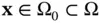 . Therefore, we have
  , which contradicts the assumption.
From ( 1.5.9), using Lemma 1.1, we conclude that
(1.5.10) 
This is the basic form of our heat conduction law. The functions  and
and  are unknown and additional information of an empirical nature is needed to determine the equation for the temperature
  . First, for many materials, over a fairly wide but not too large temperature range, the function
  depends nearly linearly on
  , so that
Интервал:
Закладка:
Похожие книги на «An Introduction to the Finite Element Method for Differential Equations»
Представляем Вашему вниманию похожие книги на «An Introduction to the Finite Element Method for Differential Equations» списком для выбора. Мы отобрали схожую по названию и смыслу литературу в надежде предоставить читателям больше вариантов отыскать новые, интересные, ещё непрочитанные произведения.









Обсуждение, отзывы о книге «An Introduction to the Finite Element Method for Differential Equations» и просто собственные мнения читателей. Оставьте ваши комментарии, напишите, что Вы думаете о произведении, его смысле или главных героях. Укажите что конкретно понравилось, а что нет, и почему Вы так считаете.