David Linden - Touch
Здесь есть возможность читать онлайн «David Linden - Touch» весь текст электронной книги совершенно бесплатно (целиком полную версию без сокращений). В некоторых случаях можно слушать аудио, скачать через торрент в формате fb2 и присутствует краткое содержание. Год выпуска: 2014, ISBN: 2014, Издательство: Penguin Books Ltd, Жанр: Психология, Биология, sci_popular, на английском языке. Описание произведения, (предисловие) а так же отзывы посетителей доступны на портале библиотеки ЛибКат.
- Название:Touch
- Автор:
- Издательство:Penguin Books Ltd
- Жанр:
- Год:2014
- ISBN:9780241184059
- Рейтинг книги:4 / 5. Голосов: 1
-
Избранное:Добавить в избранное
- Отзывы:
-
Ваша оценка:
Touch: краткое содержание, описание и аннотация
Предлагаем к чтению аннотацию, описание, краткое содержание или предисловие (зависит от того, что написал сам автор книги «Touch»). Если вы не нашли необходимую информацию о книге — напишите в комментариях, мы постараемся отыскать её.
Dual-function receptors in our skin make mint feel cool and chili peppers hot. Without the brain’s dedicated centers for emotional touch, an orgasm would feel more like a sneeze—convulsive, but not especially nice. From skin to nerves to brain, the organization of our body’s touch circuits is a complex and often counterintuitive system that affects everything from our social interactions to our general health and development.
In Touch, neuroscientist and bestselling author David J. Linden explores this critical interface between our bodies and the outside world, between ourselves and others. Along the way, he answers such questions as: Why do women have more refined detection with their fingertips than men? Is there a biological basis for the use of acupuncture to relieve pain? How do drugs like Ecstasy heighten and motivate sensual touch? Why can’t we tickle ourselves? Linking biology and behavioral science, Touch offers an entertaining and enlightening answer to how we feel in every sense of the word.
Touch — читать онлайн бесплатно полную книгу (весь текст) целиком
Ниже представлен текст книги, разбитый по страницам. Система сохранения места последней прочитанной страницы, позволяет с удобством читать онлайн бесплатно книгу «Touch», без необходимости каждый раз заново искать на чём Вы остановились. Поставьте закладку, и сможете в любой момент перейти на страницу, на которой закончили чтение.
Интервал:
Закладка:
“I’m having the time of my life!” she agreed.
“I mean,” he asked, “I never tied you up or attacked you, right?”
“What are you talking about?” she countered.
“When you said that I raped you, that was a lie, wasn’t it?”
“Whatever,” she said. “Put that thing down and party with us.”
When the verdict came, the defendant was aghast, unable to believe that the video hadn’t saved him. We, the jury, had convicted him on all counts: rape, battery, and unlawful imprisonment. In his statement to the court before sentencing, he tried, none too successfully, to sound contrite: “I’m sorry for what I did. I do have a temper. I’ll admit it. And believe me—it was a really bad handjob.”

Now let’s imagine, in the style of a Quentin Tarantino revenge fantasy, that the girlfriend, newly empowered and burning with righteous fervor, has dragged her batterer/rapist into the alley behind the courthouse and forced him to undergo a painful biopsy of the sural nerve. This nerve runs down the back of the calf muscle and innervates the outer edge of the foot. Cutting the nerve and turning it to examine the cut end with a microscope, we’d see a cross-section of different kinds of sensory nerve axons, all intermingled (figure 3.1). 1The large-diameter axons, called A-fibers, are wrapped in layers of insulating myelin protein to speed neural signals and have several subsets with different functions. One group of A-fibers, called A-alpha, carries very fast information from special sensors embedded in muscles, joints, and tendons. These signals enable you to form a mental image of where your body is in space. This ability, called proprioception, makes it possible for you to sense, for example, the position and the movement of your arm, even when your eyes are closed and you are not touching anything. Another A-fiber, A-beta, conveys fast signals from the skin mechanoreceptors we discussed in chapter 2—the Merkels, Meissners, Ruffinis, and Pacinians that allow for fine tactile discrimination as well as the fast signals from hair deflection. The third type, A-delta, is smaller in diameter and has fewer wrappings of myelin protein, so it conducts signals at medium speed. Some A-delta fibers carry certain aspects of pain and temperature sensation, such as sharp, pricking pain and noxious heat and cold—but more on that later.
The sural nerve also contains much smaller-diameter axons, called C-fibers, which lack insulating myelin. Because of these structural features, electrical signals in C-fibers travel at a leisurely, sidewalk-strolling speed of about 2 miles per hour. By comparison, information from the skin mechanosensors flows at about 150 miles per hour via A-beta fibers, and proprioceptive signals race along at about 250 miles per hour on A-alpha fibers. 2The conduction speeds of these various fibers constrain the kind of information that they can carry. Fast fibers are necessary to transmit rapidly changing, highly nuanced signals about object shape, texture, vibration, and remote sensing with tools—the kind of fine tactile information encoded by mechanosensors that enable us to discriminate between subtly different touch experiences. For example, Braille writing could not be read if the information it contained was conveyed over slow C-fibers—the fast A-fibers are required for this.
C-fibers, in contrast, are not built to inform the parts of the brain involved in discriminative, factual aspects of touch sensation, but rather function to integrate information slowly and to discern the emotional tone of the particular touch involved—the vibe, if you will. For many years it was thought that C-fibers carried only information about pain, temperature, and inflammation (not the sharp, pricking, well-localized component of pain, but rather its slow, burning, throbbing, aching aspect, which is so emotionally taxing). However, more recently it has become clear that some C-fibers convey a special kind of tactile information: They appear to be tuned for interpersonal touch. These axons, called C-tactile fibers, are caress sensors.
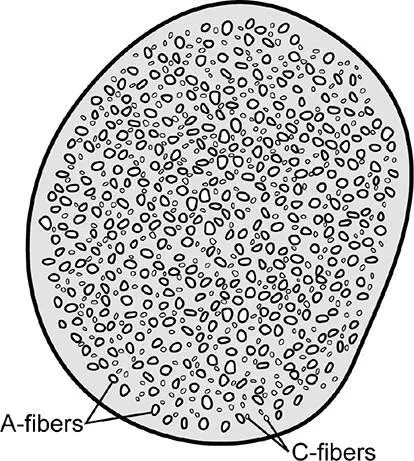
Figure 3.1Cross-section of the sural nerve. Normal human nerve, like that presumably present in our rapist, showing large myelinated A-fibers and small unmyelinated C-fibers intermixed. This is one fascicle (a bundle of fibers that run together as a cable) in the sural nerve, which typically contains several fascicles.
C-tactile fibers innervate only hairy skin, and their endings wrap around hair follicles, enabling them to respond to hair deflection. We don’t yet have unambiguous images of C-tactile fibers in human skin. However, using genetic tricks in mice, David Ginty and his colleagues at the Johns Hopkins University School of Medicine were able to introduce fluorescent molecules into different populations of sensory neurons. This study showed that certain types of hair follicles (giving rise to hairs called zigzag and awl/auchene types) are innervated by C-tactile fibers. These appear to be the equivalent of human vellus hairs. Interestingly, these types of follicles are also innervated by A-delta and A-beta fibers, and their longitudinal lanceolate endings are interleaved with one another in a beautiful pattern that looks like overlapping picket fences (figure 2.4). Obviously, the furry skin of a mouse has a somewhat different structure from the merely lightly haired skin of a human. Nonetheless, these findings indicate that hair deflection can give rise to multiple sensations even when a single type of hair is involved: a fast, discriminative, emotionally neutral signal mediated by A-beta fibers, and a slow, diffuse, pleasant signal from the C-tactile fibers. 3
Studying the role of C-tactile fibers in touch sensation is complicated by the fact that hairy skin is also innervated by fast A-beta and medium-speed A-delta fibers, relaying signals from hair deflection, as well as by the four conventional mechanoreceptors. It is not possible to simply stroke hairy skin and measure the percept evoked by C-tactile fibers alone, either with behavioral tests or a brain scanner, as any stroke would activate A-fiber responses as well. For years this problem of overlapping signals impeded our understating of the caress sensors.
At the age of thirty-two, G.L. became touch-blind. If you ask her, she’ll tell you that, in her daily life, she can’t feel anything below her nose, and if she closes her eyes, she has no idea where her limbs are in space. G.L.’s neurological deficit is remarkably specific. She is intelligent and does not have obvious problems with cognition or mood. Her ability to contract her muscles and thereby move her body is also intact. However, because she has no proprioceptive sense, she must rely mostly on vision to know where her limbs are positioned. As a consequence, her movements are slow and poorly coordinated, and she must use a wheelchair to ambulate. After extensive physical therapy she has been able to live independently in her home in Québec, Canada, for many years (she is sixty-five at the time of this writing).
A biopsy of G.L.’s sural nerve revealed the origin of her touch-blindness. She has lost her large myelinated fibers: the A-alpha fibers that carry proprioceptive information and the A-beta fibers that convey signals from the skin mechanoreceptors (figure 3.2). Because her A-delta fibers and C-fibers remain intact, her sensations of pain and temperature are normal. She is one of a small number of patients worldwide who have this syndrome, known as acute sensory neuronopathy. 4Some people with G.L.’s syndrome report that their bodies have come to feel like a foreign entity. 5They inhabit them, yet they are not entirely theirs. Others have a sense of becoming hyperconscious of their bodies, perhaps because they are focusing their attention strongly to detect the diminished touch sensations that do remain.
Читать дальшеИнтервал:
Закладка:
Похожие книги на «Touch»
Представляем Вашему вниманию похожие книги на «Touch» списком для выбора. Мы отобрали схожую по названию и смыслу литературу в надежде предоставить читателям больше вариантов отыскать новые, интересные, ещё непрочитанные произведения.











Обсуждение, отзывы о книге «Touch» и просто собственные мнения читателей. Оставьте ваши комментарии, напишите, что Вы думаете о произведении, его смысле или главных героях. Укажите что конкретно понравилось, а что нет, и почему Вы так считаете.