David Linden - Touch
Здесь есть возможность читать онлайн «David Linden - Touch» весь текст электронной книги совершенно бесплатно (целиком полную версию без сокращений). В некоторых случаях можно слушать аудио, скачать через торрент в формате fb2 и присутствует краткое содержание. Год выпуска: 2014, ISBN: 2014, Издательство: Penguin Books Ltd, Жанр: Психология, Биология, sci_popular, на английском языке. Описание произведения, (предисловие) а так же отзывы посетителей доступны на портале библиотеки ЛибКат.

- Название:Touch
- Автор:
- Издательство:Penguin Books Ltd
- Жанр:
- Год:2014
- ISBN:9780241184059
- Рейтинг книги:4 / 5. Голосов: 1
-
Избранное:Добавить в избранное
- Отзывы:
-
Ваша оценка:
Touch: краткое содержание, описание и аннотация
Предлагаем к чтению аннотацию, описание, краткое содержание или предисловие (зависит от того, что написал сам автор книги «Touch»). Если вы не нашли необходимую информацию о книге — напишите в комментариях, мы постараемся отыскать её.
Dual-function receptors in our skin make mint feel cool and chili peppers hot. Without the brain’s dedicated centers for emotional touch, an orgasm would feel more like a sneeze—convulsive, but not especially nice. From skin to nerves to brain, the organization of our body’s touch circuits is a complex and often counterintuitive system that affects everything from our social interactions to our general health and development.
In Touch, neuroscientist and bestselling author David J. Linden explores this critical interface between our bodies and the outside world, between ourselves and others. Along the way, he answers such questions as: Why do women have more refined detection with their fingertips than men? Is there a biological basis for the use of acupuncture to relieve pain? How do drugs like Ecstasy heighten and motivate sensual touch? Why can’t we tickle ourselves? Linking biology and behavioral science, Touch offers an entertaining and enlightening answer to how we feel in every sense of the word.
Touch — читать онлайн бесплатно полную книгу (весь текст) целиком
Ниже представлен текст книги, разбитый по страницам. Система сохранения места последней прочитанной страницы, позволяет с удобством читать онлайн бесплатно книгу «Touch», без необходимости каждый раз заново искать на чём Вы остановились. Поставьте закладку, и сможете в любой момент перейти на страницу, на которой закончили чтение.
Интервал:
Закладка:
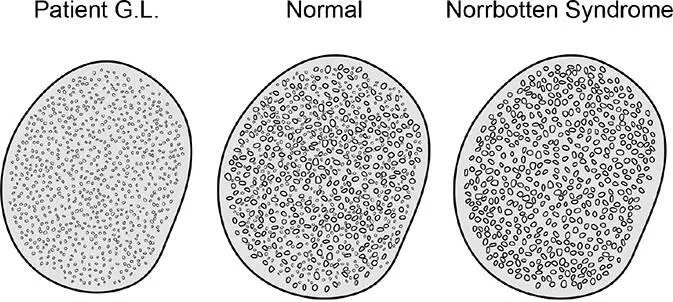
Figure 3.2A sural nerve biopsy of patient G.L. In G.L.’s sural nerve, note the lack of large myelinated A-fibers and the preservation of small unmyelinated C-fibers. In the center, a normal nerve is shown for comparison. A nerve from a patient suffering from Norrbotten syndrome (also called HSAN V) shows the converse of G.L.’s condition, with spared large A-fibers and decimated A-delta and C-fibers.
G.L. herself has been very generous with her time and has consented to be the subject of many investigations. Although she claims to be entirely touch-blind in everyday life, an interesting exception is revealed in the lab. When a stroke with a soft brush or a gentle fingertip caress is applied to the hairy skin of her forearm and she is asked to concentrate, she has a vague pleasant sensation, with no associated feeling of pain, temperature, itch, or tickle. When attending closely, she can usually tell which arm is being touched but cannot determine the location precisely. Crucially, when these gentle strokes are repeated on the glabrous skin of the palm, she has no sensation at all. These diffuse pleasant sensations are conveyed by her surviving C-tactile fibers, which innervate hairy but not glabrous skin. Amazingly, G.L. and patients like her lack fast, information-rich, emotionally neutral discriminative touch, but seem to retain a dedicated slowly functioning system for diffuse pleasant touch that conveys a feeling of safety. 6
But are G.L.’s C-tactile fibers functioning like those in uninjured people, or have their properties changed in response to the loss of neighboring A-fibers? The former appears to be the case. When electrical recordings were made from single nerve fibers running in the arm of normal subjects, experimenters could locate C-tactile fibers that responded to a caress of the hairy skin but not to simple skin indentation or vibration. (C-tactile fibers are never activated by any form of touch on the glabrous skin of the palm.)
Single A-beta fibers can be recorded in normal subjects that correspond to the various types of skin mechanosensors described earlier (Merkel, Pacinian, etc.), but they all have response properties that distinguish them from C-tactile fibers. A-beta fibers will respond to both a forearm caress and other forms of tactile stimulation, such as textured surfaces, edges, and vibration. And, of course, they respond to touches on the glabrous skin of the palm and fingers. Most important, and in noted contrast to the C-tactile fibers, A-betas are most effectively activated by intense stimuli: The more rapid the stroke, the stronger the response. A-beta fibers are capable of resolving a wide range of touch stimulus properties, while the C-tactile system appears to be tuned to detect a particular type of touch: a light caress within a particular range of speed. This tuning for an optimal speed is crucial for perception. When caresses of various speeds are delivered to the forearm or thigh of normal subjects, the caresses that are reported as feeling the most pleasant are those in the 3- to 10-centimeters-per-second range, which are precisely those that most strongly activate the C-tactile fibers. 7
When brain-imaging studies are performed with normal subjects, a forearm caress evokes activation of the primary and secondary somatosensory cortices, which are involved in fine shape and texture discrimination and driven by information originating in A-beta fibers, as well as a region called the posterior insula, which has been implicated in the emotional aspects of sensory processing. When G.L.’s brain is imaged, the forearm caress activates the posterior insula, but not the primary or secondary somatosensory areas, suggesting that her spared C-tactile fibers strongly activate the former but not the latter (figure 3.3). Furthermore, the same intermediate-speed caresses that strongly activate C-tactile fibers and are rated as the most pleasant also produce the strongest activation of the posterior insula in both G.L. and uninjured subjects. 8
Taken together, these experiments argue that C-tactile fibers function as caress detectors that innervate the hairy skin and project through a pathway to the posterior insula, the activation of which produces a slow, diffuse, pleasant sensation. Importantly, this pathway functions in all people, not just those suffering from sensory neuronopathy, like G.L. That includes the nineteen-year-old rapist in my jury duty case. While the glans penis is glabrous, the shaft of the penis is hairy skin and thereby innervated by C-tactile afferents. It’s likely that the handjob that enraged him by being either too fast or too slow was outside the range that would strongly activate the C-tactile sensors in the hairy skin of his penile shaft.
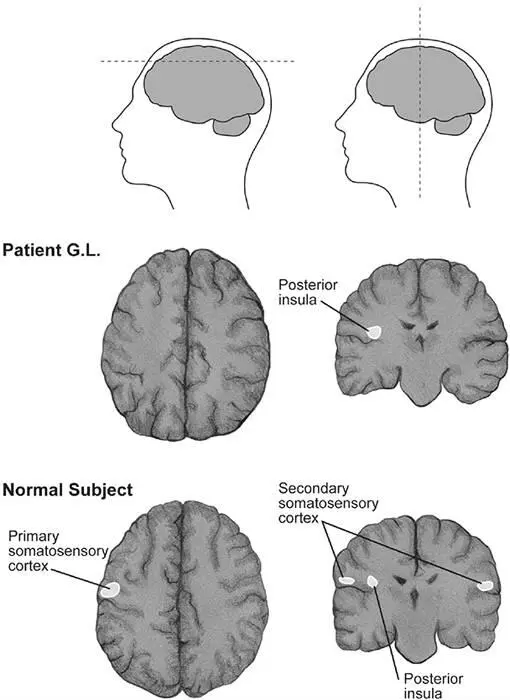
Figure 3.3A light caress on the right forearm activates the left anterior insula in both patient G.L., who lacks large myelinated sensory nerve fibers, and normal, uninjured subjects. The primary and secondary somatosensory cortices, which are necessary for fine discrimination, recognition, and localization of touch stimuli, are not activated by a forearm caress in G.L. Note that, consistent with our discussion in chapter 2, stimulation of the right forearm activates the left primary somatosensory cortex, but both left and right secondary somatosensory cortices in the normal subjects. The data depicted here are from H. Olausson, Y. Lamarre, H. Backlund, C. Morin, B. G. Wallin, G. Starck, S. Ekholm, I. Strigo, K. Worsley, Å. B. Vallbo, and M. C. Bushnell, “Unmyelinated tactile afferents signal touch and project to insular cortex,” Nature Neuroscience 5 (2002): 900–904, with permission of Nature Publishing Group.

If you ask people in Norrbotten, a large, sparsely populated region of Sweden located north of the Arctic Circle, they’ll tell you that the problem started in the seventeenth century or perhaps even earlier, with a man who couldn’t feel pain. Consequently, he sustained frequent injuries, ranging from skin abrasions to broken bones to deteriorated joints, a trait he passed on in his family line. 9Over the years it has not been uncommon for the residents of Norrbotten to marry their first or second cousins, reinforcing hereditary pain insensitivity, which has continued in the region to this day.
The Norrbotten pain-insensitive patients are affected with the condition to varying degrees, but all tend to have severely reduced sensations of both deep and surface pain as well as temperature. They are cognitively normal and their sense of fine touch is unimpaired, as is their proprioception and motor coordination. Genetic testing has revealed that the Norrbotten mutation disrupts a gene that encodes a protein called nerve growth factor beta (NGFbeta). Because NGFbeta is required for the survival of small sensory neurons, it is not surprising that nerve biopsies of these patients reveal a loss of C-fibers and A-delta fibers, sparing the larger myelinated A-alpha and A-beta fibers (figure 3.2). 10
The Norrbotten sensory nerve syndrome is almost exactly the opposite of that displayed by patient G.L., whose C- and A-delta fibers survive. While the Norrbotten patients are best known for their pain insensitivity, their loss of C-fibers means that their caress-detecting C-tactile fibers are impaired as well. When Norrbotten patients are evaluated in a brain scanner, a forearm caress at the ideal intermediate speed produces only a weak activation of the posterior insula, and they rate the caress as significantly less pleasant than do age- and sex-matched control subjects. 11Putting all the puzzle pieces together—the results from C-tactile fiber-lacking Norrbotten patients and C-fiber-spared patients like G.L.—suggests that C-tactile fibers drive a specialized system in the brain for sensing caresses. 12
Читать дальшеИнтервал:
Закладка:
Похожие книги на «Touch»
Представляем Вашему вниманию похожие книги на «Touch» списком для выбора. Мы отобрали схожую по названию и смыслу литературу в надежде предоставить читателям больше вариантов отыскать новые, интересные, ещё непрочитанные произведения.











Обсуждение, отзывы о книге «Touch» и просто собственные мнения читателей. Оставьте ваши комментарии, напишите, что Вы думаете о произведении, его смысле или главных героях. Укажите что конкретно понравилось, а что нет, и почему Вы так считаете.