David Linden - Touch
Здесь есть возможность читать онлайн «David Linden - Touch» весь текст электронной книги совершенно бесплатно (целиком полную версию без сокращений). В некоторых случаях можно слушать аудио, скачать через торрент в формате fb2 и присутствует краткое содержание. Год выпуска: 2014, ISBN: 2014, Издательство: Penguin Books Ltd, Жанр: Психология, Биология, sci_popular, на английском языке. Описание произведения, (предисловие) а так же отзывы посетителей доступны на портале библиотеки ЛибКат.
- Название:Touch
- Автор:
- Издательство:Penguin Books Ltd
- Жанр:
- Год:2014
- ISBN:9780241184059
- Рейтинг книги:4 / 5. Голосов: 1
-
Избранное:Добавить в избранное
- Отзывы:
-
Ваша оценка:
Touch: краткое содержание, описание и аннотация
Предлагаем к чтению аннотацию, описание, краткое содержание или предисловие (зависит от того, что написал сам автор книги «Touch»). Если вы не нашли необходимую информацию о книге — напишите в комментариях, мы постараемся отыскать её.
Dual-function receptors in our skin make mint feel cool and chili peppers hot. Without the brain’s dedicated centers for emotional touch, an orgasm would feel more like a sneeze—convulsive, but not especially nice. From skin to nerves to brain, the organization of our body’s touch circuits is a complex and often counterintuitive system that affects everything from our social interactions to our general health and development.
In Touch, neuroscientist and bestselling author David J. Linden explores this critical interface between our bodies and the outside world, between ourselves and others. Along the way, he answers such questions as: Why do women have more refined detection with their fingertips than men? Is there a biological basis for the use of acupuncture to relieve pain? How do drugs like Ecstasy heighten and motivate sensual touch? Why can’t we tickle ourselves? Linking biology and behavioral science, Touch offers an entertaining and enlightening answer to how we feel in every sense of the word.
Touch — читать онлайн бесплатно полную книгу (весь текст) целиком
Ниже представлен текст книги, разбитый по страницам. Система сохранения места последней прочитанной страницы, позволяет с удобством читать онлайн бесплатно книгу «Touch», без необходимости каждый раз заново искать на чём Вы остановились. Поставьте закладку, и сможете в любой момент перейти на страницу, на которой закончили чтение.
Интервал:
Закладка:

Thus we have two separate touch systems in the skin, operating in parallel, which report fundamentally different aspects of our tactile world (figure 3.4). The fast A-beta fibers convey touch information with high spatial and temporal resolution, which allow one to discriminate between subtly different stimuli anywhere on the body. They are all about the facts. The slow C-fiber caress system produces a diffuse, emotionally positive sensation on only the hairy skin. It is all about the emotional vibe, and as such conveys both the crucial social information that’s necessary for the proper emotional development of newborns and the social touches later in life that are critical for the development of trust and cooperation, in both humans and other animals. 13
Why is it necessary to have a slow, diffuse C-tactile fiber system at all? Isn’t the information conveyed by the C-tactile fibers merely a subset of that already encoded in the A-beta fibers? Why not just detect caresses with A-beta fibers and fast mechanosensors? One possible answer: If we imagine that the emotional information of social touch is determined by stroke velocity, then it may be easier to have dedicated slow-velocity detectors like the C-tactile fibers. In wide-range detectors, like those innervated by A-beta fibers, the information encoding emotional significance is buried in other tactile signals that do not have emotional meaning and is therefore difficult to extract. Well, then, why not just have a subset of fast A-beta fibers that are tuned for optimal caressing speeds? That would give you the best of both worlds—you could detect caresses selectively but maintain fast transmission of information. There is no definitive answer to this question. It may be that the temporal integration produced by having slow signals is actually better for making decisions based upon emotional touch. These might be the kinds of choices that you want to make more deliberately, based on a longer touch stimulus. You don’t want to misinterpret a casual brush, for example, as a socially motivated caress. (As my teenage kids would say, “That would be so awkward.”) Or it may be that A-beta fibers are simply too expensive, in the respect that they use a great deal of energy, and their myelin wrapping needs a lot of cross-sectional space in the nerve. If you don’t need the speed, it’s advantageous not to pay the biological price for it and instead to use a cheap, slow fiber. Alternatively, it may simply be that the C-fibers evolved first, and that this early system constrained further evolutionary change.
It’s important to note that these two touch systems, the fast and the slow, are not completely separate. There is two-way communication between the posterior insula, the main cortical hub of the C-tactile caress system, and the primary and higher somatosensory cortices, the cortical regions that process fine tactile discrimination from A-beta fibers (figure 3.4). Each may influence the other, and the entire system is under powerful multisensory and emotional modulation relating to situational and social contexts. The exact same optimal-velocity caress may feel entirely different coming from a sweetheart than it does if applied by a stranger—or even from a sweetheart during a loving, connected time versus in the middle of an unresolved argument. While the strongest activation by an optimal caress is seen in the posterior insula, recent work has shown that the primary somatosensory cortex can also be activated by caress and that the degree of activation can be modulated by social-cognitive factors like the perceived sex of the caresser, information that is presumably received from nonsomatosensory brain regions. 14
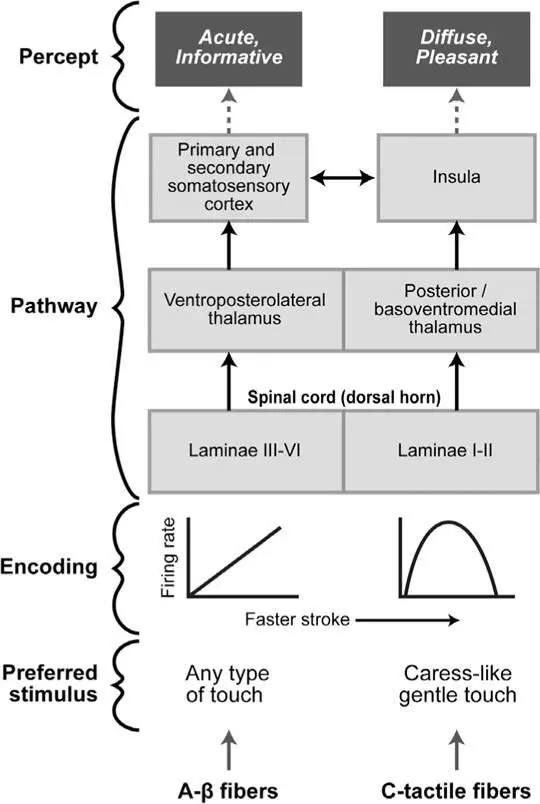
Figure 3.4A schematic diagram showing the flow of information in two separate pathways from the hairy skin to the brain that mediate fast informative touch and slow diffuse caress detection. The A-beta system responds to any type of touch in a linear fashion: Faster and more forceful strokes result in stronger electrical signals (more spike firing) in the fast myelinated axons. These fibers ascend in the deeper layers of the spinal dorsal horn, called laminae III–VI, and, following a synaptic relay in the brain stem, cross the midline and activate a region of the thalamus called the ventroposterolateral nucleus. These thalamic neurons then send their axons to activate the primary and higher somatosensory cortices, where successive computations underlying discriminative fine touch are performed. By contrast, the C-tactile system is tuned for light stroking at intermediate speed, imposing a strong initial filter on tactile information. The slow C-tactile fibers contact neurons in the more superficial lamina I and II of the spinal dorsal horn, and these cross the midline and send their axons along a pathway called the spinothalamic tract to activate neurons in different regions of the thalamus: the posterior and basoventromedial nuclei, which in turn send their axons to the posterior insula, where the pleasant diffuse percept is felt. This figure is adapted from I. Morrison, L. S. Löken, and H. Olausson, “The skin as a social organ,” Experimental Brain Research 204 (2010): 305–14, with permission of Springer.
In chapter 1 we discussed the important role of social touch in developing and reinforcing trust and cooperation in a wide range of bonding situations, ranging from babies to adults and from colleagues to lovers. A caress communicates that you are safe. You can trust the person administering it, just as you trust your mother, who first caressed you; he or she is not a threat. The C-tactile system plays a crucial role in this communication. Caresses activate not only the posterior insula and the somatosensory cortices but also other brain regions that integrate many kinds of sensory and motor information. These include areas of the cortex involved in social cognition, such as the superior temporal sulcus, the medial prefrontal cortex, and the anterior cingulate cortex. 15Of course, studies of such regions were conducted with normal subjects, not with patients like G.L., so these social cognition centers likely received some fast A-beta tactile signals as well. However, they showed significantly less activation in response to a fast caress than to an optimal-speed caress, consistent with an important role for the C-tactile system in driving their responses, and, presumably, social bonding.
Adults with autism spectrum disorder have a range of challenges in social cognition and struggle to discern the social intentions of others. They tend to have an aversion to certain forms of social touch and rate optimal caresses as less pleasant than matched control subjects do. Furthermore, there is a positive correlation between the severity of autism and the reduction in perceived pleasantness: Patients with the most severe autism gave the lowest caress ratings of all. When brain imaging was performed on autistic subjects, a similar correlation emerged: Those with the most severe autism had the smallest activation of certain social cognition centers (the medial prefrontal cortex and the superior temporal sulcus) by an optimal-speed arm caress. 16
This study, while provocative and interesting, leaves much unexplained. Where is the defect in caress processing actually located? Do the C-tactile fibers of severely autistic people encode caresses normally, or does the defect exist in the activity of the skin and sensory nerves? Is the response to caresses in the posterior insula normal in autistic people? And, perhaps most important, what is the causality here? Is there a defect in caress sensation that makes autistic people averse to social touch? And does this make it harder for them to discern the social intentions of others? Recall that the Norrbotten patients, who lack C-tactile fibers, appear to be cognitively normal and do not show signs of autism (although this particular question has not been studied carefully). Alternatively, perhaps caress seeking and caress liking require a certain amount of experience to develop. Autistic people, by living a less social life for reasons unrelated to touch, might fail to have those experiences early in life.
Читать дальшеИнтервал:
Закладка:
Похожие книги на «Touch»
Представляем Вашему вниманию похожие книги на «Touch» списком для выбора. Мы отобрали схожую по названию и смыслу литературу в надежде предоставить читателям больше вариантов отыскать новые, интересные, ещё непрочитанные произведения.












Обсуждение, отзывы о книге «Touch» и просто собственные мнения читателей. Оставьте ваши комментарии, напишите, что Вы думаете о произведении, его смысле или главных героях. Укажите что конкретно понравилось, а что нет, и почему Вы так считаете.