David Linden - Touch
Здесь есть возможность читать онлайн «David Linden - Touch» весь текст электронной книги совершенно бесплатно (целиком полную версию без сокращений). В некоторых случаях можно слушать аудио, скачать через торрент в формате fb2 и присутствует краткое содержание. Год выпуска: 2014, ISBN: 2014, Издательство: Penguin Books Ltd, Жанр: Психология, Биология, sci_popular, на английском языке. Описание произведения, (предисловие) а так же отзывы посетителей доступны на портале библиотеки ЛибКат.
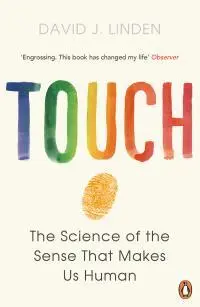
- Название:Touch
- Автор:
- Издательство:Penguin Books Ltd
- Жанр:
- Год:2014
- ISBN:9780241184059
- Рейтинг книги:4 / 5. Голосов: 1
-
Избранное:Добавить в избранное
- Отзывы:
-
Ваша оценка:
Touch: краткое содержание, описание и аннотация
Предлагаем к чтению аннотацию, описание, краткое содержание или предисловие (зависит от того, что написал сам автор книги «Touch»). Если вы не нашли необходимую информацию о книге — напишите в комментариях, мы постараемся отыскать её.
Dual-function receptors in our skin make mint feel cool and chili peppers hot. Without the brain’s dedicated centers for emotional touch, an orgasm would feel more like a sneeze—convulsive, but not especially nice. From skin to nerves to brain, the organization of our body’s touch circuits is a complex and often counterintuitive system that affects everything from our social interactions to our general health and development.
In Touch, neuroscientist and bestselling author David J. Linden explores this critical interface between our bodies and the outside world, between ourselves and others. Along the way, he answers such questions as: Why do women have more refined detection with their fingertips than men? Is there a biological basis for the use of acupuncture to relieve pain? How do drugs like Ecstasy heighten and motivate sensual touch? Why can’t we tickle ourselves? Linking biology and behavioral science, Touch offers an entertaining and enlightening answer to how we feel in every sense of the word.
Touch — читать онлайн бесплатно полную книгу (весь текст) целиком
Ниже представлен текст книги, разбитый по страницам. Система сохранения места последней прочитанной страницы, позволяет с удобством читать онлайн бесплатно книгу «Touch», без необходимости каждый раз заново искать на чём Вы остановились. Поставьте закладку, и сможете в любой момент перейти на страницу, на которой закончили чтение.
Интервал:
Закладка:

Ah, the gentle touch of a woman—so subtle, so nuanced, so much better than the ham-fisted groping of a man. Is this the case because her fingertips are more sensitive to the finest details of tactile form? Findings from two different labs initially suggested that this was true. In experiments in which adult subjects were asked to resolve a grooved surface carefully pressed against a stationary fingertip, women significantly outperformed men: On average, they could distinguish grooves that were about 0.2 millimeter closer together. 50Was this because female fingertip skin is softer and more easily indented? No—women’s fingertip skin was determined to be deformed by the grooved surfaces to the same degree as men’s. Was it because of some sex-based difference in somatosensory brain circuitry or ability to focus on the task? Perhaps, but there’s no evidence to support or disprove that theory.
Daniel Goldreich and his colleagues at McMaster University in Ontario, Canada, had a simpler hypothesis: Maybe, on average, women are better at tactile discrimination because they have smaller fingers. If the same number of Merkel disks, the sensors that subserve the finest discriminative touch, were distributed evenly over large and small fingertips, then the small fingers would have a higher sensor density and therefore greater acuity—it would be like having a 10-megapixel camera in your cell phone instead of a 5-megapixel one. To test this notion they recruited one hundred undergraduates, fifty men and fifty women, and had them perform the grooved-surface discrimination task as a measure of tactile acuity; they also carefully measured the area of the pad of each subject’s index finger, which was the one used in the task. Confirming previous results, on average the women bested the men by about 0.2 millimeter. When they made a scatterplot comparing tactile acuity to fingertip area, however, fingertip area proved to be an excellent predictor of fine touch discrimination, a finding that held true for both men and women. Or, stated another way, a man and a woman with fingertips of equal size will, on average, have the same tactile acuity (figure 2.11).
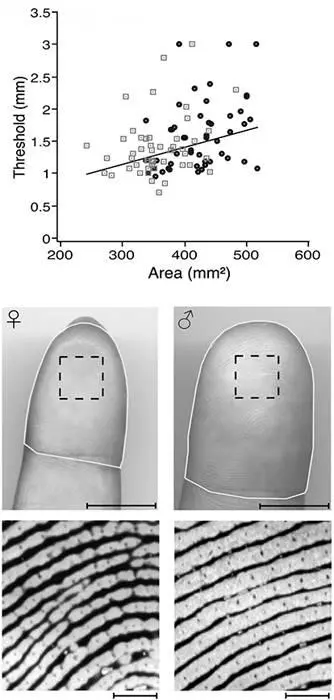
Figure 2.11Tactile acuity is predicted by the fingertip area in both men and women. Top: a scatterplot relating fingertip area to tactile acuity showing that smaller fingertips are more discriminative. Each plot symbol is a subject. The square symbols are women and the round ones are men. Bottom: High-resolution scans of small female (left) and large male (right) fingertips show that the density of sweat pores, and therefore, presumably, Merkel disk clusters, is higher in smaller fingers. Scale bars = 1 centimeter (top) and 1 millimeter (bottom). This figure is from R. M. Peters, E. Hackeman, and D. Goldreich, “Diminutive digits discern delicate details: fingertip size and the sex difference in tactile spatial acuity,” Journal of Neuroscience 29 (2009): 15756–61, with permission of the Society for Neuroscience.
There’s no way to directly measure Merkel disk density in fingertips without a painful skin biopsy. But because Merkel disks have been found to cluster around the bases of sweat pores in glabrous skin, sweat-pore density, which can be gauged by wiping the fingertip with water-soluble finger paint and then pressing it against a standard optical scanner, was used as a proxy measure of Merkel disk density. Indeed, sweat-pore density was shown to be significantly greater in smaller fingers. Goldreich and coworkers concluded that finger size predicts tactile acuity independent of sex and that this difference is subserved by increased Merkel disk density in small fingers. 51Their appealingly compact and parsimonious explanation leads to all kinds of other questions: What about the complement of mechanosensory receptors on other body parts that vary in size? Are there also a fixed number of mechanosensors per leg or breast or penis? 52
By now you have come to understand the basic idea that there are different sensors in the skin, each tuned to extract a different aspect of information about the tactile world. These streams of information are sent to the brain, where, through a series of serial and parallel pathways, the simple information from individual touch sensors is pooled and combined to extract more complex features of touch, like three-dimensional shape and fine texture and remote sensation at the ends of tools. But don’t conclude that the sensors we’ve considered so far, the fast mechanical touch sensors of glabrous skin, are the whole story. As we’ll see, they are only one portion of the full spectrum of touch experience.

CHAPTER THREE
The Anatomy of a Caress
Baltimore, 1996
It was hot and stuffy in the jury room. Dust motes hung in the air, and the plumbing pipes ticked. There was a fusty olfactory tableau of cologne, armpit, and lingering cigarette smoke on the clothes of the jurors. The proceedings had been mysteriously halted, and we’d been waiting for hours for the trial to resume. I’d finished my magazine and was left to ponder the testimony thus far. The tale that emerged had raised one of the deep enduring mysteries of tactile neurobiology: What is it, exactly, that makes for a lousy handjob?
One of the true joys of living in Baltimore is serving on jury duty for the Circuit Court for Baltimore City, an all-too-frequent experience. Each year the dreaded government-green envelope appears, and each year I ready myself for what’s usually a single boring day in the courthouse. Although I rarely get picked for a jury, on one of the occasions I did, the defendant, a short, muscle-bound nineteen-year-old night watchman, decided that he would represent himself in court and thereby save the expense and trouble of an attorney. He didn’t know that he could challenge prospective jurors, and so I became juror number four.
The prosecutor laid out the case: The defendant’s pretty and skittish sixteen-year-old girlfriend had turned up at an emergency room, starved, bruised, and dehydrated. She was reluctant to tell her story, but it gradually emerged. One afternoon she and her boyfriend, the defendant, had been lying in bed at his place, fooling around. He asked for manual stimulation, and she dutifully complied. When he complained that she wasn’t doing it right, she tried to vary her technique and add some dirty talk. These flourishes were insufficient, though, and, as he explained, “She would either stroke it too slow or too fast.” He rapidly became enraged and then utterly lost control, punching her in the face and chest repeatedly. He then handcuffed her to the bed frame and kept her captive for two days, raping her intermittently. Her testimony was consistent with the medical examination, but she was concerned about the outcome of the case, as she said she still loved him.
When it came time for the defendant to mount his defense, he wheeled a television and VCR into the courtroom and popped a cassette inside. The video showed a house party several weeks after the incident. Teenagers were drinking beer and smoking weed while rap music was pounding in the background. The camera soon found his girlfriend, who, obviously intoxicated, was slurring her words and staggering. Her eyes were bright, wet, and unfocused.
The defendant now asked, “So, that night, I didn’t hit you, right?”
Читать дальшеИнтервал:
Закладка:
Похожие книги на «Touch»
Представляем Вашему вниманию похожие книги на «Touch» списком для выбора. Мы отобрали схожую по названию и смыслу литературу в надежде предоставить читателям больше вариантов отыскать новые, интересные, ещё непрочитанные произведения.











Обсуждение, отзывы о книге «Touch» и просто собственные мнения читателей. Оставьте ваши комментарии, напишите, что Вы думаете о произведении, его смысле или главных героях. Укажите что конкретно понравилось, а что нет, и почему Вы так считаете.