David Linden - Touch
Здесь есть возможность читать онлайн «David Linden - Touch» весь текст электронной книги совершенно бесплатно (целиком полную версию без сокращений). В некоторых случаях можно слушать аудио, скачать через торрент в формате fb2 и присутствует краткое содержание. Год выпуска: 2014, ISBN: 2014, Издательство: Penguin Books Ltd, Жанр: Психология, Биология, sci_popular, на английском языке. Описание произведения, (предисловие) а так же отзывы посетителей доступны на портале библиотеки ЛибКат.

- Название:Touch
- Автор:
- Издательство:Penguin Books Ltd
- Жанр:
- Год:2014
- ISBN:9780241184059
- Рейтинг книги:4 / 5. Голосов: 1
-
Избранное:Добавить в избранное
- Отзывы:
-
Ваша оценка:
Touch: краткое содержание, описание и аннотация
Предлагаем к чтению аннотацию, описание, краткое содержание или предисловие (зависит от того, что написал сам автор книги «Touch»). Если вы не нашли необходимую информацию о книге — напишите в комментариях, мы постараемся отыскать её.
Dual-function receptors in our skin make mint feel cool and chili peppers hot. Without the brain’s dedicated centers for emotional touch, an orgasm would feel more like a sneeze—convulsive, but not especially nice. From skin to nerves to brain, the organization of our body’s touch circuits is a complex and often counterintuitive system that affects everything from our social interactions to our general health and development.
In Touch, neuroscientist and bestselling author David J. Linden explores this critical interface between our bodies and the outside world, between ourselves and others. Along the way, he answers such questions as: Why do women have more refined detection with their fingertips than men? Is there a biological basis for the use of acupuncture to relieve pain? How do drugs like Ecstasy heighten and motivate sensual touch? Why can’t we tickle ourselves? Linking biology and behavioral science, Touch offers an entertaining and enlightening answer to how we feel in every sense of the word.
Touch — читать онлайн бесплатно полную книгу (весь текст) целиком
Ниже представлен текст книги, разбитый по страницам. Система сохранения места последней прочитанной страницы, позволяет с удобством читать онлайн бесплатно книгу «Touch», без необходимости каждый раз заново искать на чём Вы остановились. Поставьте закладку, и сможете в любой момент перейти на страницу, на которой закончили чтение.
Интервал:
Закладка:

We think of neurons as being microscopic in scale, like other cells, and in one sense this is true: The cell bodies of sensory neurons in the dorsal root ganglia range from 0.01 to 0.05 millimeter in diameter. (The very largest of these cell bodies is approximately the same diameter as a human guard hair.) However, it’s remarkable how long certain sensory neurons must be to convey touch signals. Let’s consider the axon of a mechanosensory neuron that innervates the heel. It runs from the heel up the leg into the pelvis and through the dorsal root ganglion to enter the spinal cord at the first sacral spinal nerve. It will then continue to ascend all the way up the spinal cord, finally terminating and forming synapses in a region of the brain stem called the gracile nucleus. In a typical person that neuron is about 5 feet long. (And, yes, in a giraffe it’s longer still.) These neurons are the longest cells of any type in the body.
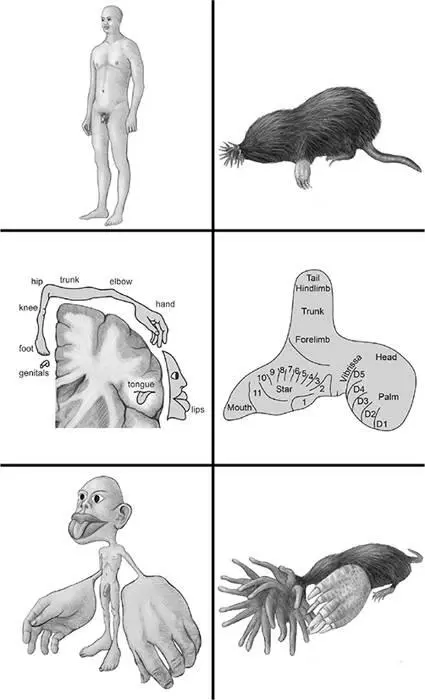
The gracile nucleus is not the endpoint for fine touch signals, however, but merely the first stop along the way. The axons of gracile nucleus neurons ascend farther, cross over to the opposite side of the brain, and convey their electrical signals onto another processing station in a region called the thalamus, which in turn sends its axons to the cortex, the huge rindlike covering that forms the surface of the brain. 36The region where these axons from the thalamus terminate is called the primary somatosensory cortex (“primary” because it’s the first of several regions in the cortex that receive touch information). This region is located in a strip just behind the central sulcus, the main fissure that divides the brain into front and back portions (figure 2.8, left center panel). Because the axons carrying touch information cross the midline of the body before they reach the cortex, the right side of the cortex responds to touch information from the left side of the body and vice versa. 37
In the late 1930s, Wilder Penfield, Herbert Jasper, and their colleagues at the Montréal Neurological Institute began using electrodes to locally stimulate the brains of epileptics during surgery. They did this in order to identify the precise region of the brain that triggered their patients’ seizures, the so-called epileptic focus, so that it could be removed while causing the least damage to healthy neighboring tissue. There is no one spot in the brain that is consistently the origin of epilepsy, so mapping the epileptic focus had to be done individually for each patient. In this remarkable procedure, a patient’s head was shaved and stabilized and the scalp was incised and retracted. Then Penfield used a miniature saw to cut away a circular flap of bone, about the diameter of a tennis ball, which was removed and put aside for later reattachment. Because brain tissue has no pain or mechanosensors, this procedure could be performed under local anesthesia to numb the scalp, underlying bone, and brain-wrapping membranes, while leaving the patient entirely conscious. Penfield wielded a handheld stimulating electrode: a device about the size and shape of an electric toothbrush with a metal needle on the business end and a wire attached to the opposite side that was connected to a device that could deliver weak electric shocks to artificially activate the neurons at the electrode tip.
Penfield would methodically move the electrode across the exposed surface of the brain, asking the patient, “What do you feel now?” at every location. The patient might respond, “I feel a tingling in my left wrist,” or, “I smell burnt toast,” or, “I’m hearing a bit of music that I last heard during childhood.” When stimulating just in front of the central sulcus, simple movements were evoked: a foot jerked, a fist was clenched, or the tongue was extended. Stimulation of the primary somatosensory cortex gave rise to buzzing or tingling sensations at various places on the opposite side of the body. The patients reported that these brain-evoked sensations didn’t feel like natural touches and would never be mistaken for normal sensory experience. Rather, they were like crude simulacra of touch experience, lacking some essential richness or context. Penfield had an assistant record every movement or report from the patient in a notebook with numbered lines. Then, after stimulating, he would insert a pin with a tiny numbered flag attached to match the stimulation site with the logged response. After a while, the surface of the brain looked like a weird miniature version of putt-putt golf, with the ridges and grooves of the brain as hazards instead of windmills and ramps. 38When the flags were photographed and the responses over the extent of the primary somatosensory cortex were analyzed, a wonderful pattern was revealed: A map of the body surface exists in the primary somatosensory cortex. When the touch signals from the skin come to the brain stem and are then passed onward to the thalamus and the cortex, they aren’t completely jumbled up. Rather, axons that innervate adjacent patches of skin remain near each other and, with some notable exceptions, those neighbor relationships are preserved all the way up to the cortex to form the touch map. 39
However, the representation of the body on the cortical touch map is a bit weird (figure 2.8, left center panel), as its constituent parts have been chopped up and reassembled, so that the forehead adjoins the thumb, for example, and the genitals, both male and female, are adjacent to the toes. (We’ll revisit the genital map in greater detail in chapter 4.) Also, certain parts of the body are hugely magnified in the map: the hands, lips, and tongue are enormous. The feet are only somewhat enlarged, while the legs, back, torso, and genitals are comparatively tiny. Of course, the configuration is clear: The regions that are magnified in the cortical map are those that have a high density of mechanoreceptors in the skin, particularly the Merkels, which subserve fine discriminative touch.
Is the magnification of certain skin areas in the touch map unique to primates, with their supersensitive fingers and lips? To address this question we can examine animals that perform fine discriminative touch with other structures. One of the most striking examples is a semiaquatic North American mammal called the star-nosed mole (figure 2.8, top right panel). This small, nearly blind creature, which is about twice the size of a mouse, digs tunnels with it strong forepaws near streams and ponds, where it can both burrow and swim. Star-nosed moles tend to evoke extreme reactions: Some people (like me) find them cute, but to others their appearance is deeply disturbing. 40Eleven pairs of fleshy appendages, called rays, surround the nose of this animal. Each ray is endowed with specialized clusters of Merkel disks, together with Pacinian corpuscles and free nerve endings, to form exquisitely sensitive tactile organs, perhaps the most sensitive in the mammalian world. Star-nosed moles deploy their rays in constant motion, exploring between ten and fifteen locations every second. When they contact prey in the form of a worm, snail, or small fish, they devour it immediately; the length of time from touch to ingestion is about 120 milliseconds. Not surprisingly the touch map in the primary somatosensory cortex of the star-nosed mole shows huge magnification of the star at the expense of the trunk, tail, and hind paws (figure 2.8, center and lower right panels). This design principle holds true across many species: Skin regions with high densities of mechanosensory receptors are magnified in the brain’s primary touch map. 41
Интервал:
Закладка:
Похожие книги на «Touch»
Представляем Вашему вниманию похожие книги на «Touch» списком для выбора. Мы отобрали схожую по названию и смыслу литературу в надежде предоставить читателям больше вариантов отыскать новые, интересные, ещё непрочитанные произведения.











Обсуждение, отзывы о книге «Touch» и просто собственные мнения читателей. Оставьте ваши комментарии, напишите, что Вы думаете о произведении, его смысле или главных героях. Укажите что конкретно понравилось, а что нет, и почему Вы так считаете.