David Linden - Touch
Здесь есть возможность читать онлайн «David Linden - Touch» весь текст электронной книги совершенно бесплатно (целиком полную версию без сокращений). В некоторых случаях можно слушать аудио, скачать через торрент в формате fb2 и присутствует краткое содержание. Год выпуска: 2014, ISBN: 2014, Издательство: Penguin Books Ltd, Жанр: Психология, Биология, sci_popular, на английском языке. Описание произведения, (предисловие) а так же отзывы посетителей доступны на портале библиотеки ЛибКат.
- Название:Touch
- Автор:
- Издательство:Penguin Books Ltd
- Жанр:
- Год:2014
- ISBN:9780241184059
- Рейтинг книги:4 / 5. Голосов: 1
-
Избранное:Добавить в избранное
- Отзывы:
-
Ваша оценка:
Touch: краткое содержание, описание и аннотация
Предлагаем к чтению аннотацию, описание, краткое содержание или предисловие (зависит от того, что написал сам автор книги «Touch»). Если вы не нашли необходимую информацию о книге — напишите в комментариях, мы постараемся отыскать её.
Dual-function receptors in our skin make mint feel cool and chili peppers hot. Without the brain’s dedicated centers for emotional touch, an orgasm would feel more like a sneeze—convulsive, but not especially nice. From skin to nerves to brain, the organization of our body’s touch circuits is a complex and often counterintuitive system that affects everything from our social interactions to our general health and development.
In Touch, neuroscientist and bestselling author David J. Linden explores this critical interface between our bodies and the outside world, between ourselves and others. Along the way, he answers such questions as: Why do women have more refined detection with their fingertips than men? Is there a biological basis for the use of acupuncture to relieve pain? How do drugs like Ecstasy heighten and motivate sensual touch? Why can’t we tickle ourselves? Linking biology and behavioral science, Touch offers an entertaining and enlightening answer to how we feel in every sense of the word.
Touch — читать онлайн бесплатно полную книгу (весь текст) целиком
Ниже представлен текст книги, разбитый по страницам. Система сохранения места последней прочитанной страницы, позволяет с удобством читать онлайн бесплатно книгу «Touch», без необходимости каждый раз заново искать на чём Вы остановились. Поставьте закладку, и сможете в любой момент перейти на страницу, на которой закончили чтение.
Интервал:
Закладка:
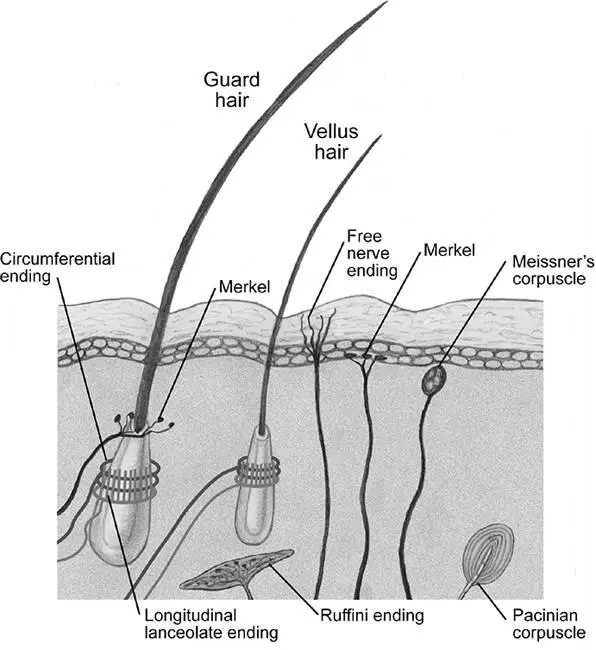
Figure 2.4Innervation of hairy skin. Guard hairs have clusters of Merkel endings surrounding the outermost portion of the hair follicle. Both guard and vellus hairs are innervated by longitudinal lanceolate and circumferential endings. Here, longitudinal lanceolate endings are shown as a single population. In fact, there are at least three different types of longitudinal lanceolate ending, each of which conveys a slightly different signal in response to hair deflection. When comparing the anatomy of the touch sensors in glabrous and hairy skin, it becomes clear that, while these two types of skin are contiguous and developmentally related, they are essentially two different organs, each of which has evolved to detect different types of tactile stimuli.
Louis Braille, the youngest of four children, was born in 1809 at Coupvray, a small town located about twenty-five miles east of Paris. His father, Simon-René, was a successful leatherworker and, even as a toddler, Louis liked to play in his workshop. When he was three years old, Louis went to the workshop to play with an awl. He rested his head on the workbench to get a close-up view, and as he tried to punch through a scrap of leather, horrifyingly, the sharp tip of the awl skittered over the tough surface of the leather and stabbed him in the eye. The injured eye became infected, and the infection eventually spread to his other eye, leaving him completely blind by age five. (This occurred long before the development of antibiotics.) Louis soon learned to navigate his town by using a cane fashioned by his father, who was determined to have the boy engage fully with the world around him. Louis impressed the teachers in his local school with his intelligence and drive, and so, at the age of ten, he was offered a place at a special boarding school, the newly founded National Institute for Blind Youth in Paris.
This school, one of the first in the world for blind children, was founded by philanthropist and director Valentin Haüy. Its pupils were taught to read using a system devised by Haüy in which Roman letters formed of copper wire were pressed into thick paper to create raised imprints that could then be “read” with the fingers. The Haüy system was useful but quite limited. Distinguishing individual letters required a lot of fingertip scanning, so reading speed was very slow. Because the letter imprints themselves were necessarily large, a single page could contain only a few sentences, and production of books using the Haüy system was time-consuming and expensive. (There were only three such books for the entire school when Louis first arrived.) And of course, the blind children had no way to write with this method, which required a specialized workshop.
Using the few Haüy books available and listening to lectures, Louis learned quickly but dreamed of an alternative system for reading and writing for the blind, one that would be faster and easier to use. In 1821, when he was twelve years old, he heard of a tactile writing system invented by a French Army officer, Captain Jacques Barbier, who developed his “night writing” for stealthy battlefield conditions where it would be dangerous to speak or shine a light lest one draw enemy fire. Barbier’s system, a series of raised dots and dashes, was superior to Haüy’s letters because it could be read by a trained soldier with a single pass of the fingers. But it was still too slow and cumbersome for reading long passages of text. Inspired by Barbier’s night writing, Louis worked to create a more compact and efficient tactile alphabet. After much tinkering with an awl, the same instrument that blinded him years before, Louis settled upon a compact two- by three-row grid of raised dots to create a code in which each letter of the Roman alphabet had a corresponding unique dot pattern. He also devised a grooved slate and stylus so that the blind could easily write on paper. Impressively, by the age of fifteen, he had produced a near-final version of the writing system for the blind that now bears his name.
Hired as a teacher at the Paris school, Louis went on to publish books about his writing system and another raised-dot code he devised for musical notation. Unfortunately, Braille writing was not adopted during his lifetime, either at the school where he taught or anywhere else. Director Haüy, who was sighted, was most interested in promoting his own tactile writing method, which was also easy for sighted people to read visually.
As a result of overwhelming protest by Louis’s students, Braille writing was finally adopted at the Paris school two years after his death from tuberculosis at age forty-three. It soon spread throughout the French-speaking world but took much longer to take root elsewhere, notably in the United States, which did not officially adopt it until 1916. Today Braille is a global standard. There are different Braille systems in use across the world, including languages that use non-Roman alphabets (like Greek and Russian) and those that use a pictogram in place of an alphabet (like Chinese), as well as mechanical Braille presses and even Braille computer interfaces.
The average reading speed for expert Braille readers is about 120 words per minute, and the very fastest Braille readers can blaze along at 200 words per minute. 30This requires extraordinarily fast processing of tactile information: Each Braille character must be recognized within about one-twentieth of a second (fifty milliseconds). When Louis Braille devised his writing system, he had no knowledge of the properties of Pacinian corpuscles or Merkel endings or sensory nerves. He simply used his own tactile experience to carefully set the spacing of the dots—sufficiently far apart so that a dot could not be mistaken for its neighbor, and sufficiently compact so that the complete two- by three-row grid could fit under a single fingertip.
Of the four mechanosensors in the fingertip, which are tuned to encode Braille characters? To address this question, Kenneth Johnson and his colleagues at the Johns Hopkins University School of Medicine took recordings of single nerve fibers while Braille characters were scanned across a subject’s fingertip. They then plotted the electrical activity in a grid to form a visual image of the information transmitted by the four different types of nerve fiber (figure 2.5A). This wonderful experiment demonstrated that only the Merkel fibers faithfully represented the pattern of Braille dots. Meissner’s fibers produced a blurry image, while the deep sensors (the Pacinians and Ruffinis) failed to encode the Braille dots at all. When this experiment was repeated using scaled-down Haüy-type raised Roman letters, the Merkel fibers were also able to encode them, but the resultant neural image reveals the ambiguity inherent in the Haüy system. Examining figure 2.5B, you can see that the neural responses to certain letters are easily confused: C, G, O, and Q are nearly identical; R looks like H; and P is similar to F. Indeed, when subjects were asked to name raised Roman letters scanned across the fingertip, those groups of letters were the ones that were most often misidentified. 31
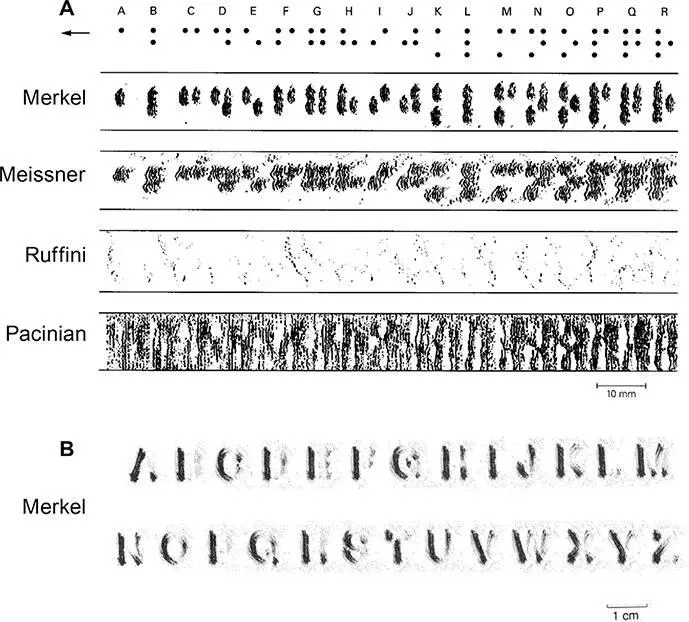
Figure 2.5The response of single axons innervating the human fingertip to Braille and Haüy-type raised Roman letters. (A) In this example, the Braille characters were scanned across the fingertip at a rate of 60 millimeters per second and electrical activity was recorded in single nerve fibers of various types. The image is created by writing a dot when a spike is fired in the fiber to make a single horizontal line. Then the Braille pattern is moved vertically by 0.2 millimeter and scanned again, and this process is repeated to create the raster image. Only the Merkel responses faithfully represent the Braille characters. The Meissner responses are blurred, and the deep sensors, the Pacinians and Ruffinis, carry no information about the Braille dots. Adapted from J. R. Phillips, R. S. Johansson, and K. O. Johnson, “Representation of braille characters in human nerve fibers,” Experimental Brain Research 81 (1990): 589–92, with permission from Springer. (B) Merkel responses to raised Roman letters are sufficient to allow for some decoding but are prone to errors of interpretation. From F. Vega-Bermudez, K. O. Johnson, and S. S. Hsiao, “Human tactile pattern recognition: active versus passive touch, velocity effects, and patterns of confusion,” Journal of Neurophysiology 65 (1991): 531–46, with permission of the American Physiological Society.
Читать дальшеИнтервал:
Закладка:
Похожие книги на «Touch»
Представляем Вашему вниманию похожие книги на «Touch» списком для выбора. Мы отобрали схожую по названию и смыслу литературу в надежде предоставить читателям больше вариантов отыскать новые, интересные, ещё непрочитанные произведения.







Обсуждение, отзывы о книге «Touch» и просто собственные мнения читателей. Оставьте ваши комментарии, напишите, что Вы думаете о произведении, его смысле или главных героях. Укажите что конкретно понравилось, а что нет, и почему Вы так считаете.