David Linden - Touch
Здесь есть возможность читать онлайн «David Linden - Touch» весь текст электронной книги совершенно бесплатно (целиком полную версию без сокращений). В некоторых случаях можно слушать аудио, скачать через торрент в формате fb2 и присутствует краткое содержание. Год выпуска: 2014, ISBN: 2014, Издательство: Penguin Books Ltd, Жанр: Психология, Биология, sci_popular, на английском языке. Описание произведения, (предисловие) а так же отзывы посетителей доступны на портале библиотеки ЛибКат.
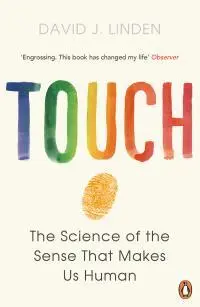
- Название:Touch
- Автор:
- Издательство:Penguin Books Ltd
- Жанр:
- Год:2014
- ISBN:9780241184059
- Рейтинг книги:4 / 5. Голосов: 1
-
Избранное:Добавить в избранное
- Отзывы:
-
Ваша оценка:
Touch: краткое содержание, описание и аннотация
Предлагаем к чтению аннотацию, описание, краткое содержание или предисловие (зависит от того, что написал сам автор книги «Touch»). Если вы не нашли необходимую информацию о книге — напишите в комментариях, мы постараемся отыскать её.
Dual-function receptors in our skin make mint feel cool and chili peppers hot. Without the brain’s dedicated centers for emotional touch, an orgasm would feel more like a sneeze—convulsive, but not especially nice. From skin to nerves to brain, the organization of our body’s touch circuits is a complex and often counterintuitive system that affects everything from our social interactions to our general health and development.
In Touch, neuroscientist and bestselling author David J. Linden explores this critical interface between our bodies and the outside world, between ourselves and others. Along the way, he answers such questions as: Why do women have more refined detection with their fingertips than men? Is there a biological basis for the use of acupuncture to relieve pain? How do drugs like Ecstasy heighten and motivate sensual touch? Why can’t we tickle ourselves? Linking biology and behavioral science, Touch offers an entertaining and enlightening answer to how we feel in every sense of the word.
Touch — читать онлайн бесплатно полную книгу (весь текст) целиком
Ниже представлен текст книги, разбитый по страницам. Система сохранения места последней прочитанной страницы, позволяет с удобством читать онлайн бесплатно книгу «Touch», без необходимости каждый раз заново искать на чём Вы остановились. Поставьте закладку, и сможете в любой момент перейти на страницу, на которой закончили чтение.
Интервал:
Закладка:
When I was a child, I loved to watch the seismograph at the Griffith Park Observatory in my hometown of Los Angeles. With its ink pens tracing wiggling lines on chart paper, this exquisitely sensitive instrument could detect vibrations from an earthquake in Japan, propagated across the entire Pacific Ocean, or from a bomb test in the Nevada desert, hundreds of miles away. But it could also be activated by thirty rowdy schoolchildren jumping up and down together in the same room that housed the instrument. (Believe me, we did the experiment.) Without contextual information provided by other seismographs in different locations, however, the Griffith Park instrument would not be able to tell one event from another. Roughly speaking, the Pacinian corpuscle is built with the same engineering trade-off as the seismograph: extreme sensitivity to vibration at the expense of localization. 23
Another role of Pacinian touch sensors is to provide a high-fidelity neural image of transient and vibratory stimuli transmitted to the hand by an object held in the hand. This object can be a quarter, as in our example, but, more important, it can be a tool or a probe. When we use a tool, like a shovel, we can perceive tactile events at the working end of the tool almost as if our fingers were present there. Imagine digging into a pile of gravel with a shovel and then doing the same with a pile of soft, loose topsoil. You can easily distinguish the different properties of gravel or topsoil through the shovel, even though your hands are far away from the contact point. Furthermore, with practice, our ability to interpret this kind of long-range touch information improves. In this way, the violinist’s bow, the surgeon’s scalpel, the mechanic’s wrench, or the sculptor’s chisel effectively become sensory extensions of the body.
This effect is not limited to simple tools. Automotive enthusiasts become rhapsodic over “road feel,” the fidelity of tactile information about the road surface transmitted to the driver’s hands through an entire series of linked mechanical parts (tires, wheels, tie rods, steering column, steering wheel). And they get upset when technological changes interfere with road feel at the expense of other features, as in this review of the 2013 Porsche Boxster by Lawrence Ulrich of the New York Times : 24
Like every other company desperate to increase gas mileage, Porsche is replacing traditional hydraulic steering with electric-assisted units. Describing the difference in feel between hydraulic and electric steering isn’t easy. But traditionally, steering a Porsche was like shutting your eyes and running your hands over a face—every crease, stubble and dip comes through your fingertips, the image of the road becoming clear. The Boxster’s electric steering delivers more muted sensations.
So next time you’re driving your old-school Porsche with hydraulic steering and appreciating the subtle sensations of road feel, consider how your Pacinian touch sensors are shaping your experience. What’s more, even if you’ve mashed the gas pedal too hard and are now tightly gripping the wheel with fear, you’ll still be able to perceive those fine road-feel sensations, because the Pacinian corpuscles report only the high-frequency vibrations transmitted through the steering wheel, not the constant force exerted by your white-knuckled fingers.
Returning to our sidewalk, as you hear your coin drop into the meter, you begin grasping and twisting the meter’s handle. This action will activate all three of the previously mentioned touch sensors. The Merkels give you information about the edges and curvature of the handle as well as the steady force of its resistance to your turn. The Meissners give you low-frequency vibration and microslip signals that you use reflexively to fine-tune your grip strength. And the Pacinians transmit the high-frequency vibrations of the meter’s internal ratchet mechanism. The fourth system that comes into play appears to be involved in sensing horizontal skin stretching and is called the Ruffini ending. The Ruffini ending forms an elongated capsule in the deep dermis in which the ends of nerve fibers intermingle with collagen fibers of the skin (figure 2.3). 25The long-axis of the Ruffini ending typically runs parallel to the skin surface, which may explain why they are highly responsive to horizontal stretching and less sensitive to skin indentation. Ruffini endings are present at much lower density in the skin of the hand than the other three sensors, so they have poor spatial resolution. Recordings from Ruffini nerve fibers show that they fire throughout a prolonged stretch stimulus and are only weakly sensitive to vibration. Stimulation of single Ruffini nerve fibers can sometimes give rise to a sensation of skin stretching.
How the brain makes use of the information from Ruffini nerve fibers is poorly understood. Ruffini signals may help detect motion of an object along the skin surface as that object stretches the skin locally. More interesting is the idea that Ruffinis provide information to the brain about the conformation of the hand and fingers through skin stretch signals: For example, as you extend your fingers, the glabrous skin of your fingers and palm is stretched. 26It has also been suggested that Ruffinis may perform a similar function in other locations where horizontal skin stretch indicates position of a limb. For example, the hairy skin over the elbow is stretched as the elbow joint is flexed, and this may help inform the brain about the status of the arm and its readiness for certain movements.
Looking at the four types of glabrous skin touch sensors in figure 2.3, we see an appealing functional symmetry: Two receptors are shallow, and two are deep; two signal briefly, and two, persistently. All the possibilities are being covered systematically. These four streams of information remain separate as they are conveyed to the spinal cord. A single nerve fiber is dedicated to one type of sensor: It won’t contact both a Ruffini ending and a Pacinian corpuscle, for example. Each of these four types of nerve fiber is a “labeled line” built to convey a single type of information onward to the spinal cord and brain stem. 27
The four touch receptor systems we’ve explored are called mechanoreceptors because they have the common property of converting mechanical energy delivered to the skin into electrical signals. There are also sensors in the skin that react to nonmechanical stimuli. Both hairy and glabrous skin have free nerve endings that terminate in the epidermis (figures 2.3 and 2.4) and are involved in sensing pain, itches, certain chemicals, inflammation, and temperature. File that information away for now, and we’ll return to discuss those other skin senses in later chapters.

In college I had a friend named Chuck, a dedicated, muscle-bound competitive swimmer who would routinely shave his arms, legs, and chest in the belief that his depilated body would glide through the water more efficiently. I was not convinced that his motivations were entirely hydrodynamic in nature. When I teased him about this, his eyes lit up, and he confided in a low, manly voice, “It may or may not make any difference to my swimming speed, but I dearly love the way it feels when I slip between the sheets at night.”
Touch sense in hairy skin has been investigated much less thoroughly than that of glabrous skin. Hairy skin comprises all four of the classical mechanoreceptors found in glabrous skin, although typically at much lower density. As Chuck appreciated, much of the sensation from hairy skin comes from the way the hairs and the surrounding tissue interact. In hairy skin, Merkel cell–nerve fiber complexes can be found in clusters around the base of guard hair follicles, where they can be deformed by bending of the hair, resulting in a persistent signal. However, the main sensory signal from hair deflection is brief and is provided by specialized bare nerve fibers that enclose the base of the hair follicle in a pattern that resembles the vertical bars of a jail cell (figure 2.4). These are called longitudinal lanceolate endings, and they can detect very small hair deflections. Like our pet cats, we know that it does not feel the same to receive a caress in the direction of the angled hairs as it does against the grain. This results from the ability of longitudinal lanceolate endings to respond differently to hair deflection toward the skin versus way from it. 28Hairs are also innervated by lasso-shaped circumferential endings, and these nerve fibers appear to be particularly sensitive to hair pulling, much to the delight of boys everywhere. 29
Читать дальшеИнтервал:
Закладка:
Похожие книги на «Touch»
Представляем Вашему вниманию похожие книги на «Touch» списком для выбора. Мы отобрали схожую по названию и смыслу литературу в надежде предоставить читателям больше вариантов отыскать новые, интересные, ещё непрочитанные произведения.











Обсуждение, отзывы о книге «Touch» и просто собственные мнения читателей. Оставьте ваши комментарии, напишите, что Вы думаете о произведении, его смысле или главных героях. Укажите что конкретно понравилось, а что нет, и почему Вы так считаете.