David Linden - Touch
Здесь есть возможность читать онлайн «David Linden - Touch» весь текст электронной книги совершенно бесплатно (целиком полную версию без сокращений). В некоторых случаях можно слушать аудио, скачать через торрент в формате fb2 и присутствует краткое содержание. Год выпуска: 2014, ISBN: 2014, Издательство: Penguin Books Ltd, Жанр: Психология, Биология, sci_popular, на английском языке. Описание произведения, (предисловие) а так же отзывы посетителей доступны на портале библиотеки ЛибКат.
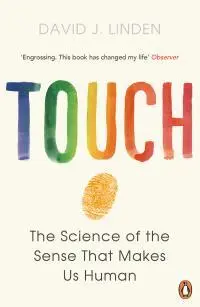
- Название:Touch
- Автор:
- Издательство:Penguin Books Ltd
- Жанр:
- Год:2014
- ISBN:9780241184059
- Рейтинг книги:4 / 5. Голосов: 1
-
Избранное:Добавить в избранное
- Отзывы:
-
Ваша оценка:
Touch: краткое содержание, описание и аннотация
Предлагаем к чтению аннотацию, описание, краткое содержание или предисловие (зависит от того, что написал сам автор книги «Touch»). Если вы не нашли необходимую информацию о книге — напишите в комментариях, мы постараемся отыскать её.
Dual-function receptors in our skin make mint feel cool and chili peppers hot. Without the brain’s dedicated centers for emotional touch, an orgasm would feel more like a sneeze—convulsive, but not especially nice. From skin to nerves to brain, the organization of our body’s touch circuits is a complex and often counterintuitive system that affects everything from our social interactions to our general health and development.
In Touch, neuroscientist and bestselling author David J. Linden explores this critical interface between our bodies and the outside world, between ourselves and others. Along the way, he answers such questions as: Why do women have more refined detection with their fingertips than men? Is there a biological basis for the use of acupuncture to relieve pain? How do drugs like Ecstasy heighten and motivate sensual touch? Why can’t we tickle ourselves? Linking biology and behavioral science, Touch offers an entertaining and enlightening answer to how we feel in every sense of the word.
Touch — читать онлайн бесплатно полную книгу (весь текст) целиком
Ниже представлен текст книги, разбитый по страницам. Система сохранения места последней прочитанной страницы, позволяет с удобством читать онлайн бесплатно книгу «Touch», без необходимости каждый раз заново искать на чём Вы остановились. Поставьте закладку, и сможете в любой момент перейти на страницу, на которой закончили чтение.
Интервал:
Закладка:
When I was thirteen years old, like most people, I had yet to have any significant romantic experience. So I was very attentive when my mother took me to see the sexy (and twisted and political) film Swept Away , directed by Lina Wertmüller. Watching the leading couple, played by Giancarlo Giannini and Mariangela Melato, caress each other’s skin was so intense, compelling, and immediate that it was almost more than I could stand. I wasn’t just watching the actors—I felt their sensations on my own skin and I can clearly recall them today, nearly forty years later.
That we can thrill to the touch of performers on the screen as we might react to a caress on our own skin results from the neural information received by the posterior insula, the main cortical center activated by caresses and a crucial node in the emotional brain. In addition to C-tactile fibers, the posterior insula receives highly processed visual information as well. Amazingly, merely watching a movie of someone’s arm being caressed will activate the posterior insula of a subject in a manner that’s similar to her receiving a real arm caress. Even more surprisingly, just as with a real tactile caress, the posterior insula is most strongly activated by a movie showing optimal caressing speed as opposed to faster or slower stimulation, and the viewer herself rates optimal-speed caress movies as most pleasant. Norrbotten patients, who lack C-tactile fibers, rated the caress footage as significantly less pleasant than control subjects and had no particularly sensitivity to caress speed. 17In this way, both the normal subjects and the Norrbotten patients evaluated the caress film in a way that was anchored in their own tactile experiences of caresses.
We humans are tuned to crucial features of emotional touch not just in our own tactile experience but also when observing others. We are highly sensitive to reading such signals between other people. This is an important feature of social cognition, helping us to track changes in affiliations, coalitions, and status within our social groups. And, of course, it is the source of endless gossip: Did you see how she touched him on the arm?

CHAPTER FOUR
Sexual Touch
It was early on in our relationship. B. and I had slept together only a few times and were very much in the discovery phase about each other’s bodies and sexual likes and dislikes. After a wonderful night of lovemaking, we had drifted off to sleep and stirred only many hours later when the bright, annoyingly persistent sunshine slanted through the gaps in the window curtain. We began nuzzling and mumbling, half asleep, happy, and hazy. The bed smelled reassuringly funky from the previous night’s activities, and the olfactory cloud added to the befuddlement of waking to render the scene unusually dreamlike. As we kissed I slowly moved my hand over her belly and upward to softly cup her breast. She made an encouraging purr, so I began to gently roll her nipple between my thumb and forefinger. This didn’t seem to evoke any reaction at all, which struck me as a bit unusual, as she had previously responded to that kind of touching—sometimes even achieving orgasm from that alone. Her nipple, which also felt odd between my fingers, suddenly detached entirely from her breast, and I was left holding it in my hand.
At that precise moment the world ceased to make sense, so I tried to take stock of the situation:
I was now holding B.’s disembodied nipple in my hand.
The fact that I was doing so didn’t seem to faze her at all. She was giving me a sleepy smile, though it quickly changed into a look of concern in response to my horrified expression.
There was no blood.
My thoughts were in overdrive; I was gaining no cognitive traction at all. How could this possibly be happening?
In a conventional tragic incident, like a devastating car wreck, our lives are changed in an instant, but the event conforms to a brutal, predictable physics. Objects collide and dissipate force. Gravity and friction exist. However much we are shaken, our core assumptions about the physical world are not violated. But lying there in bed, late on a sunny morning, I was at once the illusionist and the audience, and I had completely stumped myself. Given my previous life experience up to that moment, all three of the above observations could simply not be true.
Even today I have no sense of the actual duration of that event, and it’s likely that only a few seconds elapsed before I continued to stroke the detached nipple. Then I began to notice that it wasn’t the familiar warm, soft, wrinkly bud but was larger than usual, spongy and faintly waxy, and, of course, upon continued exploration I realized it was not a nipple at all. The spinning wheels of my mind finally found purchase: The spongy object was in fact a foam earplug that had come loose in the night and landed on her chest. My heart was racing, and I sputtered with relief, though it would be many more seconds—whole cognitive lifetimes—before I could explain to B. what had happened.

The detached nipple story illustrates an important point about sensation, perception, and the difference between the two. The way we perceive a sensory event is not determined simply by the physical parameters of the stimulus involved (for example, 10 grams of force delivered to the pad of the thumb and index finger). Nor is it accounted for by how those stimulus parameters are filtered by the receptors that transduce it (in this case, the response properties of the skin mechanosensors in the pads of that thumb and index finger). Even when we add to this data additional information provided by our exploratory behavior (proprioceptive signals from the muscles in the hand and arm), it’s still not enough to account for our ultimate perception of the stimulus. Rather, our perception of a sensory stimulus is crucially dependent upon our expectations, as they have been formed by our life experience up to that moment. 1We know that nipples don’t just fall off, and if somehow they could detach, we would expect that bleeding (and howls of pain) should result. We are confident from what we’ve learned that gravity should operate, living mammalian bodies should be warm, and so on. When there’s a mismatch between expectation and sensation, it’s a sign that something weird is happening, and our perception of that sensation is fundamentally altered.
Likewise, context is key in sensory experience. For most of us, the feeling of a finger tracing our lips is delightful and arousing in a romantic setting with a lover but decidedly unerotic when it takes place in the doctor’s office. 2And, of course, contextual perception is not limited to the sense of touch or to sexual situations. The taste of coffee can be jarring if you were expecting tea in your mug, even if you typically enjoy coffee. A faintly sulfurous odor lingering in a public toilet is disgusting, but that same odor can be delightful when encountered in a cheese shop (figure 4.1).
There are all kinds of sexual touching—lips and nipples often play key roles. For many, light touching or kissing of the ears, neck, inner arm, or anus can be sexually transporting. It doesn’t matter if you’re male or female or intersex, gay or straight, or bisexual—if you ask enough people in any group, you will find someone who experiences a sexual sensation from being touched on almost any part of the body. (If you’re not convinced of this, just search the Internet for “eyebrow fetish” or “armpit sex.”) The near-limitless variation in sexual behavior is a central feature of our human experience.

Интервал:
Закладка:
Похожие книги на «Touch»
Представляем Вашему вниманию похожие книги на «Touch» списком для выбора. Мы отобрали схожую по названию и смыслу литературу в надежде предоставить читателям больше вариантов отыскать новые, интересные, ещё непрочитанные произведения.












Обсуждение, отзывы о книге «Touch» и просто собственные мнения читателей. Оставьте ваши комментарии, напишите, что Вы думаете о произведении, его смысле или главных героях. Укажите что конкретно понравилось, а что нет, и почему Вы так считаете.