J. Ledgard - Giraffe
Здесь есть возможность читать онлайн «J. Ledgard - Giraffe» весь текст электронной книги совершенно бесплатно (целиком полную версию без сокращений). В некоторых случаях можно слушать аудио, скачать через торрент в формате fb2 и присутствует краткое содержание. Год выпуска: 2007, Издательство: Penguin Group, Жанр: Современная проза, на английском языке. Описание произведения, (предисловие) а так же отзывы посетителей доступны на портале библиотеки ЛибКат.
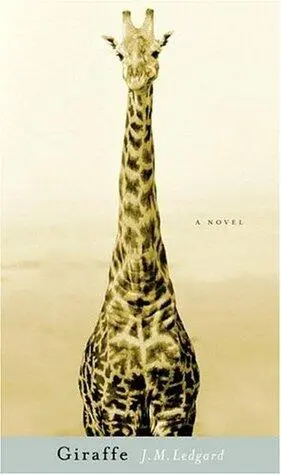
- Название:Giraffe
- Автор:
- Издательство:Penguin Group
- Жанр:
- Год:2007
- ISBN:нет данных
- Рейтинг книги:3 / 5. Голосов: 1
-
Избранное:Добавить в избранное
- Отзывы:
-
Ваша оценка:
Giraffe: краткое содержание, описание и аннотация
Предлагаем к чтению аннотацию, описание, краткое содержание или предисловие (зависит от того, что написал сам автор книги «Giraffe»). Если вы не нашли необходимую информацию о книге — напишите в комментариях, мы постараемся отыскать её.
In 1975, on the eve of May Day, secret police dressed in chemical warfare suits sealed off a zoo in a small Czechoslovakian town and ordered the destruction of the largest captive herd of giraffes in the world. This apparently senseless massacre lies at the heart of J. M. Ledgard's haunting first novel, which recounts the story of the giraffes from their capture in Africa to their deaths far away behind the Iron Curtain. At once vivid and unearthly, Giraffe is an unforgettable story about strangeness, about creatures that are alien and silent, about captivity, and finally about Czechoslovakia, a middling totalitarian state and its population of sleepwalkers.
It is also a story that might never have been told. Ledgard, a foreign correspondent for the
since 1995, unearthed the long-buried truth behind the deaths of these giraffes while researching his book, spending years following leads throughout the Czech Republic. In prose reminiscent of Italo Calvino and W. G. Sebald, he imbues the story with both a gripping sense of specificity and a profound resonance, limning the ways the giraffes enter the lives of the people around them, the secrecy and fear that permeate 1970s Czechoslovakia, and the quiet ways in which ordinary people become complicit in the crimes committed in their midst.
Giraffe — читать онлайн бесплатно полную книгу (весь текст) целиком
Ниже представлен текст книги, разбитый по страницам. Система сохранения места последней прочитанной страницы, позволяет с удобством читать онлайн бесплатно книгу «Giraffe», без необходимости каждый раз заново искать на чём Вы остановились. Поставьте закладку, и сможете в любой момент перейти на страницу, на которой закончили чтение.
Интервал:
Закладка:
I consider Hubert. He dismounted. He unfurled his hands. His fingers I suppose to be snagged from thorns and tethered hawks. Christ spoke through the stag in a voice I cannot conceive, saying:
Hubert! How long will you pursue the animals of the forest?
This is a vain and selfish passion. When will you consider
the safety of your soul, the quickness of your fall. If you
do not cease hunting, you will go to hell.
It is contradictory. Hubert bowed down before a beast. He renounced slaughter, but became the saint of hunters and of butchers, who cut up the animals brought out of the forest.
I FIND A HARE KICKING hard in a trap intended for a pine marten. It is anguished, but uninjured. I pull it free. I hold it up by the back of the head. It pedals the air. It arches itself and slowly closes its eyes, awaiting a mortal blow. I let it go. The hare reminds me of a story told to me of an aristocrat who walked up from the Svět on a summer evening in 1771 and entered the forest under a large setting sun. He went deep into the forest. He set his musket up behind a rock in a clearing. He took out his snuffbox from his embroidered waistcoat. After some hours he saw the largest owl he had ever seen, larger than an eagle, carrying a live hare in its talons. The aristocrat aimed his long barrel at the owl. He fired. The ball passed through the hare but missed the bird. The hare fell dead at his feet, twice hunted, and the owl swooped off, unburdened.
I put a bullet into damp air as I put an ax to a tree. The bullet drills into the chest of a deer. The deer loosens under the blow; it slumps to the floor. It gives itself out into the fir roots, through the hole I have made in it, and is so pressed down in that moment, with no possibility of rising again, that gravity itself seems to me increased, as if there were a magnet hidden in the foliage and another in the body of the deer and they have met and snapped together at the moment of death. I let my hounds off the leash. I run behind them. The deer is always dead when I lay down my rifle beside it. It is already stiff under my gaze, the throat open like a jug.
I imagine death to come on us, on deer also, like the hand of an anesthesiologist, pulling limbs into cruciform, pushing a needle into a vein. There is a chemical closing over, a kind of drowning. The lungs fill with fluid, as in the womb. The eyes close, or glaze over. I run up to the deer. I drag the hounds off it. I regard it. My first thought is of the space between life and death, the fragment when you are neither living nor dead, which in a deer might be a flickering of a divine stag and in a man the longest purgatory.
I WALK THE RIDGE ABOVE the secret military base. I see other foresters in the distance, sawing spruce trees for Christmas. I call out to them, but they do not hear me. My father believed in Hubert and in the communion of saints. He described it as a piece of engineering, a turbine: Saints gather up prayers, convert them into love and majesty, and so power the present with hope. I do not believe in such a communion. I observe St. Hubert’s Day only out of respect for my father. He marked the day with a suspension of deer hunting and by taking his hounds to be blessed in the chapel of St. Michael, which stands between the zoo and the town. I went with him. I stood near the altar, holding the muzzled hounds tightly, while around me the music for the mass was performed on hunting horns.
I reach the edge of the forest. I do not walk out. I take up my binoculars. I look down at the town zoo. I see the giraffes stepping slowly through their enclosure. I see a smaller animal, an okapi. I see a young woman on a bench, looking up at the giraffes as Hubert looked up at the stag.
I know okapi from my childhood. A Congolese priest, whose education my father sponsored, wrote us gentle letters in Latin of glimpsing okapi in the jungle, and of his sadness on accompanying scientists capturing songbirds:
We are all of us brightly colored birds, over which the fowler
death casts a net. We are thrown to the earth, and so
our song, our form and colors are gone.
I turn my binoculars on the okapi. The colors are like decaying leaves, the body and neck purple, the legs barred in bluish oil-brown and white. It stands on concrete. It is not right to see it so revealed. It has no understanding of Czechoslovakian daylight. It belongs to the Upper Congo and is meant to move there through boles, creepers, vines, and large leaves, shedding rivulets of water; the priest wrote to us that it was wet in the jungle, “So that whenever an okapi is sighted, it appears to be weeping.”
I raise my binoculars. I see the town. I see turrets and spires. I see the bog and quicksands about the walls. I avoid the town. It is not a place for me. The birds sit there, silent and listless, on broken gutters. The people I pass wear vacant expressions; they have migrated into themselves as I have migrated into the forest. There is giddiness only in the hospital waiting room, where those waiting have hope that their malaise will be given a name.
I see the parkland around the chapel of St. Michael planted with English oaks, scarlet oaks, horse chestnuts, Montpelier maples, Cappadocian maples, and black mulberries. I trace the chapel’s fine lines of polychrome sandstone and pink marble, its oval windows raised on the backs of sculpted lions with two tails, the yew trees clumped around its crypt, and the slope of steps from its front doors down to the Svět, the most beautiful, wide steps, set on either side with fruit trees of apple, snow pear, sour cherry, plum, and bullace.
I focus on the golden statue of Michael. He is flying down at speed, with an oval shield marked in Hebrew and a gold spear, his feet just touching the chapel roof, as though scattering invisible demons and hydras, who, when pierced by his spear, are made aware of their own weight, are taken by gravity, and fall in great fear toward an inferno.
There is a grille at the base of a yew tree through which it is possible to see the zinc coffins lying in the crypt and a stack of skulls, which are foresters and fishermen of the Svět, bulbous as babies in that dark blue light, stitched across the crown, with many teeth or none, flaking, honeycombed through the nose, some split between the nose and lip, congenitally, or with an ax: forester’s mistake. There is an altar in the center of the crypt set with a silver cross and an ivory tusk, spiraled like the plague column in the town, said to be that of a unicorn, but actually the tusk of the narwhal that swims in icy seas. The thought of those seas disturbs me. There are no trees there, nor any soil. The narwhals are massive, corpse-colored, done through with oil and blubber, nothing like the deer that prance from field to forest, whose antlers and skullcaps I hang on the walls of the forestry hut, who collapse into leaves and twigs, bleed into root systems, are dead but still warm when I arrive at them.
I say that I do not disguise my intentions. Well then, there is a fear in me from catechism. Thinking of these things, of crypts, saints, and Congolese priests, seems to make the forest floor brittle and thin as the ice under which the narwhal plows. I fear the judgment that will cause the ground to open and cast me down, so that I will feel the weight of my own body. I am a Communist because I do not wish to believe. I hold to ČSSR out of fear and am openly relieved at its banality.
I remain in the forest now. I take a long swig of liquor from my hip flask and turn back toward the hut. If I were forced to leave the forest, it would be for the mountains. Alpine heights are the only exposure I favor. I wish the forest had not been ground so low by a glacier long ago. I wish it would rise steeply, far higher than the slope with a single rope tow pulling up skiers, above any treeline. I imagine in idle moments a mountain on which socialism with a human face might be built. It would rise from the Svět tall as Pik Communism in the USSR. There would be no factories or paneláks on it; all the humdrum living would happen elsewhere. At its base would be a maternity hospital where babies might be born with a view of the Svět. A little higher would be nurseries and primary schools, then secondary schools, vocational colleges, up to universities, military academies, agricultural and forestry institutes. On the broad slopes of the mountain would be gymnasiums, stadiums, registry offices where marriages might be recorded, cinemas, theaters, a symphony hall, tearooms, beer halls. Large chalets serving inventors and explorers would be scattered in meadows of wildflowers. Sanatoriums performing lifesaving procedures would be hidden above, in stretches of larch, before a lake of melted snow. So my ČSSR would go, higher and higher, with all life beneath it, so the ground would not become brittle or give way, until reaching the state homes for the elderly in the snowy heights among the chamois and finally the crematorium a little higher, on the glacier, outside of which brass bands would gather and play mournful Czechoslovak tunes as the ashes of the dead were cast onto a breeze, which might blow at that altitude.
Читать дальшеИнтервал:
Закладка:
Похожие книги на «Giraffe»
Представляем Вашему вниманию похожие книги на «Giraffe» списком для выбора. Мы отобрали схожую по названию и смыслу литературу в надежде предоставить читателям больше вариантов отыскать новые, интересные, ещё непрочитанные произведения.



Обсуждение, отзывы о книге «Giraffe» и просто собственные мнения читателей. Оставьте ваши комментарии, напишите, что Вы думаете о произведении, его смысле или главных героях. Укажите что конкретно понравилось, а что нет, и почему Вы так считаете.